By Hannah Beckett
There is a singer everyone has heard,
Loud, a mid-summer and a mid-wood bird,
Who makes the solid tree trunks sound again…
“The Oven Bird”, a 1916 poem by Robert Frost, celebrates the recognizable song of the title bird. This migrating songbird’s loud, ringing calls punctuate the warm summer months throughout the forests of North America.
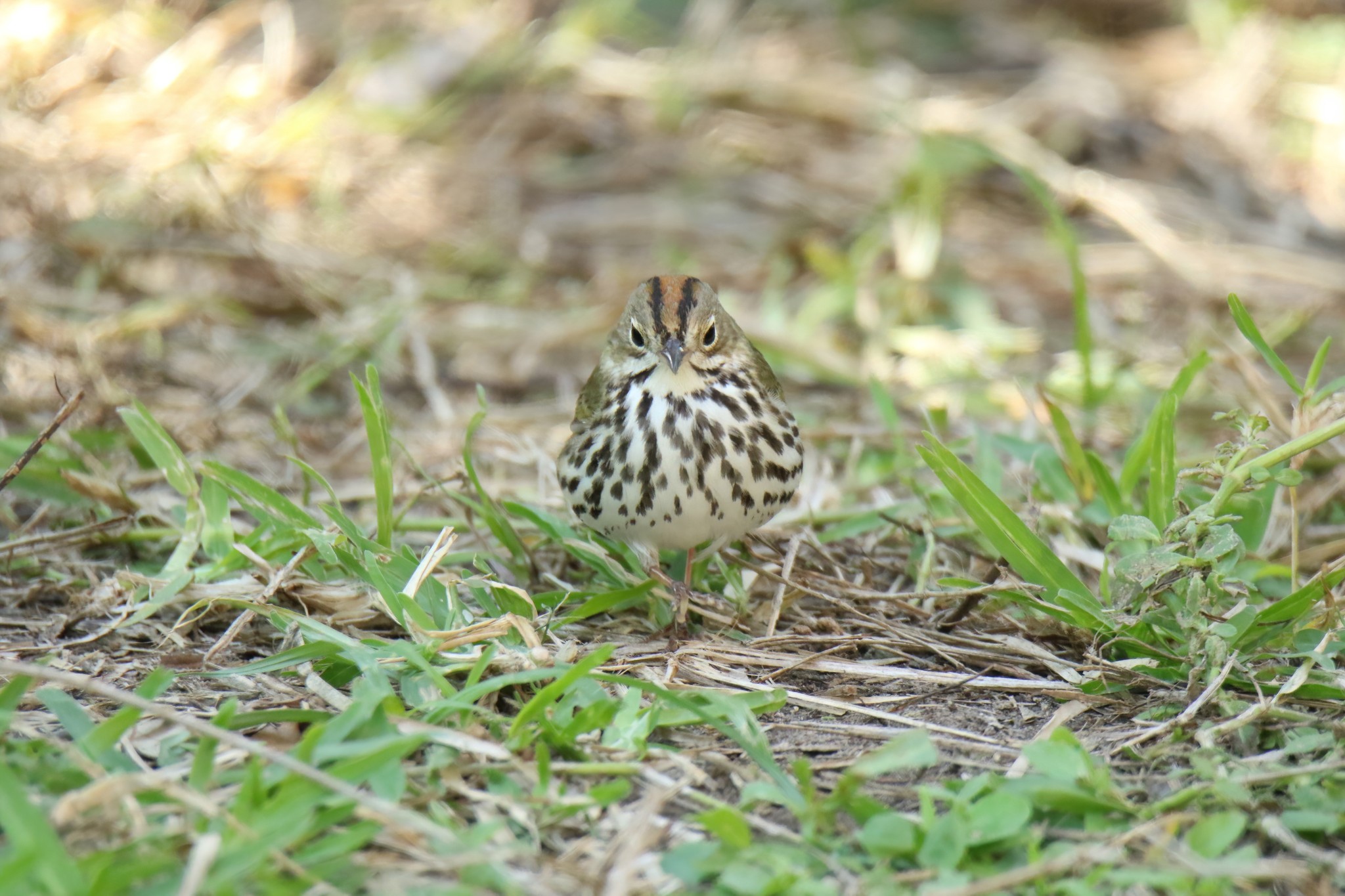
At first glance, one may mistake the Ovenbird (Seiurus aurocapilla) for a thrush, due to its brown coloration and streaked breast. It may also be mistaken for a wren as both hold their tails at jaunty angles. However, the Ovenbird is categorized as a wood warbler. This fact may surprise birders since it spends most of its time on the ground for feeding and nesting, unlike a typical warbler.
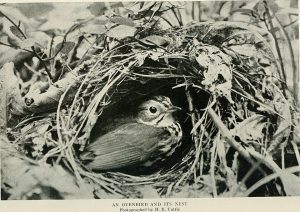
The Ovenbird receives its name from the distinct shape of its nest. The female weaves stems and grasses into a domed nest on the ground which looks like an old-fashioned dome oven. She then drops leaves and twigs on top for camouflage. Three to six eggs are laid in the inner cup of the nest and incubate for about two weeks before hatching.
If her nest is threatened, the female Ovenbird will perform a broken-wing display, similar to a Killdeer, to lead the threat away from the nest. The hatchlings remain in the nest for a little more than a week after hatching. Once they leave the nest, the young birds remain with their parents for another month.
Differing from other small songbirds who hop on the ground, Ovenbirds navigate the forest floor with a herky-jerky wandering stroll with their tail cocked upwards. Many compare its stride to that of a diminutive chicken. It struts across leaf-littered grounds tossing aside leaves to expose beetles, caterpillars, spiders, snails, worms, small lizards, and any other small critters.
Its chanting song of tea-Cher, tea-Cher, tea-Cher, tea-Cher, tea-Cher is easy to recognize, but finding the little bird in the dense undergrowth is often a challenge. Its olive-green back and striped chest help it blend into the leafy forest it calls home. If you happen to spot the Ovenbird, they are distinguished by a handsome orange crown framed by a pair of black stripes and a bold white eye-ring.
Ovenbirds nest throughout North America in the spring and summer, and overwinter in the Caribbean and Central America. They prefer closed-canopy forests with an abundance of leaf litter on the forest floor for foraging and nest-building. As a result, the Ovenbird is very sensitive to habitat fragmentation. The large, continuous forests they once relied on have now been fragmented into smaller and smaller parcels. Fewer trees result in the loss of the humid, thick, leafy floor of the forest and the abundance of arthropods found within the loam.
Additionally, habitat fragmentation also makes these birds vulnerable to nest failure due to brood parasites and predators who take advantage of the shrinking forests. Therefore, Ovenbirds have been the subject of many scientific studies on the effects of logging and habitat fragmentation on migrating songbirds.
Photo: Ovenbird
Credit: Sheryl Travis
Photo: Bird-lore (1919)
Credit: Internet Archive Book Images, Public Domain, via Wikimedia Commons

