
By Evan McGuire
Everyone has heard of mistletoe and its connotations with Christmas, but do you really know what it is? I don’t think I really knew what it was until a year or two ago when learning about birds like the Phainopepla, that rely on mistletoe as a primary food source. Watching the mistletoe is a reliable way to see said birds.
Mistletoe is a hemiparasite, meaning that it is a parasitic plant, but it is not completely reliant on its host. They still have green leaves so they still take energy from the sun as well as their host. Typically, they only take water and a small amount of nutrients from their host.
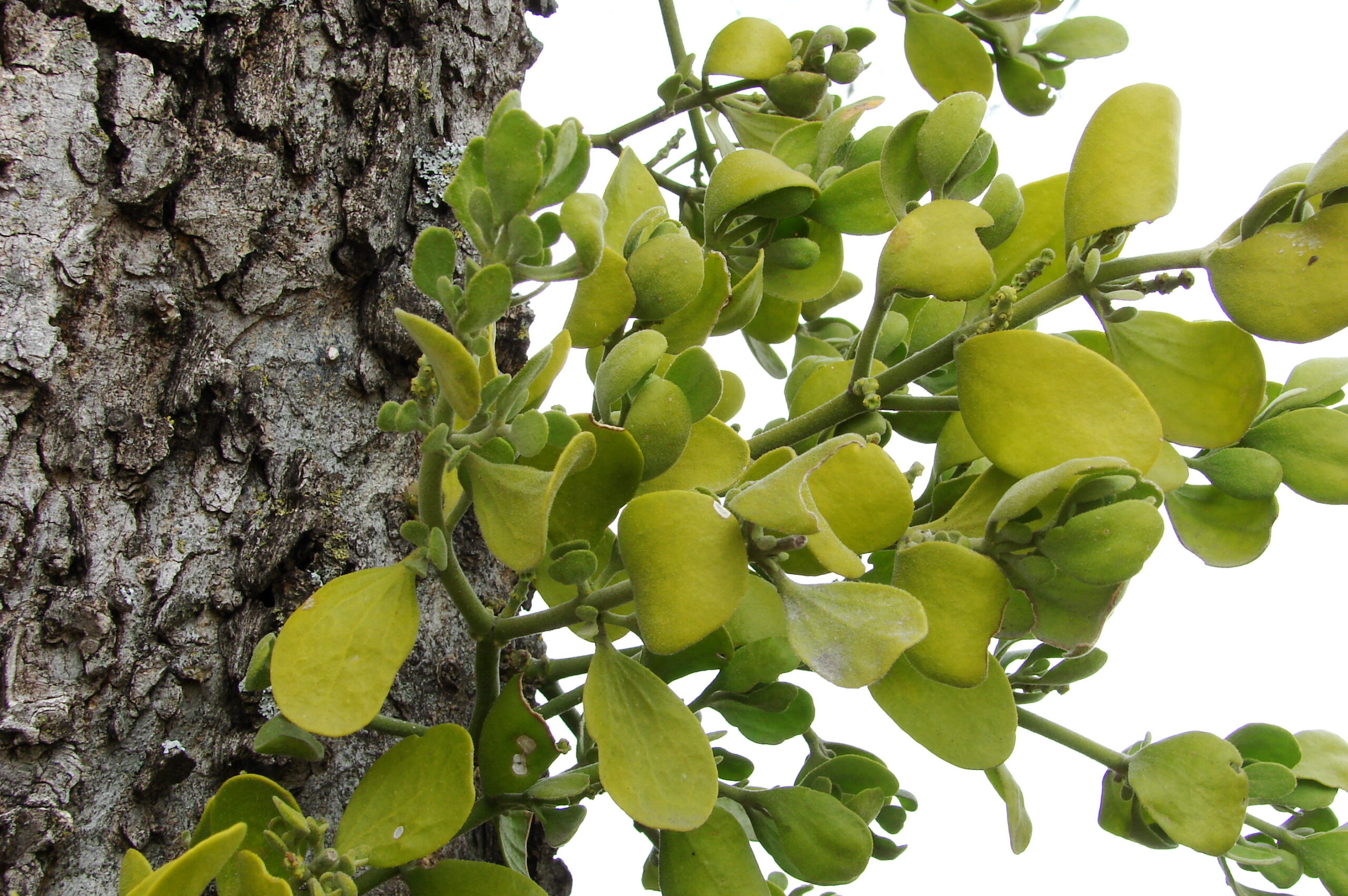
Mistletoe is easiest to see on trees that have lost their leaves in the winter, often you see a clump of waxy green or orange leaves in the middle of the tree. In east Texas and the eastern US, there is only one species that you will probably see: American mistletoe (Phoradendron leucarpum), which has white flowers and white berries. There are at least 7 other species native to Texas but they are limited to the mountains in far west Texas.
You might be wondering if, as parasites, mistletoes are harmful. It can be complicated, but yes, to the host tree, they can cause stress and can potentially kill branches or weaken the tree to other infections. Often though, mistletoe is not solely responsible for killing trees and can be an indicator of an already vulnerable tree. Once established, mistletoe can be difficult to remove. I personally would welcome the new plant as a food source for the local fauna as opposed to fighting the hemiparasite.
The mistletoes may be harmful to their host, but they provide food and habitat to many animals including birds, mammals, and butterflies. The Great Purple Hairstreak is a butterfly that is reliant on mistletoe as a place to lay its eggs and a food source. Their caterpillars feed exclusively on mistletoe and then, as butterflies, they feed on the nectar of the flowers. Many frugivorous, or fruit-eating birds, will eat mistletoe berries as well. There is even a bird in Australia called the Mistletoebird, which is entirely reliant on mistletoe.
In addition to providing food, the plant can also provide nesting habitat to birds and squirrels. You may find that your local clump of mistletoe could have baby birds chirping for food.
Though parasites are usually regarded as bad, they can still be incredibly important. For example, ticks and mosquitoes are abundant food sources that many animals use as food. Parasitic plants can be similarly detrimental to their hosts but can create interesting niches and relationships with other organisms.
Photo: Eastern Mistletoe (Phoradendron leucarpum) in Northeast Texas
Credit: Loadmaster (David R. Tribble)This image was made by Loadmaster (David R. Tribble).Email the author: David R. TribbleAlso see my personal gallery at Google Photos, CC BY-SA 3.0 <https://creativecommons.org/licenses/by-sa/3.0>, via Wikimedia Commons

