Katie Titsworth
At first glance, owl feathers may appear relatively ordinary, displaying shades of brown, gray, and other muted colors. However, under ultraviolet (UV) light, these same feathers can reveal something much more striking: a bright pink fluorescence. This unusual glow is caused by naturally occurring compounds within the feathers called porphyrins.
Porphyrins are pigments that fluoresce when exposed to ultraviolet light, producing the distinct pink coloration visible under a UV flashlight. However, this fluorescence does not last forever. As feathers are exposed to sunlight and environmental conditions, porphyrins gradually break down, causing their fluorescence to fade over time. This difference in fluorescence between newer and older feathers provides researchers with a useful tool for estimating the age of an owl.
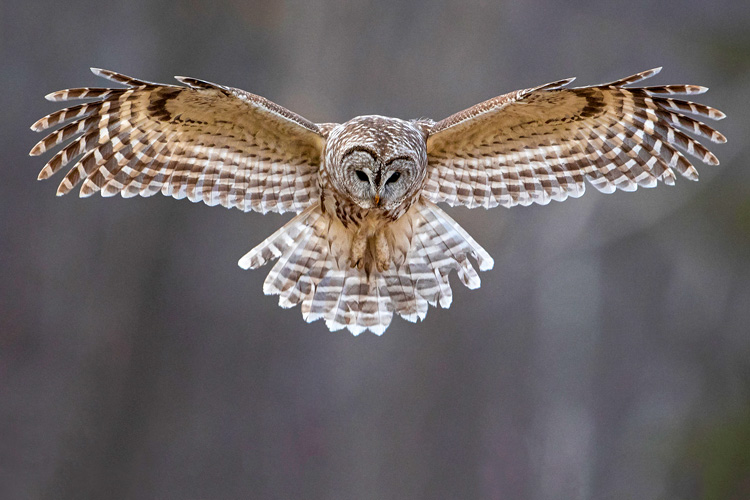
The relationship between feather age and UV fluorescence becomes particularly useful when examining an owl’s wings. Newly grown feathers contain porphyrins that fluoresce brightly, while older feathers exhibit weaker fluorescence as their porphyrins degrade. Consequently, the distribution of bright and faded feathers across a wing can reveal information about an individual’s molting history.
In juvenile owls, which hatched earlier in the same calendar year, all flight feathers typically develop during the same general period. Because these feathers are relatively similar in age, they fluoresce quite uniformly under ultraviolet light, producing an almost entirely bright pink appearance across the wing.
This pattern changes as an owl matures. At approximately one year of age, owls begin replacing their feathers through a more gradual molting process rather than growing all their flight feathers simultaneously. Only a portion of the feathers are replaced each year, leaving a combination of newer and older feathers. Under UV light, newer feathers fluoresce bright pink, while older feathers appear increasingly dull. The result is a distinctive patchwork, or mosaic, pattern across the wing.
Researchers can use these differences in fluorescence to estimate an owl’s age with considerable confidence, particularly during its first two years of life. Beyond this point, molting patterns become more variable and irregular, making it difficult to distinguish between older age classes. As a result, most owls beyond their second year are grouped into a general category known as “after second year”.
Interestingly, ultraviolet sensitivity also varies among bird species. Many diurnal birds possess specialized UV-sensitive cone cells in their eyes, allowing them to perceive ultraviolet wavelengths. Owls, however, lack these specialized cones. Nevertheless, research suggests that they may still be capable of detecting some ultraviolet light, potentially allowing it to play a role in social signaling or mate selection.
Porphyrins are not exclusive to owls or even to birds. They occur across a variety of organisms, including mammals and invertebrates. In many of these organisms, excess porphyrins are eliminated through waste or contained within keratinized structures, such as shells. This is important because porphyrins can be phototoxic in high concentrations, meaning exposure to light can cause damaging reactions.
What appears to be an ordinary brown feather under natural light can therefore reveal a surprising amount of information under ultraviolet illumination. Through the fluorescence of porphyrins, researchers can examine feather age, identify molting patterns, and gain valuable insight into an owl’s development. It is a fascinating example of how much information can be hidden within something as seemingly simple as a feather.
Photo: Barred Owl
Credit: Larry Koester, CC BY 2.0, via Wikimedia Commons


