

By Ruth Ann Ruiz
The Post Newspaper Features Editor
The O’Neal brothers, Phillip and David, grew up in a family of longshoremen and provided the audience at Nia Cultural Center with an informative and engaging presentation covering the history of Galveston’s longshoremen.
“I loved working as a longshoreman,” said Phillip O’Neal. “It was a job—if you could handle the physical demands, you could make good money and set your own conditions. If you didn’t want to work, you didn’t show up.”
Though longshoreman had the option of working or not, Phillip explained that belonging to the International Longshoremen’s Association required a worker to log at least 400 hours a year. There were perks to being a member of the association, such as contracts that covered payment and a brotherhood of working men.
The two brothers spoke of the brotherhood that longshoremen shared with fellow members their families and the support for everyone else in the community that was historically part of the International Longshoremen’s Association.
“When segregation was in place, Black longshoremen were the backbone of the Black community. We shopped at Black owned businesses and were able to buy things for our families, and we didn’t live in subsidized housing,” said Phillip.
Their fond recollections of growing up in a longshoreman household and community were echoed by members of the audience who remembered their own fathers’ and grandfathers’ years as longshoremen.
Phillip and David were both born and raised in Galveston, and both worked for a while as longshoremen before going to college. David returned to Galveston after college and worked with the U.S. postal service. But Phillip returned from college to work on the docks.
“I never intended to be a longshoreman, but when I got out of college, I realized I could make good money back in Galveston,” said Phillip. He attended Lamar University, where he played football and graduated with a degree in business administration.
For at least four years, Phillip O’Neal served as the president of Galveston’s local Longshoremen’s Council, and he also served as president of the Port of Houston’s Longshoremen’s council.
Phillip not only made a good living and enjoyed life as a longshoreman—he also reports that he learned a key life lesson working on the docks: the importance of not being afraid to admit what you don’t know.
“You can’t be afraid to ask questions—that’s how you learn. I asked questions, and that’s how I learned,” said Phillip.
Historically, Galveston’s Black longshoremen were known as the Cotton Jammers Association. Packing as many bales of cotton as possible into the hold of a steamship was essential to the success of the cotton industry. The cotton jammers’ craft followed a precise pattern: first, bales were arranged in an arch for support, and then additional bales were layered and pressed tightly until the arch was forced down to the floor of the hold, maximizing the ship’s capacity.
Along came a mechanical cotton presser and the need for cotton jammers became a thing of the past.
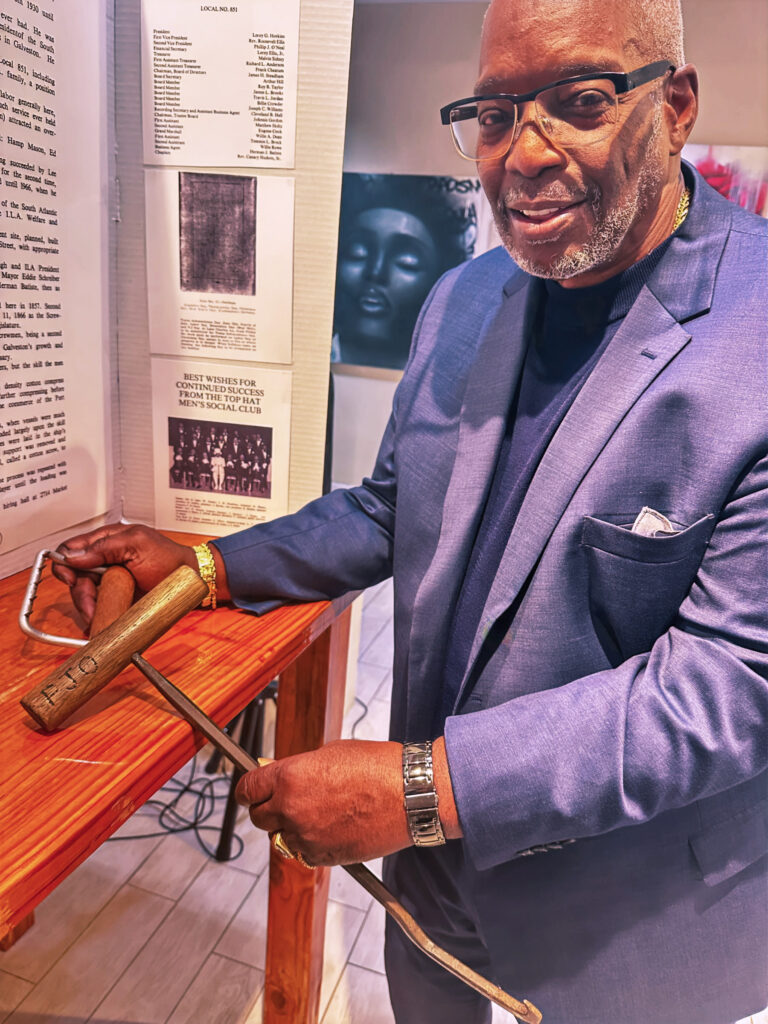
Phillip brought some of the key hand tools used for loading cotton onto ships, including a hook and a screw jack. His initials are carved into the handle of the hook he once used during his years working on the docks of Galveston.
The audience was so engaged with the topic covered by the O’Neal brothers that they expressed hope of one day reading a book or watching a documentary detailing the history of Galveston’s Cotton Jammers and the growth of the I.L.A. on the docks of Galveston. Cotton Jammers and the growth of the I.L.A. on the docks of Galveston.


1 comment
The flag flies high for the two O’Neal Brothers David and Phillip who opened the doors for opportunity for many black men in Galveston County