
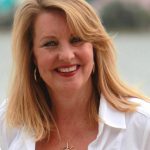
By Ruth Ann Ruiz
The Post Newspaper Features Editor
Everyone has a story to tell, and it is my job as a features editor to listen and ask questions. But my interview with Gunther Emil M. Sales. Consul General of the Philippines started off with the Consul General interviewing me. In fact, it felt like I was sitting with a minister who wanted to know how he could help me.
As the conversation went on for about 20 minutes, I realized I needed to switch it into an interview. But that switch just didn’t happen. In fact, our time together turned into a two-way conversation between me, the journalist, and Sales, the diplomat. I learned from Sales that Texas was once called Nuevas Filipinas.
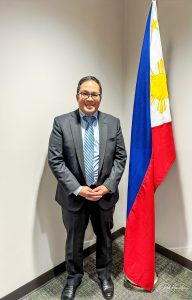
Texas and the Philippines share a similar history in that both were once colonized by Spain and this is the reason for the temporary name of Nuevas Filipinas for parts of the area that we know as Texas.
I learned a lot more from Sales, such as about the cross he and his wife, Joanna carry. And I also learned that in Sales’ experience, Americans are especially inclusive of people with special needs.
Sales was on assignment at the Philippine embassy in Washington D.C. from 2014-2021. While his family was living in Washington D.C., they learned of a cross they would be carrying for the rest of their lives.
Their second son was two years old, and they noticed that he was no longer maintaining eye contact with them. They sought out answers. It was an American doctor who diagnosed their son with autism.
“Our son Scott is autistic nonverbal,” Sales explained.
Sales described a moment when his son was being very noisy in their apartment elevator while they were living in Washington. As a father, he felt the need to apologize to the other person in the elevator. The response he received surprised him.
“The man said, ‘Why are you sorry?’”
Sales and his wife grew to learn the American culture is tolerant and accepting of people who are different.
“There is hardly any prejudice against people with special needs. People are accepting and they understand,” Sales said. “There is a very inclusive culture here.”
Because their child has autism, they have found American schools and therapy to be very beneficial for their family.
Sales also expressed comfort with Americans’ use of the term “special needs students” versus terms that have been used in the past.
Their oldest child, Samuel, is 14, and he does not have autism. Both sons are currently attending public schools in Houston.
Going further into the conversation with Sales, I learned he was born in Nairobi, Kenya. His father worked with the Philippine foreign service. As a child, he lived in Korea, London and in his family home in Manila.
It was while his father was working in Manila that Sales decided he was not going to move again, at least until he entered his own career. He elected to stay behind in Manila with his older brother at the family home rather than travel to his father’s next work assignment.
After completing high school, he entered university and began pursuing a degree in economics. It was at this point that I began to understand why speaking with him felt so comfortable. He attended Ateneo De Manilla University, which is a private Catholic college established by Jesuits in 1859.
It was his university education that had contributed to my feeling like I was with a friend or a minister. He described several times the impact of a priest who told him that every day one should be sure to make another person feel better about themselves.
As part his heartfelt commitment to supporting his fellow Filipinos, he attends as many Philippine celebrations and events as he can fit into his schedule as consul general
Upon arrival in Houston, Sales realized he needed to make the Filipino nurses of Houston feel better about themselves. He worked with Houston’s mayor John Whitmire’s office to officially honor nurses serving in Houston who come from the Philippines.
During National Nursing Week, Whitmire officially proclaimed May 13 as Filipino Nurses Day in Houston.
Filipino nurses play a vital role in serving the massive medical infrastructure of Houston and the surrounding regions. It is estimated that one in every 20 registered nurses in the United States was trained in the Philippines.
Sales shared with me that the Philippine culture tends to be a caring and nurturing culture which lends itself very well to developing nurses who are committed to compassionate nursing care.
Beyond nursing, Sales listed many other professions that Philippines serve in. According to Sales, there are about 80,000 Filipinos living in Houston and 280,000 in all of Texas.
The Philippines is a nation formed of 7,000-plus islands and, for a brief period, the island nation was a colony of the United States. English is spoken by almost all Filipinos. The official language is Filipino, a standardized version of Tagalog, and Spanish is also spoken, dating back to when Spain colonized the island nation. There are at least 300 other dialects or languages spoken.
Our conversation/interview lasted nearly three hours. In the end, I left feeling like I had just sat and chatted with a friend. Possibly it is because of the friendly nature of the Filipino culture.

