
By Ruth Ann Ruiz
The Post Newspaper Features Editor
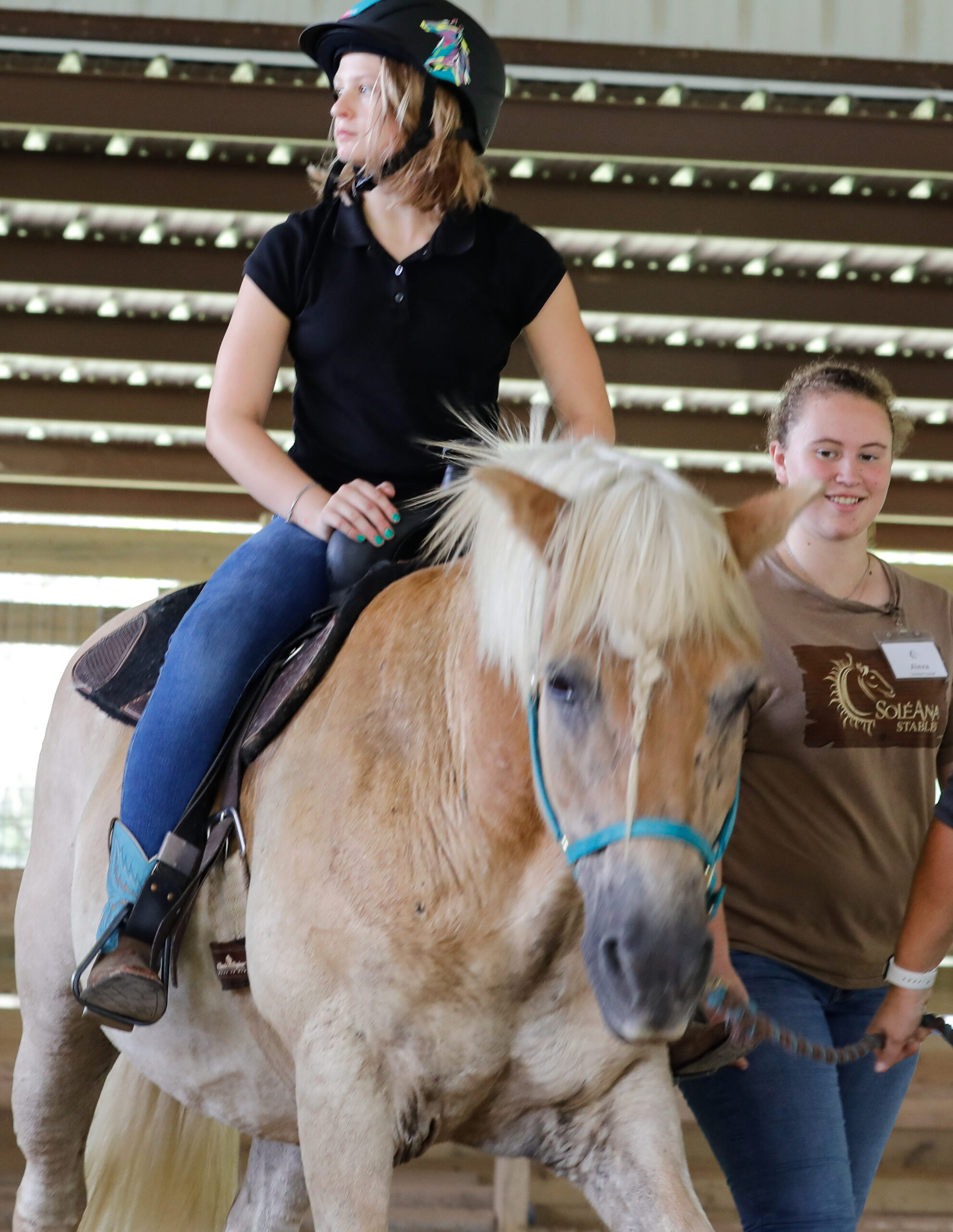
Positioned atop her Brabant named Bee, sits Dea Martin, like a mother bear protecting her children which are both four-legged and two-legged. She is quick to call out people approaching the arena area with an umbrella.
An umbrella might spook a horse which could lead to an injury inside the arena where there are half a dozen volunteers walking alongside several horses with young riders.
Dea Martin’s horse sense is very apparent as she looks out for the needs of the equines while engaging riders in therapeutic lessons. Taking photos is only allowed outside the arena and a flash is not allowed as that too might spook the horses.
She has served as a PATH instructor with SoleAna Stables for six years. She’s been an expert on horses for several decades. Her earliest horse training started at age 11 in West Virginia.
PATH International, of which SoleAna Stables is a member of, is the credentialing organization for accrediting centers and certifying instructors and equine specialists. SoleAna Stables abides by their strict safety guidelines while adding additional standards to further ensure quality of life for horses and riders alike.
Rules such as wearing a helmet when on a horse, how to announce the opening of the gate, checking the riders’ helmets and saddle for security, knowing when a horse is in stress, keeping volunteers educated on horse safety, and knowing when a rider is not able to manage a lesson are all part of PATH training.
Working with special needs children is a specialty that requires a unique personality. Add horses to the mix and you will need an even rarer breed of human to do the task and do it well. If you have the will, then it takes a lot of training, and very high levels of patience to provide therapeutic riding lessons for clients with limitations.
Gentle, positive, coaching words are needed to engage a rider with limitations onto a horse and continue with a lesson. All the while, the instructor must be knowledgeable of horses and equine safety.
Katelyn Del Angel, who served in the US Air Force from 2014-2020, spent the past several months training to be a PATH instructor under Martin. She recently completed a Doctorate in Occupational Therapy from Methodist University in North Carolina. Her focus in her graduate studies was on equine therapy.
On days when a child is having an emotional meltdown, the instructor is processing the situation. “We don’t want a child to think they have to get off the horse just because they cry. We want to reassure them and let them know we are there for them,” said Del Angel.
“It is up to the instructor to get the student engaged in the lesson and make sure the equine is not going into too much stress,” Del Angel added.
If necessary, a student might have to come back down out of the saddle. But lots of care is put into getting the rider engaged rather than discontinuing a lesson.
Because of the intensity of therapeutic riding a horse is usually only able serve in this capacity for 3.5-4 years. “Horses are very sensitive and intelligent animals, and we don’t really know how much of the riders’ emotions they are absorbing,” Martin explained at a volunteer training session.
Therapeutic riding isn’t just for the sake of riding a horse. Each student comes to lessons with their own set of needs.
Some need verbal development, which is done with volunteers engaging students in conversations. Others need to work on coordination and balance and some need to work on maintaining emotional self-control. All are areas that PATH instructors have been trained.
SoleAna Stables will be hosting their annual fund-raising event on September 17 at the Lone Star Flight Museum. If you are interested in attending, you can reach the stables at: director@soleanastables.org