
By Ruth Ann Ruiz
The Post Newspaper Features Editor
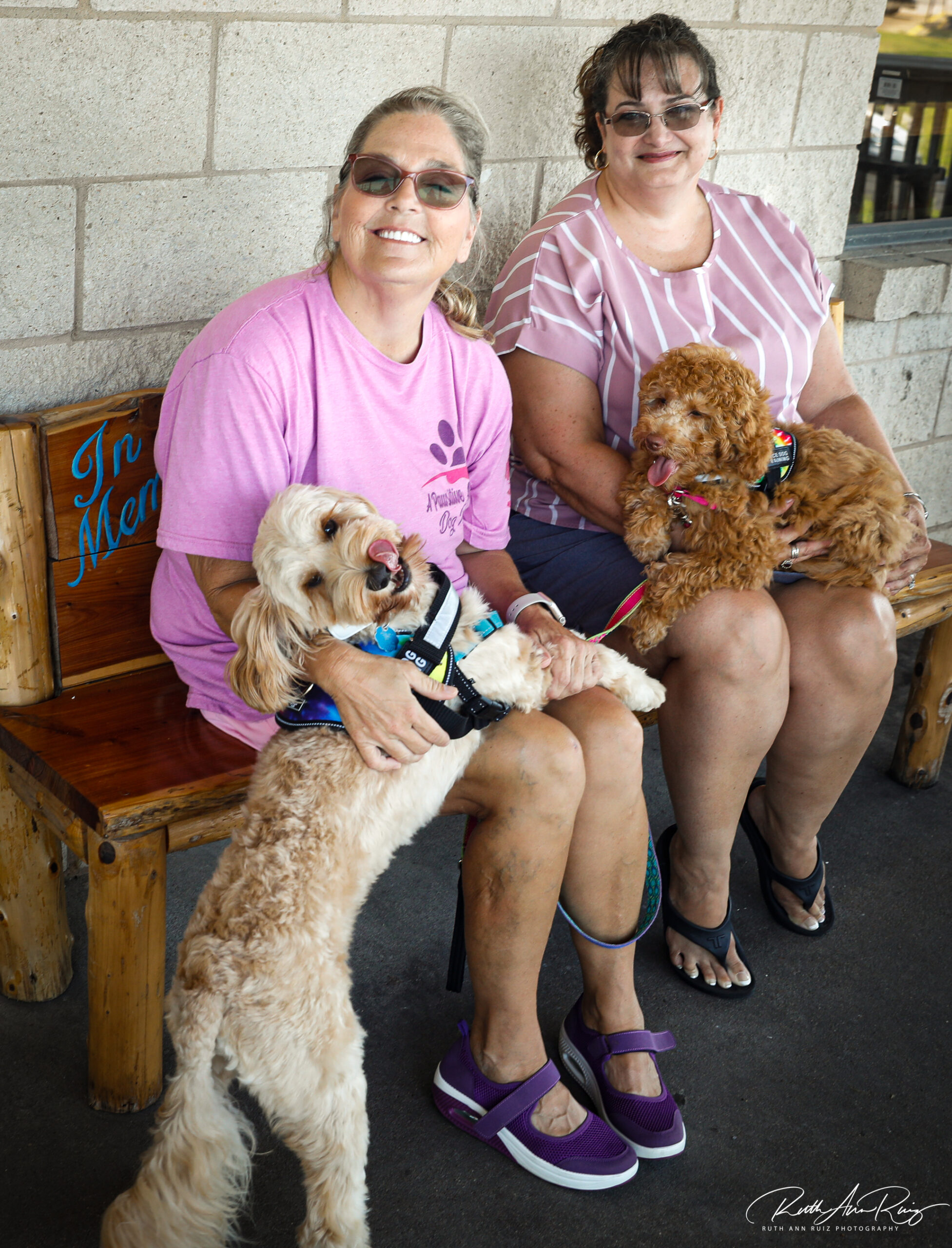
If you spot Lisa Songy or Cathy Dorchuck pushing a stroller full of puppies with a couple mature dogs coming along on leashes, their request is: Don’t touch the dogs.
The dogs are friendly and won’t hurt anyone. But when Lisa or Cathy goes out to Target, Bayou Bistro, or other public facilities with their puppies, they are training the young dogs for their future purpose as medical alert service dogs.
Cathy has been training dogs to be service dogs since 2014. Her dogs are trained by scent.
“If someone comes up and pets our dogs, it will take an hour or more for the dog to lose the scent of the petter and get back to their training,” Cathy explained.
“Everyone has some sort of scent on their hands, such as perfumed lotion or the soap they just used to wash their hands and this throws off our puppies,” Lisa added.
Dogs are Cathy’s life. She remembers each dog she has known since she was just two years old. There has always been a special dog for Cathy Dorchuck.
When she was in her 40s, she took her love of dogs to work with her when she became a groomer at a pet store. She loved that this work kept her hands on the fur of every type of dog brought in for her to groom and to care for in other ways.
Reaching out and touching the fur of a dog has soothed Cathy throughout her adult life. She has had some challenges to overcome, including childhood trauma that left her with complex PTSD. Through the years, no matter what was caving in around her, a dog was nearby to comfort her.
While working at the pet shop she received lots of requests to train dogs to be service animals. The pet shop did not train dogs, so Cathy saw an opportunity to build a business around her love for dogs and her compassion for others.
Her vision for training medical alert service dogs was specific to children with needs. She has provided over fifty fully trained dogs to handlers.
Cathy’s business, A Pawsitive Approach Dog Training, is in Santa Fe and all the training practices Cathy employees with her dogs are positive. Cathy reports she does not use punishment or force to train her dogs.
Her training begins when the dogs are still little pups. She exposes her puppies many times to a scent so that they will grow up to be able to notify their future owner of a potentially dangerous medical condition.
For example, she begins training puppies with the scent of a human whose blood sugar level has dropped to serve a diabetic client in the future. She also uses human scent to train dogs to be service animals for children with autism, PTSD, and other nonvisible medical conditions.
Originally, she purchased her puppies from a breeder out of Colorado. Then she met Lisa, whose daughter has a heart condition, dysautonomia. So far Cathy has not found a dog suitable for Lisa’s daughter, but Cathy and Lisa have formed a business bond.
Lisa suggested they go together into the business of breeding dogs to raise as service animals rather than buying and training dogs. Cathy was eager to breed them because, she reported, many of the dogs she purchased were not suitable for training.
The two women have formed a kinship as business partners. Cathy has the years of experience in training dogs, so Lisa defers to her for any clarification on procedures. When puppies are born, Lisa spends nights at Cathy’s place to be part of carefully caring for the future service dogs.
Once the puppies’ eyes are open, they begin their training outside the comfort of their home. The ladies shared that they take the dogs on their first outing to get them acquainted with the outside world and guide them in focusing on following directions.
One traditional first outing is to Bayou Bistro.
“We know the owner. That’s why we feel good about bringing the dogs here,” both women explained. The dogs they brought with them this time, Ginger, and Milo, are sitting quietly under the table at Cathy’s and Lisa’s feet. On this outing, there are no puppies.
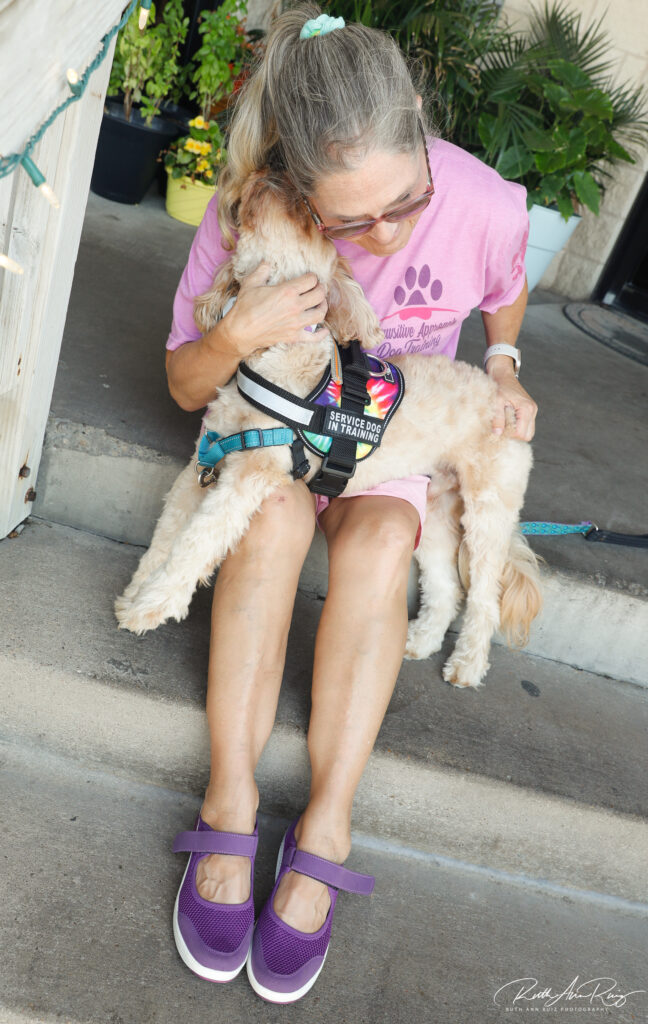
Ginger, whose fur is the color of ginger, is still in training, and she required a little more attention during the interview than Milo did.
Cathy and Lisa give each dog a name related to when he or she is born. For a litter born in the early spring the dogs were named after flowers. One puppy named Blue Bonnet was renamed by his child owner to Jasper.
Though the business partners name each dog, Cathy shared they are careful not to get attached to the dogs they are training.
“I have to be ready to give them away, and if I got too close, I’d be a basket case,” she explained. “Each dog needs to focus on the handler so that is part of the training.”
New dog owners called handlers are allowed to take their puppy home for overnight bonding during the early training process. Eventually after many overnight visits the dog will end up in the home of the handler.
The handler is the child with a medical need who will one day acquire the dog. For those children who have hidden illnesses such as anxiety disorders or autism, the dogs are trained to sense when their handler is on emotional overload.
“The dog will start to guide its handler to leave a situation if the dog senses the handler’s anxiety is getting too high” Cathy explained.
Cathy shared that a medical service dog trained to do so will not only guide an anxious person out of a setting, but also it will sense when it needs to come near its handler and lay on the child’s feet or lap.
Cathy said she doesn’t just train dogs. She also works with the children and parents who purchase a dog. It takes a lot of training to teach a human how to give proper commands and work with a service dog.
In addition to working with service dogs, the duo provides therapy dogs that come from the same litters as their service dogs.
Some dogs are not cut out to be service dogs.
“We can tell at about nine months if the dog will be a service dog or a therapy dog,” Cathy said.
Therapy dogs go to work in hospitals, schools, and nursing homes providing comfort to the people in those settings.
Cathy and her dogs and HCA Houston Clear Lake are finalizing the details of a contract for her dogs to provide dog therapy for the staff at the hospital. Yes, you read that correctly — just for the staff. Doctors and nurses sometimes need a little time with a furry friend.
While training dogs and working with their new owners occupies most of Cathy and Lisa’s time, they do take one day each week to give back to the community at no cost. On that day they go with their dogs into nursing homes, children’s centers, and other places where there might be people who need a little time snuggling with a trained therapy dog.


1 comment
Assistance Canines of Texas is proud to have Cathy on our Board of Directors. We will be relying on her eye for detail when we begin our remote training courses. She is also serving as our Confirmation Director, making sure that our teams reach our confirmation requirements.