By Alex Coenen
On the Pacific Northwest Coast, rocky beaches blend into dense old growth forests shadowed in a thick misty veil. Here lives one of the most enigmatic seabirds of this region, whose breeding behavior puzzled naturalists until the 1970s.
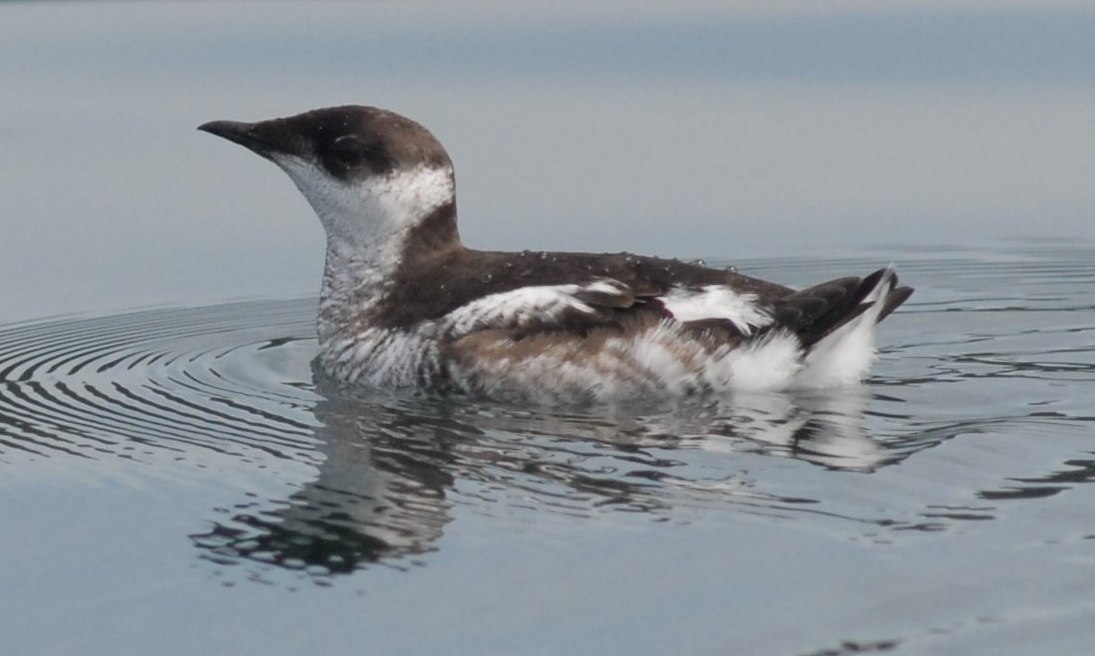
The Marbled Murrelet is a rather cute seabird whose breeding plumage is an assemblage of sooty and rusty feathers. Their non-breeding plumage is a stark contrast of white underbody and a black back. These birds spend their winters in coastal, protected waters along the West Coast from central California to the Aleutian Islands in Alaska. They come together in social groups, feeding on schooling fish and crustaceans.
In the spring, breeding pairs fly up to 50 miles inland to nest solitarily within old growth coniferous forests. These seabirds lay a single egg in a mossy nest on the limbs of large conifers. For a long time, the breeding behavior of Marbled Murrelets was not known to western science, as their concealed nests were notoriously difficult to locate.
Even though Indigenous people within the area long believed that these birds nested in the forests, early western ornithologists believed that -like other seabirds- they would nest along the rocky coastline. This created the uncertainty and mystery that plagued these seabirds for decades. In fact, Marbled Murrelets were the last North American bird species to have their nests discovered when in 1974 a tree pruner in Big Basin State Park almost stepped on a chick sitting in a nest 150 feet above the ground.
Marbled Murrelets are currently listed as endangered under the Endangered Species Act and face threats from every direction: from bycatch in gill nets and oil pollution in offshore waters to logging and habitat fragmentation inland. The trees that Marbled Murrelets nest in, such as Douglas firs and Western Hemlocks, are also those most sought out by logging companies.
A large amount of breeding habitat has been cut down and little coastal old growth forests are left. In the process of logging these forests, many chicks and eggs were killed from felled trees. In fact, before the first nest was even discovered, loggers noticed that when they would cut down certain trees, they would find the remnants of chicks and eggs on the ground.
Oil spills are also a major threat to these birds, as they overwinter within inner coastal waters, where most oil spills occur. Oil spills can directly kill many birds but can also affect breeding and can significantly decrease the availability of prey populations.
Since these birds are believed to only lay one egg a season, many disturbances in the environment around them can have extreme effects on nesting success and long-term population trends. Population models suggest that Marbled Murrelets are declining by 4-7% per year throughout their range.
Seabirds play an essential role in nutrient cycling of coastal environments and logging practices are important for the economies of rural communities. Like many other cases where natural resources and wildlife can come into conflict, these seabirds and loggers can coexist. Let’s look forward to effective sustainable forestry practices that meet the economic needs of rural communities and protect vital nesting habitat for these charming birds.
Photo a Marbled Murrelet swimming
Credit: Martin Raphael, U.S. Forest Service

