By Rebecca Bracken
It’s hard for me to believe it’s almost summer, but here we are. Some of my favorite spring wonders – like the annual bluebonnet emergence – have already passed. Yet there are still many surprises to be had, even as the season changes. Spring and summer are a time of viewing the amazing feats of nature, including the return of our migratory birds to their nesting grounds.
Over the centuries, humans have learned to create magnificent structures that can withstand many destructive forces. But animals have long been able to build nests that seem to survive almost anything. Over time, animals, driven by evolutionary fitness, have adapted to the everchanging conditions to increase their chances of survival and reproduction. So why do some birds, such as the small but gregarious Wilson’s Plover, choose to nest in what seems like an unsafe manner and environment?
The Wilson’s Plover, known for its heavy bill when compared to our other, similar-size plover species, is a species of high conservation concern here in Texas. With its sandy brown coloring, the plover darts back and forth across the beach, seemingly invisible at times, feeding on insects and crustaceans gleaned from the mud or sand along our shorelines and in coastal lagoons. Generally thought to be monogamous, the male makes several scrapes, or circular depressions, in the sand, fanning his tail and extending his wings in hopes that his mate will choose a particular scrape for her eggs. These scrapes a bare; sometimes the edges will be decorated with shells, algae, pebbles, or gravel, but the interior remains smooth and empty. The female will lay three buffy eggs, carefully incubating them for 25-32 days.
Can you see why the plover’s way of nesting might be an issue? While these nests are designed to blend in to the environment, providing camouflage for protection, this poses challenges for researchers and beachgoers alike. Most Texas beaches are legally designated as public highways, meaning hundreds if not thousands of people are out driving on the beaches on pleasant days. As plovers are known for choosing areas along dunes and above the high tide line, in a perfect world there would be little interaction between nesting plovers and beachgoers. However, there has been a sustained loss and degradation of nesting, and foraging, habitats along beaches, pushing plovers to create their tiny scrapes closer and often into areas that are frequented by vehicles and people.
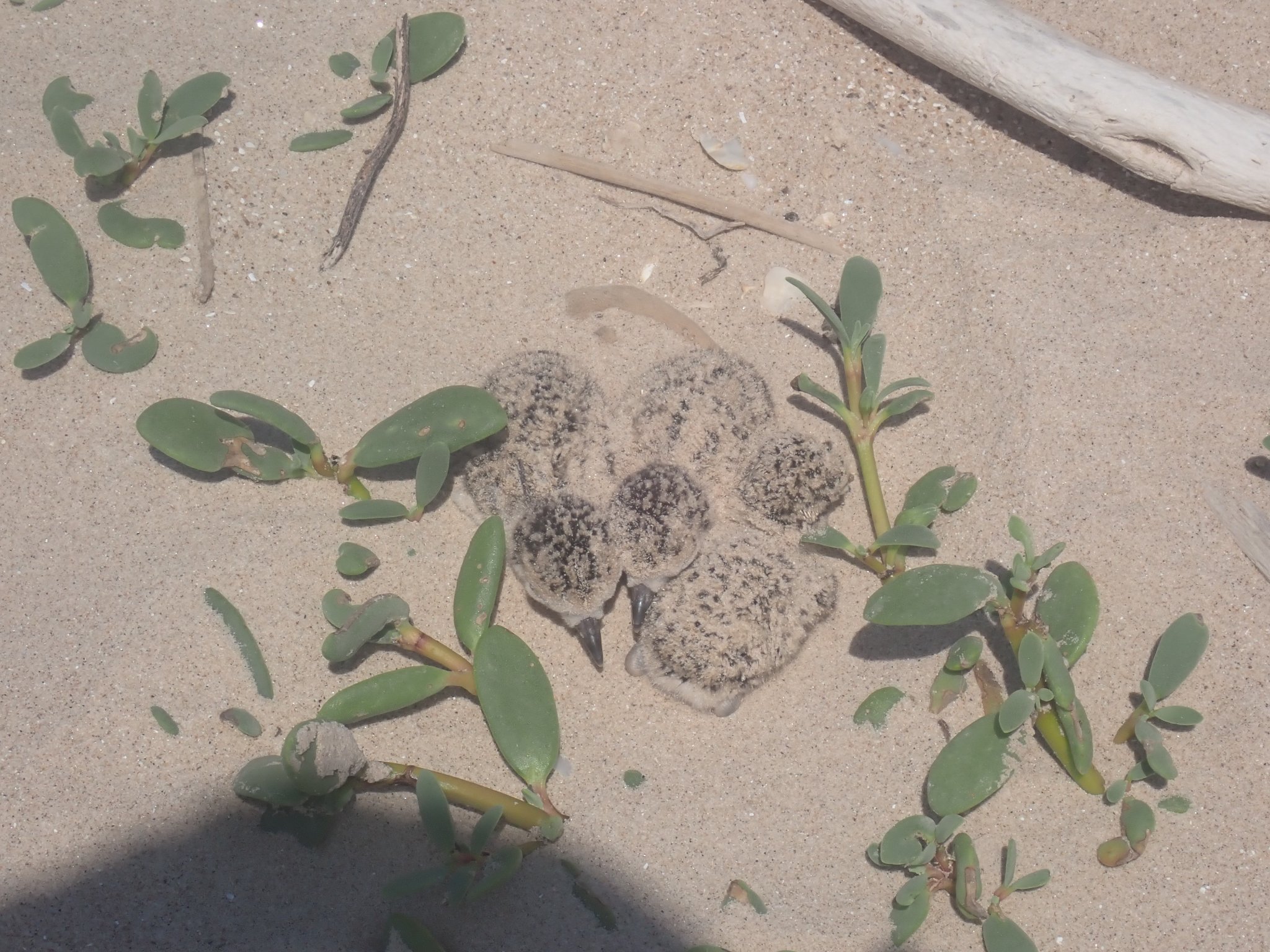
It is incredibly easy to accidently run over a plover nest given their ability to blend in. Plovers are also known to nest in the middle of tire tracks, possibly thinking that the divots created by the tires on sand would provide protection. Once the eggs hatch, the chicks are just as likely to be invisible. With their pale brown or buffy coloring, chicks often lay flat on the sand to appear inconspicuous, leaving them vulnerable to the unsuspecting person passing by.
Here at Gulf Coast Bird Observatory, we are trying to bring awareness to the issues facing many of our shorebird species. We have monitored nesting Wilson’s Plovers for many years, and frequently see nests destroyed because of human activities. Even something as simple as walking along the edge of the dunes or along the small pools created by rain and high tides can inadvertently cause a plover nest to fail, by direct physical destruction or by opening it up for predation. So next time you’re out, please keep an eye for nesting shorebirds – stay out of fenced of areas, watch from a distance, keep dogs on leash, don’t drive in the dunes, and enjoy your time on the beach!
Photo Credit: Taylor Bennett
Caption: Wilson’s Plover chicks camouflaged in the sand

