By Caleb Clarkson
Frequently, I find myself being surprised by the behaviors of animals while exploring the natural areas of the Gulf Coast. Whether its grackles waiting patiently at Buc-ee’s to feast on a buffet of car-crushed lovebugs, or a Reddish Egret using its wings to shade the sun for better visibility in the water, I find myself wondering… how does it know how to do that?
As humans, it’s easy to say, “that’s smart!” when we see these kinds of interesting and successful tactics. And for some animals, that’s true. Crows, for example, use problem solving, planning, experience, and a fair amount of insight to inform their behavior when securing food, territory, or mates. Plenty of creatures along the Gulf Coast show signs of intelligence. But “intelligence” is not always the case. Sometimes, these behaviors come from a much older source.
Over many years of evolution, animals have developed clever tactics for surviving and thriving that don’t require intelligence or problem solving at all. Some behaviors are automatic and don’t require any thought. When certain small mammals, like bats or rodents, get cold, they reduce their metabolism and energy expenditure to conserve valuable resources during cold snaps, when food is less available, entering a state called torpor. Torpor isn’t something the animal is actively choosing to do. It’s hardwired into their physiology. Behaviors like this are instincts and don’t require learning or planning, only the conditions to trigger them.
There are other behaviors that fall somewhere between instinct and high intelligence. These behaviors, while not instinctual and known from birth, still originate from generations up the family tree. They are learned and passed down, shaped by experience rather than built directly into the animal from the start. We may never know where behaviors like these first began, but it continues from one generation to the next. Many birds are born without knowing their song, but as they grow and spend time with adults who do, their song develops into the familiar notes we recognize. Coyotes aren’t born knowing how to hunt and scavenge, they learn over time from their parents.
Humans, intelligent as we are, often overvalue the importance of intelligence in nature. Jellyfish in the Gulf lack a brain, yet they continue to thrive, securing food effectively and reproducing constantly. An ant on its own may seem simple, but as part of a colony, it contributes to a larger system that is surprisingly efficient and organized. Colonies can defend territory, compete with rivals, and even cultivate resources to support the group. When a behavior increases an animal’s chances of surviving and reproducing, it tends to stick around. It doesn’t have to make sense to us. It just has to work for them!
Photo by Celeste Silling
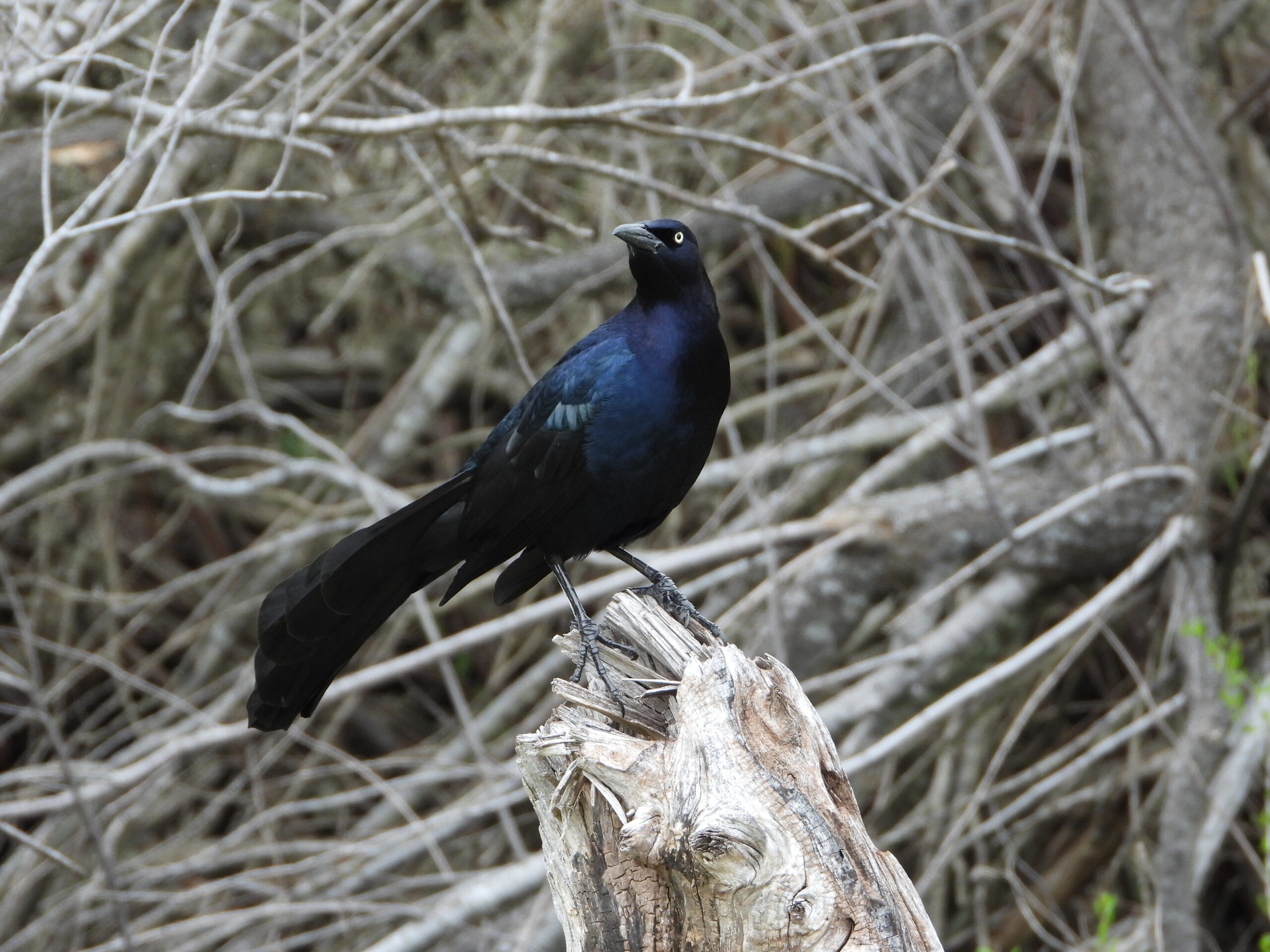
Caption: Great-tailed Grackle

