By Celeste Silling
Spring migration is well underway on the Texas Coast. Migratory birds that winter in South and Central America are making their way North to the United States and Canada. This is a long, treacherous journey for many birds, especially those who fly directly across the Gulf, instead of circumventing through Mexico. The journey across the Gulf takes around 18 hours if the weather is good. For the small hummingbirds, warblers, and others that make the trek, there is no drinkable water, no food, and likely nowhere to rest (unless they find a lucky ship). If the weather is stormy, or if a wind is pushing against them, the trip is made even longer and more perilous for the brave travelers.
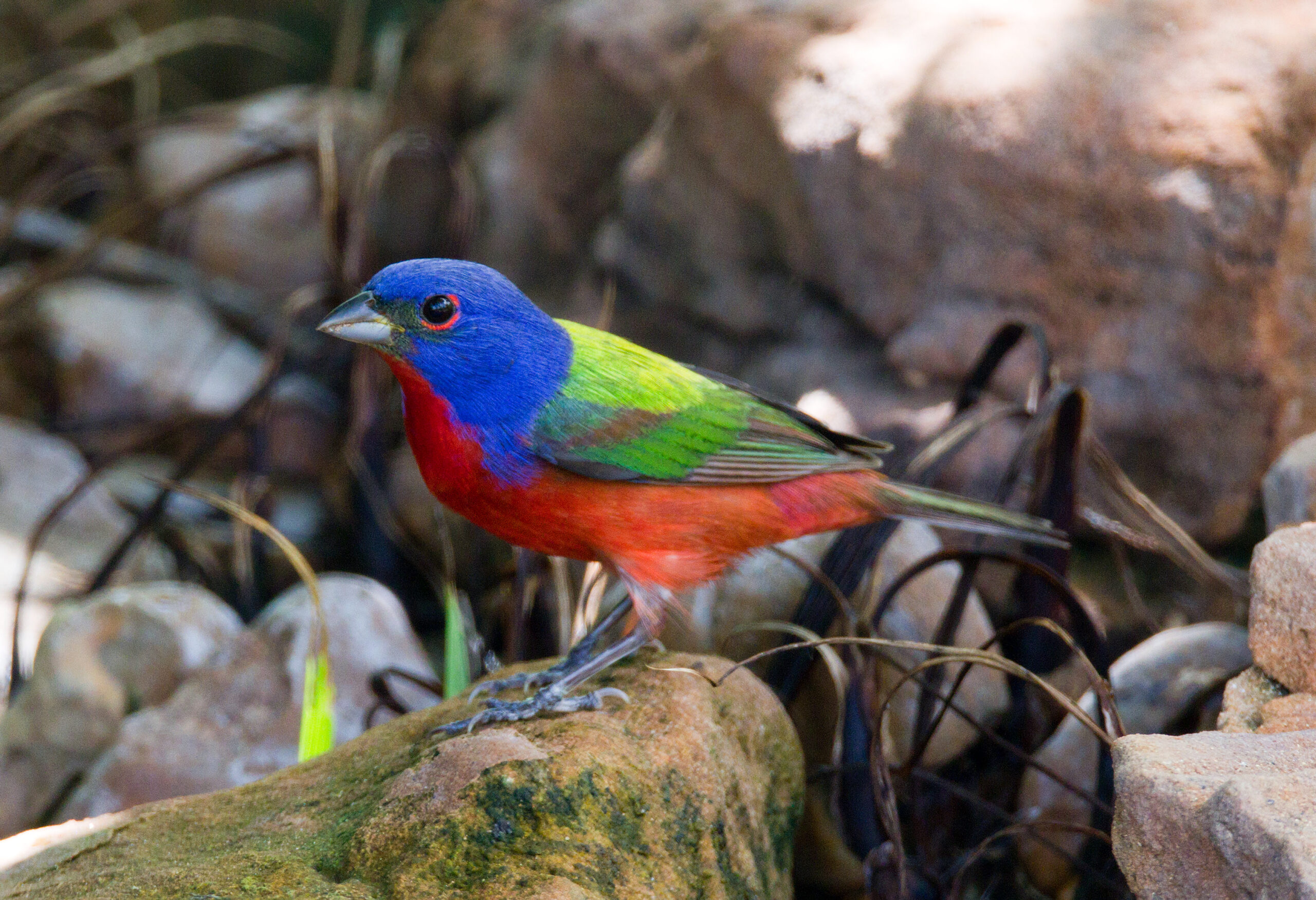
One such migrant is the Painted Bunting. The Painted Bunting is an incredibly colorful little bird who stands out even amongst the rainbow of visiting songbird species. The males have a blue head, red neck and breast, and lime green back. The females are a beautiful bright green throughout, a color not often seen in birds of our region.
The Painted Buntings spend their winters in Mexico, Central America, Florida, and the Caribbean Islands. In the spring, they begin to make the challenging journey up North to their breeding grounds in Texas and other Southern and Central states. While some of the birds, such as those that winter in Florida, don’t need to cross huge bodies of water, others do. The Painted Buntings that land on our Upper Texas shores in April, are most likely ones that have just flown across the entire Gulf in one day.
Painted Buntings, like most other migratory birds, migrate at night. They do this for several reasons. First, it is cooler at night, which is important when you are attempting an incredibly difficult physical feat for 18 hours. Second, it helps them avoid predators, such as hawks and other raptors, who might be on the lookout for tired travelers. Third, they can use the stars, moon, magnetic field, and other navigation tools to orient themselves, even with nothing but blank water below.
Because their journey is so difficult, Painted Buntings and other migratory birds are exhausted when they reach our shores. Some die in the process, and those who land in Texas are greatly diminished. They need clean water to drink, bugs, seeds, and berries to eat, and safe quiet space to rest and recover. Much of their habitat has disappeared over the years, so these important stop-over sites with water, food, and native plants are hard to come by.
Fortunately, we can help the Painted Buntings and other migrating birds! The first step is to turn off your lights at night. Light pollution from towns and cities can affect the nighttime migration of birds, turning them in the wrong direction, or causing them to crash into building and cars. You can help by turning off your lights from 11PM to 6AM, especially outdoor lights. You can also close your curtains to block your interior lights, or put lights on a timer or motion-activation setting. You can also put out clean water in bird baths, seed and meal worms in seed-feeders, and plant native plants. All of these things will help migrating birds and welcome them to Texas.
To see Painted Buntings and other migrating songbirds, come by the Quintana Neotropical Bird Sanctuary in Quintana! It is full of spring migrants at the moment, and open to the public.
Photo: Painted Bunting by Mike Williams

