Megan Hobratschk
You may wonder which came first, the Kiwi (fruit), the Kiwi (people), or the Kiwi (bird). Although a much-loved subtropical fruit and a colloquial term for New Zealanders, the Kiwi bird was the first! This bird, native to New Zealand, is not named after the fruit, but was named by the Maori people of New Zealand after the bird’s call, which they thought sounded like “kee-wee.” The informal “Kiwi”, used to describe the people of New Zealand, was inspired by this national symbol.
There are five species of Kiwi, all of which are flightless, nocturnal, and endemic to, or found only in, New Zealand. For being a smaller to medium-sized bird, the Kiwi can live for quite a long time- up to 50 years! As a result, it typically takes three to five years for individuals to reach their adult size after hatching. Individuals of different species range in size from two to eight pounds and in color from gray to brown. In all Kiwi species, females are the larger sex and have longer bills than males.
As if these birds weren’t interesting enough as is, the Kiwi holds the world record for producing the largest eggs relative to its body size, with females laying an egg weighing up to 25% of their body weight! During the few days leading up to egg laying, females are not able to eat, as the egg takes up too much of the body cavity. Instead, females rely on fat stores to finish producing their giant egg. Kiwi chicks are precocial, meaning they emerge from the egg fully feathered and with open eyes.
The most common species of Kiwi are the Brown kiwi, the Great spotted kiwi, and the Tokoeka, all of which have populations ranging from 15,000 to 26,000 individuals. Unfortunately, being a flightless bird has its disadvantages, as Kiwi adults and chicks are vulnerable to stoats, dogs, cats, ferrets, and vehicles. Despite their large population sizes, the Great spotted kiwi and the Tokoeka are considered threatened. Similarly, two other species of Kiwi, the Little spotted Kiwi and the Rowi, are classified as threatened and have very small populations in the wild (500-1,800 individuals). Things are looking up, however, as populations of Kiwi are increasing in certain areas as a result of continual conservation and predator control efforts.
Kiwi hold great cultural significance and are national symbols of New Zealand, representing the uniqueness of New Zealand’s wildlife and the value of New Zealand’s national heritage. The Maori of New Zealand consider the Kiwi a taonga, or treasure, with which they have special spiritual and historical connections. Due to their cultural, spiritual, and historical significance, the Maori have become key stakeholders in Kiwi management and conservation.
I enjoyed watching videos of these birds in my Ornithology class, and every once in a while, a video of a Kiwi running around in the wild will pop up on my social media feed. These never fail to make me smile, as the birds have a very goofy run! If you are ever in need of a quick pick-me-up, I highly recommend looking up videos of Kiwis scurrying around.
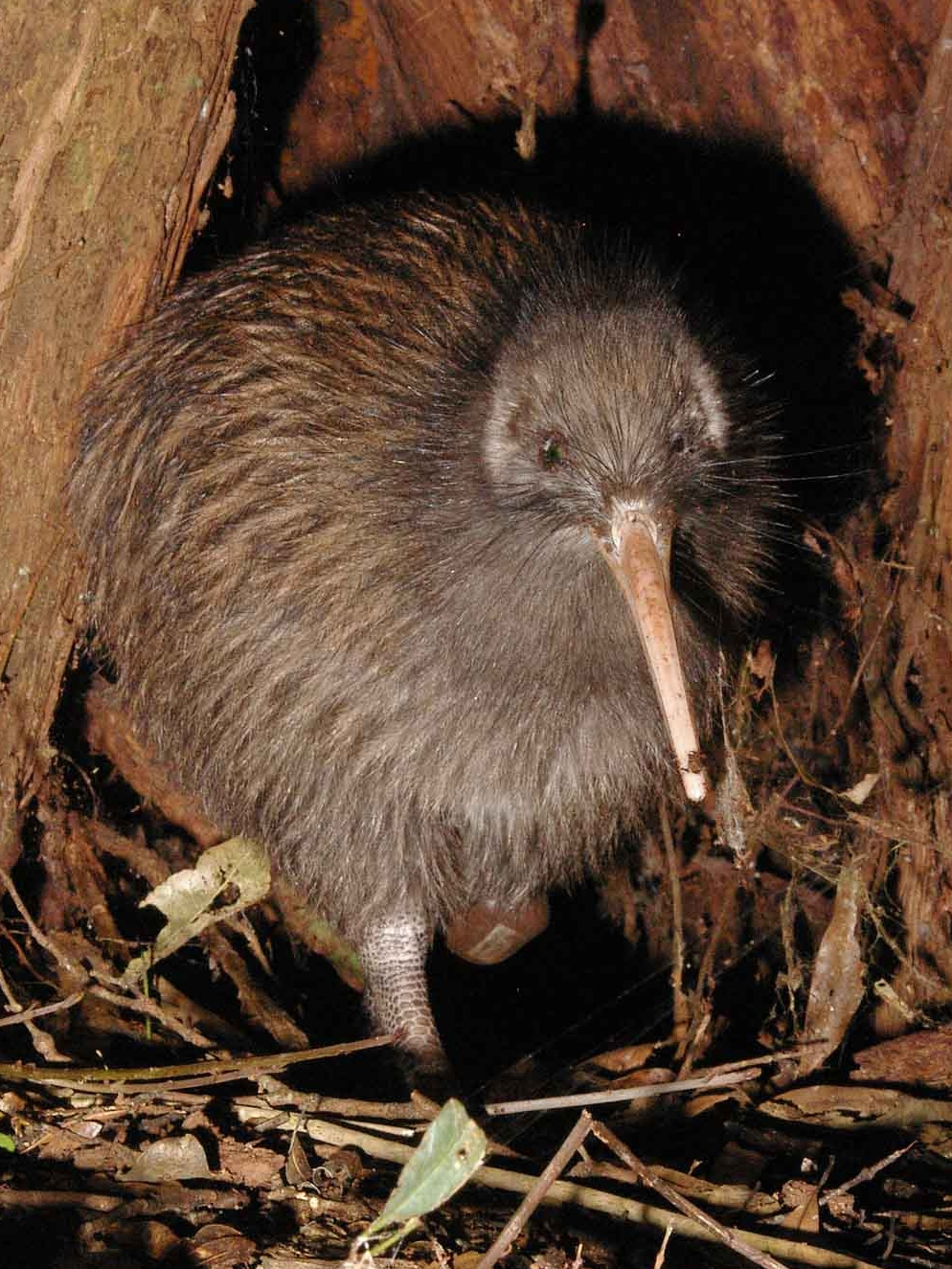
Photo: Male North Island brown kiwi bird, sitting in its nest.
Credit: Maungatautari Ecological Island Trust, Public domain, via Wikimedia Commons

