Evan McGuire
If you live near Live Oak trees, you will often see plants like Spanish moss or lichens growing on them. You might also see ferns growing on them. The resurrection fern (Pleopeltis michauxiana) is a common fern that you will see growing on other trees in the Southeastern US. Though the resurrection fern can grow on any suitable surface, it is often seen on Live Oaks.
The resurrection fern is an epiphyte, meaning that it grows on other plants or surfaces instead of rooting into soil or another substrate. Some epiphytes that you may have heard of include bromeliads, air plants, many orchids, mosses, and other ferns. Epiphytes acquire water and nutrients from the air, typically using some kind of precipitation like rain or fog.
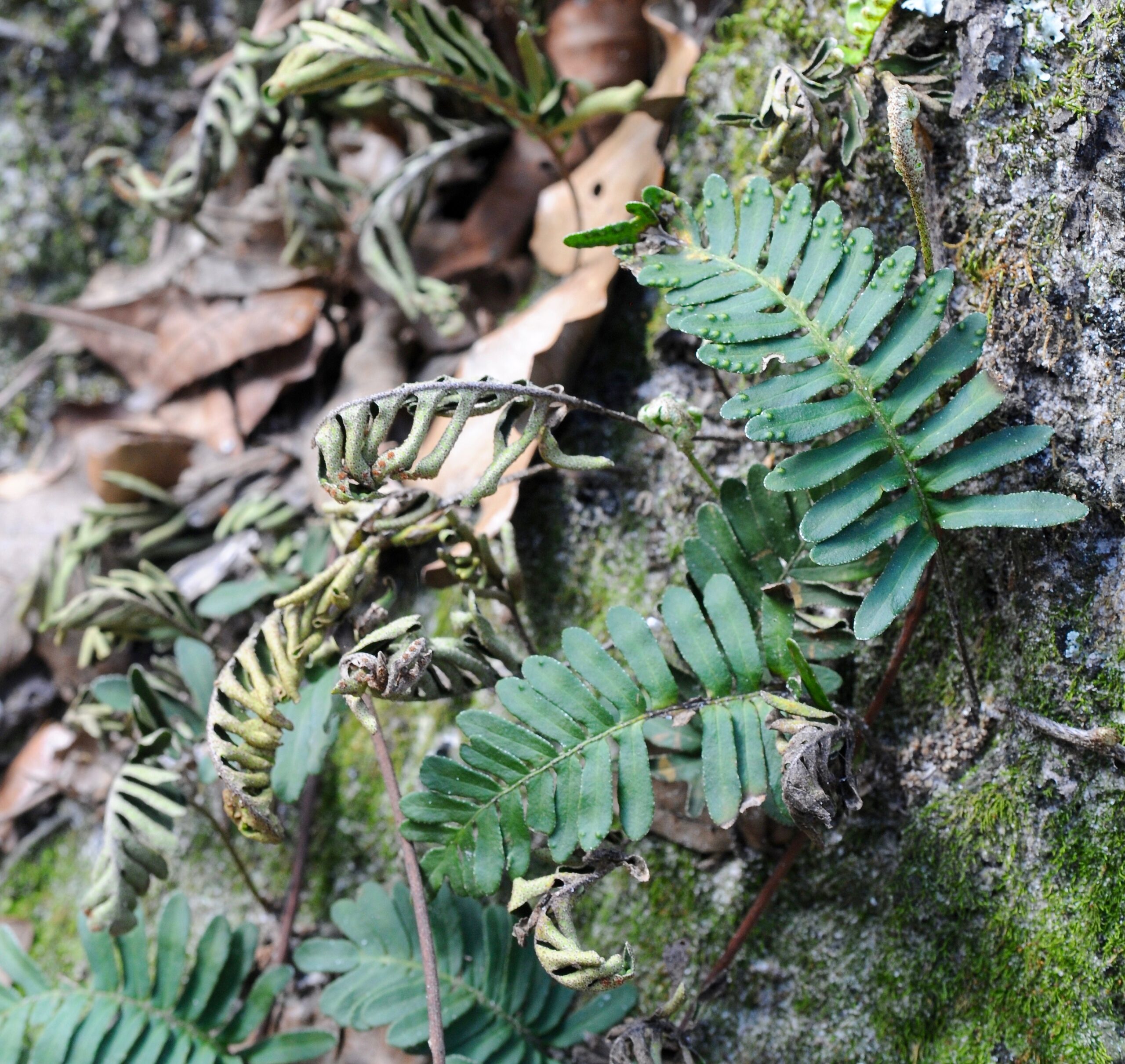
The resurrection fern is special because it can lose up to 95% of its water content and still survive. Often, in drier parts of the year, it will look shriveled up and nearly dead. But after a good rain, it will bounce back and look lush and green. This is similar to how many tropical seasonal forests will have a dry season and a wet season where plants will lose their leaves in the dry season and regain them during the wet season. Many mosses have a similar property where they can lose a large portion of their water content and dry out, but then bounce back the next time it rains.
Being a fern (Polypodiopsida) means that instead of growing fruits with seeds like fruiting plants (Angiosperms) or plants that grow cones or scales with seeds (Gymnosperms), the resurrection ferns grow spores to reproduce. The spores are often visible at the right time of year on the backs of the leaves of the fern in little round orange clumps.
On the plant family tree, ferns represent a group in between the most primitive plants that are not vascularized and cannot send water and nutrients throughout the body of the plant, like liverworts and mosses, and the more recently evolved gymnosperms and angiosperms that have complex seed structures.
The resurrection fern grows by rhizome, which means that it sends shoots to grow new portions of the same plant. A rhizome is just a modified root structure that can grow more of the same plant, the largest organism in the world is a colony of rhizomal grown aspen trees, often known as “Pando.” Many plants can do this, such as bamboo, ginger, and many of your lawn grasses. Often, introduced species of plants from other continents that can grow by rhizome become invasive, because of their ability to keep growing despite a lack of suitable reproductive partners.
The resurrection fern isn’t very picky about where it grows, thriving even after the tree it was growing on falls or dies. They can come back from almost being dead after losing nearly all of their water, making their survival even more impressive. The next time you’re outside on Upper Texas Coast, look up and try to spot one of these determined and persistent plants.
Photo credit: sonnia hill, CC BY 2.0 <https://creativecommons.org/licenses/by/2.0>, via Wikimedia Commons
Photo caption: Resurrection Fern

