
Hailey Burrow
Almost everyone is familiar with Haliaeetus leucocephalus, otherwise known as the Bald Eagle. They are our national symbol and one of the greatest success stories in conservation history after they were brought back from the brink of extinction. As these birds continue returning to their original range, more and more people are seeing these birds in person for the first time and are becoming more invested in their lives.
At five years old, Bald Eagles reach adulthood and are ready to begin searching for a mate. When a pair is interested in each other they will perform a courtship display involving aerial acrobatics known as the death spiral. The two will soar to dizzying altitudes before locking talons with each other and freefalling together, somersaulting towards the ground. If all goes well and the female is impressed by the male’s performance, the two will separate before they hit the ground. Luckily, most eagles will only need to partake in this high-stakes first date once in their life. Bald Eagles will typically mate for life, however if one partner dies (or they are simply not doing their part around the nest) the other will seek out a new mate.
Building the nest is also no small undertaking. Bald Eagles build exceptionally large nests, and even hold the record for the world’s largest bird nest ever recorded at over nine feet wide, twenty feet deep, and estimated to weigh over two tons. These hefty nests can take up to three months to make, and are built with the combined effort of the male and female eagle, typically at the tops of tall coniferous trees. Most eagles will return to the same nest year after year, and will continue adding onto it when the pair reunites at the nest each season.
When the nest is ready, the female can begin laying her eggs; she can lay up to four eggs, but two or three is the most common number. It takes a little over a month for the eggs to incubate and hatch into hungry little eaglets. For the first couple of weeks, one parent, usually the female, will stay with the newly hatched babies while the male hunts for them. But after those first weeks the female will starts hunting as well once the eaglets are able to start feeding themselves.
Unlike some other bird species, Bald Eagles won’t regurgitate food for their young, but they will help rip their food (usually fish) into smaller pieces and feed it to the chicks when they are too young to do so themselves. Parents will typically feed the largest chick first as they have the greatest chances of survival long term, but if there is not enough food to go around this chick may be the only one who survives to adulthood. Food scarcity isn’t the only threat eaglets: things like other birds of prey or storms can also cause nests to fail.
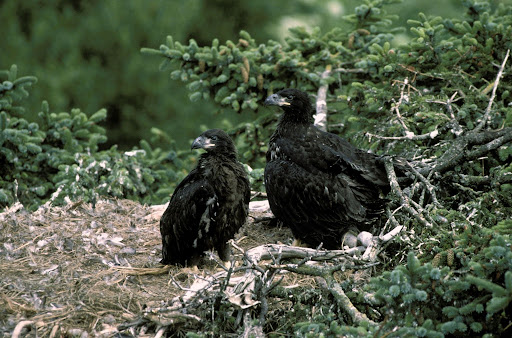
If all goes well the little eaglets won’t stay little for very long. It only takes about three months for Bald Eagles to replace all their gray down feathers with dark brown flight feathers and grow to their full size. At this age the young eagles will begin exploring outside the nest, branching and taking small flights. In just a month or two these Bald Eagles will be ready to leave the nest for good and seek out their own territory, and in five years, they’ll be ready to start this process all over again with young of their own.
Photo: Two fledgling Bald Eagles in the nest
Credit: David Menke, Public domain, via Wikimedia Commons
Hailey Burrows is a biology intern at Gulf Coast Bird Observatory, a non-profit organization dedicated to saving the birds and their habitats along the entire Gulf Coast and beyond into their Central and South America wintering grounds.

