By Hannah Beckett
Did you know that there are sirens living in Texas? No, not the ones from Greek mythology, but amphibians! These animals are aquatic, mysterious, and vocal, earning them the name of “siren” for all species within the family Sirenidae. Of the many siren species in North America, the Rio Grande Siren (Siren texana) is unique to Texas and Mexico.
Considered a type of salamander, sirens are perennibrachiate and neotenic. These scientific terms indicate they retain their external gills and other juvenile features throughout their life, unlike most other amphibians, which lose their gills in adulthood.
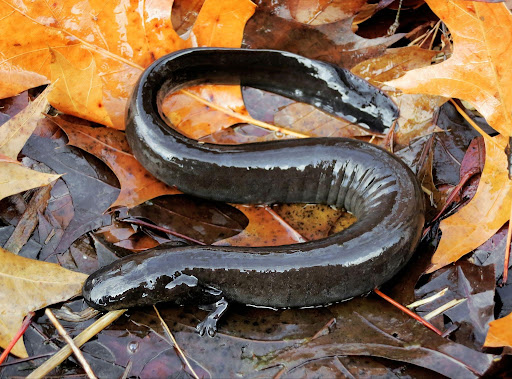
The Rio Grande Siren has a dark gray or black body with a subtle light line along the upper jaw. Some individuals may also have small black dots on their already dark skin. Sirens have tiny front legs and lack not only hind legs, but also a pelvic girdle entirely. Adults reach an average length of up to 27 inches. Male sirens are larger than females and have enlarged jaw muscles, making their heads appear larger than their female counterparts.
Rio Grande Sirens live permanently in densely vegetated waters such as bayous, marshes, and ditches in the southern part of Texas. Since they respire through their gills, lungs and skin, they survive well in the often hypoxic environments low in oxygen. Shallow bodies of water that the Rio Grande Siren calls home are prone to drying out during summer months.
Sirens use “aestivation”, or summer dormancy, to withstand the rigors of these dry seasons. They burrow into the mud and secrete a mucous cocoon to reduce dehydration. Respiration and heart rate slow significantly and their gills atrophy, which allows them to withstand long periods without water or sustenance. In this way, the Rio Grange Siren is able to survive aestivation for several months and some individuals have even aestivated for up to 2 years! With the return of water, the sirens become active within a day. However, it will take several weeks for the siren to regain its pre-aestivation metabolic rates and weight.
Rio Grande Sirens have poor eyesight and rely on other senses to forage. They use chemical cues to hunt through the murky waters and dense vegetation for their food. The Rio Grande Siren is primarily carnivorous and preys on crustaceans, insects, worms, snails, amphibians, and other small prey. Some algae and plant material may also be ingested due to their feeding method of gulping large quantities of material.
Unlike other salamander species, sirens are very vocal. They can produce various noises such as clicks and yelps. The tendency to click is greater in groups which suggests there maybe communications between sirens. Resting sirens are usually silent but may produce trains of pulsed clicks. Sirens will also yelp in cases of distress or alarm. When sirens butt or bite each other, the bitten or injured individuals may swim away quickly, emitting yelps at frequencies of 880 Hz. These yelp sounds could have communicational significance if they prevent further attack or signal to other individuals that one is injured. They will also emit a very shrill call when approached or attacked by a predator.
Some controversy surrounds the Rio Grande Siren on its standing in the phylogeny. Researchers disagree on whether the Rio Grande Siren is its own species or a subspecies of either Lesser Sirens (S. intermedia) or Greater Sirens (S. lacertina). More research is required to know the full narrative of these seldom seen and often forgotten eel-like denizens of the slow, muddy waters of Texas.
Photo: Sirens are aquatic, mysterious, and vocal, just like the ones in mythology
Credit: Peter Paplanus from St. Louis, Missouri, CC BY 2.0 <https://creativecommons.org/licenses/by/2.0>, via Wikimedia Commons

