By Celeste Silling
Above a coastal prairie, a bird hovers as if tied to a string. This bird is called a Kite, named for the way it stays in place in the sky as it hunts for prey. Here in Texas, we have three main species of Kite: the Mississippi Kite, the Swallow-tailed Kite, and the White-tailed Kite. All three of these birds exhibit the kite-like flying behavior, and all three are gorgeous birds.
The Mississippi Kite is a small, gray raptor, with a sleek and angular silhouette in flight. Its face is quite distinct, with a dark red eye lined with black. They winter in South America and breed here in the U.S., including the Upper Texas Coast. I have seen them flying over Lake Jackson and Clute, and some even nest in trees in residential neighborhoods. They feed on insects, rodents, bats, small reptiles and other birds. While they do exhibit the kite-flying behavior while hunting, I have most often noticed them as they swoop to catch prey, sometimes even taking a nibble in midair.
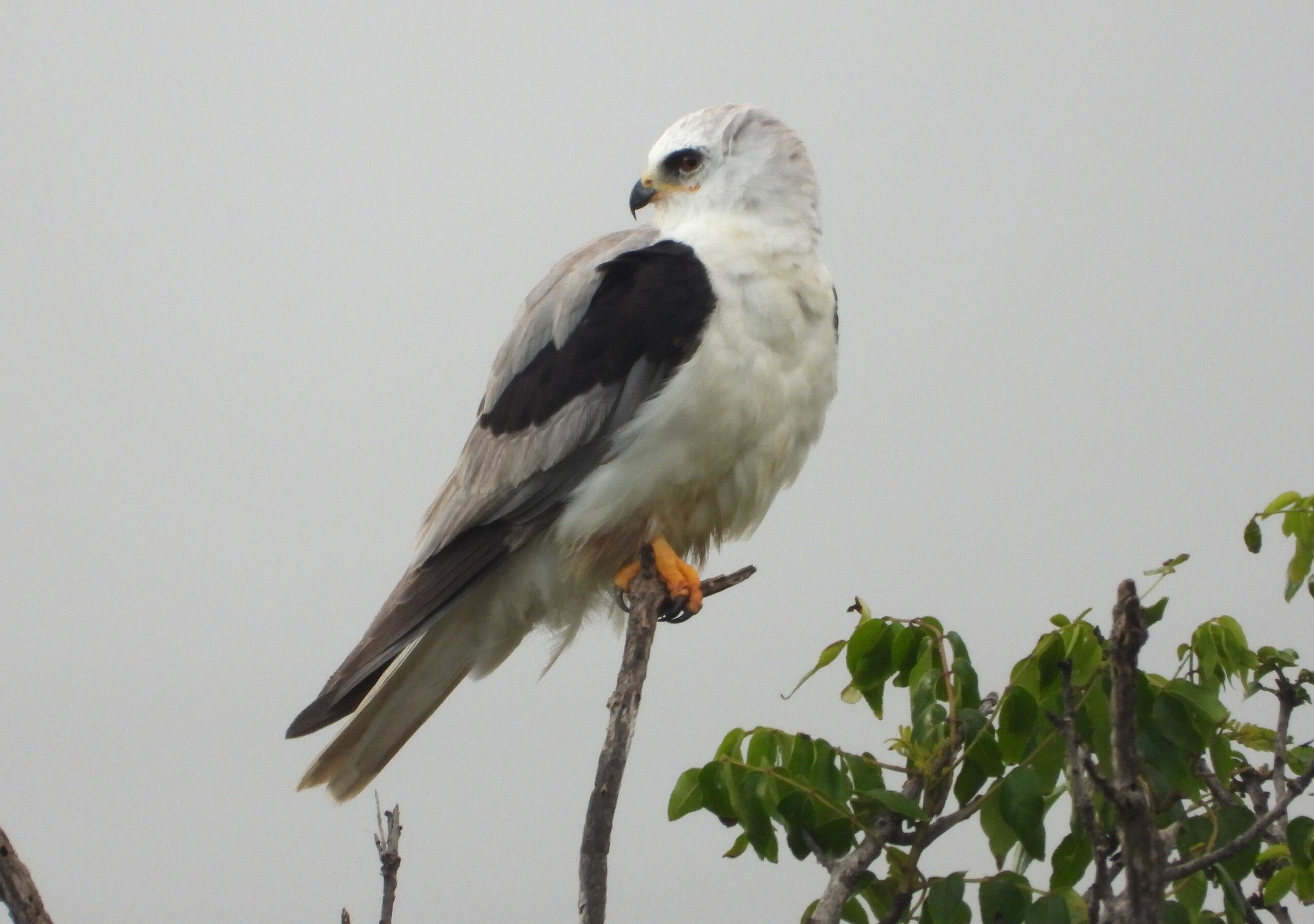
The White-tailed Kite is a similar size to the Mississippi, but with white feathers instead of gray. It’s wing-tips are dark in flight, and it looks very sleek and sophisticated (in my opinion) as it soars. Bright red eyes stand out starkly against white feathers, lined with black. These birds tend to prefer grasslands and marshes, and I see them most often along Bluewater Highway on Follet’s Island. White-tailed Kites aren’t migratory, unlike the Mississippi and Swallow-tailed Kites, so you can see them year-round here. I usually see them perched up, resting, or hovering in search of small mammals to eat.
Finally, the Swallow-tailed Kite is perhaps the most distinctive of the bunch. As you might guess, it has a long, forked tail that splays out beautifully in flight. Its body is white, like the White-tailed, but there’s no mistaking them with those tail feathers. Unlike the other two, the Swallow-tailed Kite has small dark eyes, which kind of remind me of those on a Beanie-baby. We don’t see White-tailed Kites around the Upper Texas Coast much, but they travel through here during migration. They nest in the South-Eastern U.S., from Louisiana to Georgia, and winter in South America. If you want to see them here, keep an eye on the skies in the fall. I’ve seen them soaring overhead, along with Mississippi Kites over Lake Jackson.
I’ve been lucky enough to see several Kites the past few weeks, and I’m always happy when I spot them. Keep an eye on the sky and hopefully you’ll see them too!
Photo: White-tailed Kite
Credit: Celeste Silling

