By Rebecca Bracken
Let’s talk hawks! No, not the Atlanta Hawks basketball team or the Seattle Seahawks football team, but the amazing birds flying overhead each fall. Watching birds migrate through our area is an exciting moment, but seeing a large swirling kettle (flock) of these migrants circling through the sky is a spectacle that can’t be missed.
Hawks nest high up in neighborhoods or in singular trees in fields, so observing them can be tricky. But once their young fledge and start venturing out on their own, watching them can get a bit easier. Fall is by far the best time of year here in the US to observe hawks, eagles, falcons, and other birds of prey. Millions of individual birds start their yearly journey south for the winter, in search of better food supplies.
Many songbirds and other bird species migrate at night, moving under the cover of darkness and using the stars to navigate over large expanses of water. But raptors migrate during the day and generally soar over land. This is because they use thermals, rising currents of air, to help them gain lift without having to spend energy flapping their wings. This provides us as bird enthusiasts a chance to observe them during these months long travels.
Here in Texas, we have only a handful of hawks during the summer months. But come fall, we are lucky enough to observe many more species. Birds like Broad-winged Hawks that breed largely in the eastern US and into the southern portions of Canada, pass through coastal Texas en masse each fall. Others, like the Sharp-shinned Hawk, come through Texas after breeding in largely Canada and Alaska, and may even spend the winter with us. The Swainson’s Hawk, a western US breeder, passes through on its way to vast pampas grasslands in Argentina, undertaking one of the longest migrations of any American raptor.
Each of these species is unique, with different habits and characteristics that can help us spot them in the skies. But each also faces challenges along their chosen route. When we think about what can affect hawks during their flights south, we commonly think about land-based changes. As coastal areas become more and more developed, raptors may have a harder time finding food. Declining insect and rodent populations in many areas may lead to an inability to find adequate food sources during their arduous journey. But the weather during the fall may play an even more important role.
Migration requires immense physical exertion. During fall migration, raptors rely on thermals and ridge updrafts for soaring. If the conditions are poor, with unfavorable wind directions and few thermals because of the air temperatures or sun exposure, hawks have to spend more time flapping and may become exhausted more quickly as their energy stores are rapidly depleted.
To help our feathered friends during the southward migration, we can drive cautiously near open fields where hawks might be hunting, and use window markers to help reduce window collisions. Remember to secure your trash and waste, and not litter our highways, to prevent small mammals and other rodents from scavenging, which in turn can lead to vehicle-hawk collisions.
At the same time, be sure to pop in on your local hawk watch! If you’re in the greater Houston area, please join us out at the Smith Point Hawk Watch sometime this fall. Gulf Coast Bird Observatory will be counting migratory hawks as they pass by, contributing to a long term, nationwide dataset that helps researchers working to conserve our amazing raptors. The hawk watch runs August 15th through the end of November, with the best times to observe hawks often occurring in mid to late September and early October. Want to learn more? Check out gcbo.org for more hawk fun!
Photo: Tony Leukering
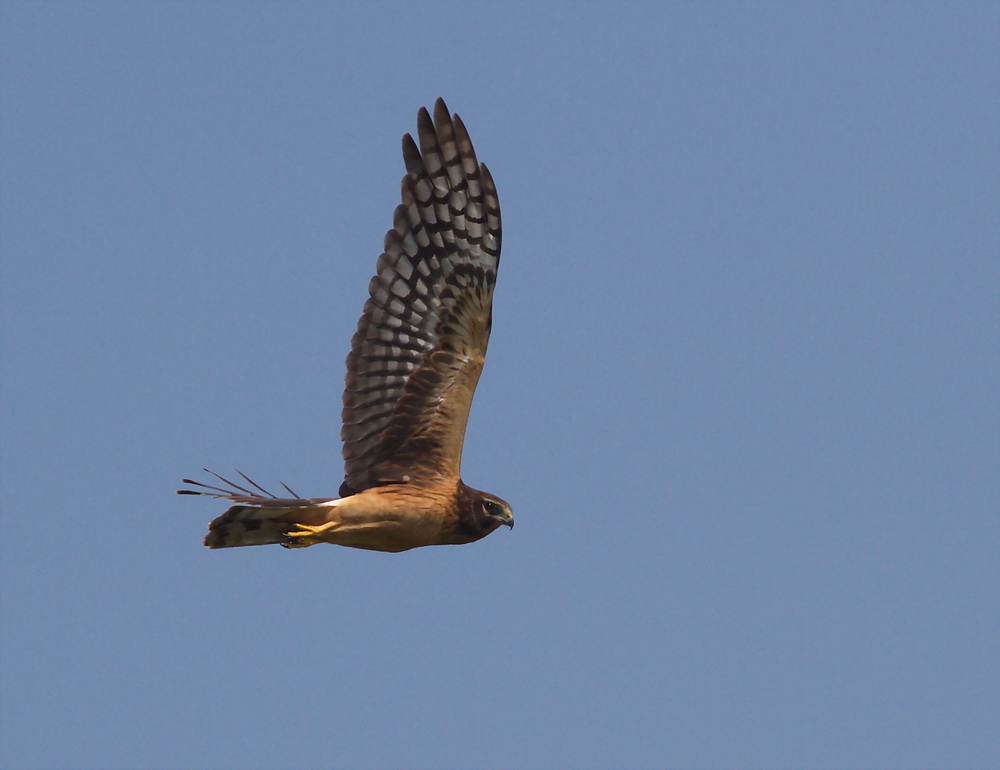
Caption: A Northern Harrier soars by Smith Point Hawk Watch

