By Hannah Beckett
I’ve heard the saying “All toads are frogs, but not all frogs are toads.” This phrase can be a mind twister until you concentrate on the meaning behind it. Both frogs and toads are amphibians in the order Anura and are referred to as anurans. All members of this order are considered frogs. So, in essence, toad is a classification of frog.
Anurans are broken down phylogenetically into separate families. Members of the Ranidae family are considered to be true frogs, whereas members of the Bufonidae family are referred to as true toads. Other families of frogs and toads exist, but these two classifications hold the majority of anurans. While there are many similarities between frogs and toads, the differences often become obvious when you know what to look for.
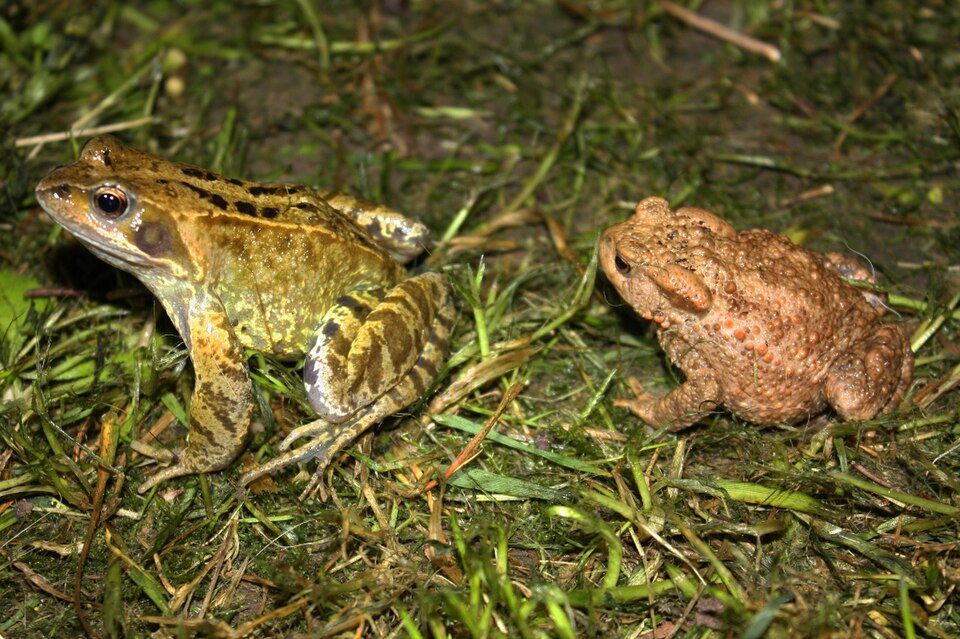
One of the best ways to tell if the difference between a frog and a toad is their skin. Frogs have smooth and slimy skin. It is thin and permeable, allowing them to absorb water and oxygen directly through their skin. For the absorption to occur, they must stay moist. This is why we often see frogs in or very near a water source. A layer of mucus helps them keep their skin moist and gives them that slimy feeling. On the other hand, toads have a thicker, bumpy skin. This thick, dry skin helps them retain water in the dry terrestrial habitats they call home.
The structure of their legs also differs. Frogs typically have long, muscular hind legs that allow them to leap long distances compared to their size. Those legs also aid them in navigating under the water. Toads have a squatty build with short hind legs better suited for walking or short hops. When approached, frogs are more likely to leap into the water, while toads are more likely to sit still and wait for the danger to pass.
While not an outwardly noticeable difference, the most significant differentiation between frogs and toads is their toxicity. All toads are naturally poisonous, while frogs are not. Even poison dart frogs do not produce their own natural poison, instead using toxins found in the insects they eat in the wild. Toads possess a special gland called a parotoid gland behind their eyes that secretes toxins. These toxins permeate their skin and act as a predator deterrent. This is why some animals’ mouths will foam when they try to bite a toad.
Despite their differences, both frogs and toads face habitat loss through both urban development and the pollution of their habitats. Anurans are important indicator species. Their presence and health indicate an ecosystem’s health. They can’t live in polluted habitats and are sensitive to changes in their environment. The presence of frogs or toads is a sign the habitat is healthy, while a sudden change in their presence can indicate the area has become polluted.
One way to help protect these amphibians is to make space for them in our yards and community green spaces. For example, you can place flowerpots or slabs of tree bark in shaded, mulched areas to create a moist daytime refuge for the amphibians.
Photo: European Common Frog (Rana temporaria) & European Toad (Bufo bufo)Credit: Thomas Brown, Public Domain, via Wikimedia Commons

