By Celeste Silling
When I first moved to Texas, I was given some misinformation that I maintained as factual in my head up until writing this article. The beautiful bright green and brown anoles, I was told, were invasive. Even believing this, I still though they were charming little animals and very exciting to look at. So, as you can imagine, I was very happy to learn that the Green Anole is, in fact, actually native to our area!
The Green Anole, Anolis carolinensis, is a small lizard in the anole family. It is native to the Southeastern United States and can be found quite commonly on the Upper Texas Coast. Identification of this species can get a bit tricky because they are able to change the color of their skin from a bright, vibrant green to a more discreet brown. The Green Anole (which turns out to be a misnomer half the time) changes color depending on their mood, activity level, and temperature.
The Green Anole’s ability to turn brown often gets it confused with the Brown Anole, an anole of similar size and shape with brown coloring. The Brown Anole, or Cuban Brown Anole, Anolis sagrei is native to Cuba, the Bahamas, Little Cayman and various other locations in Central America. This species is invasive in Texas and is likely the source of the false accusations against the Green Anole.
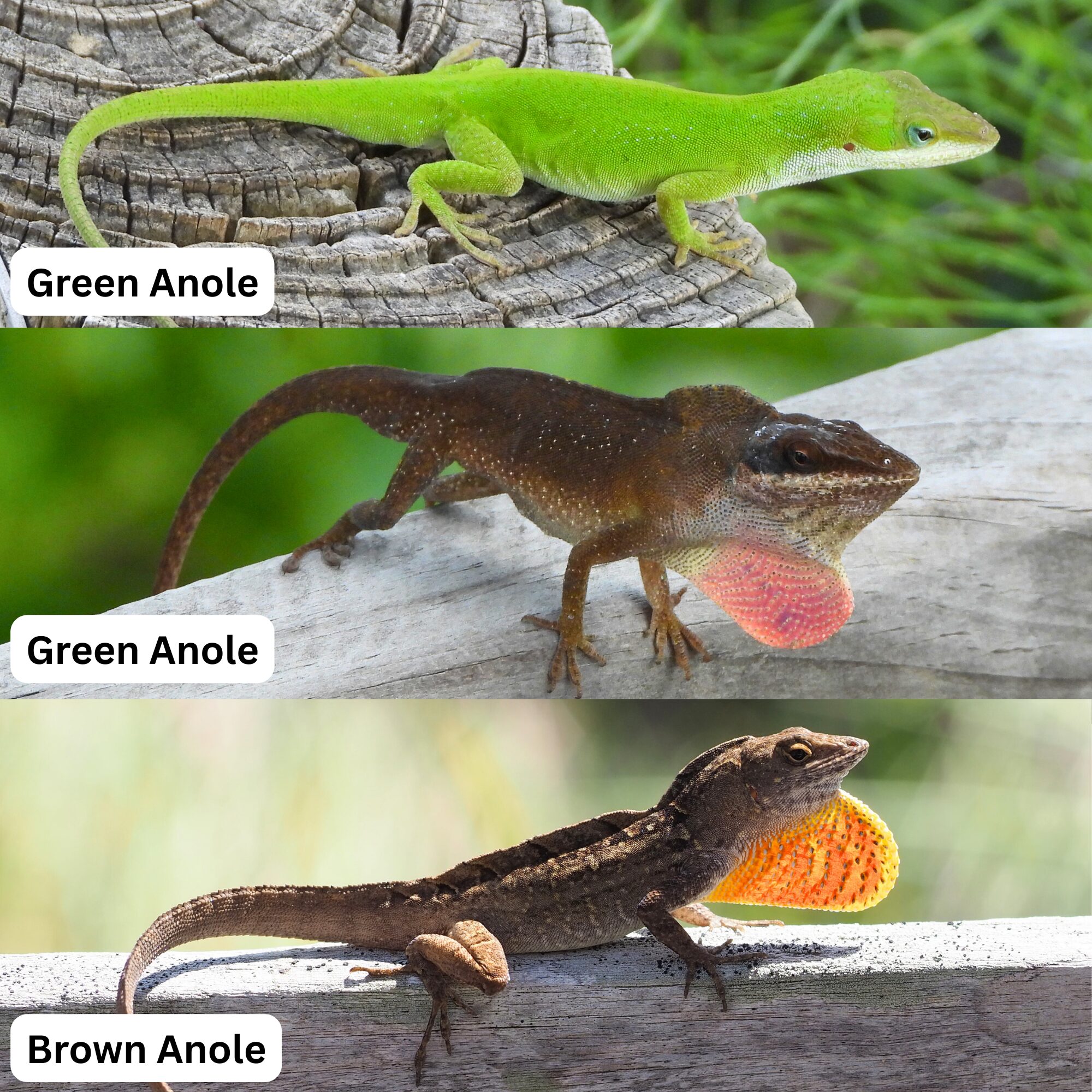
You can tell the Green Anole from the Cuban Brown Anole in a few different ways. First, the Green anole can turn brown, but the Brown Anole cannot turn green. So, if you see a vibrant green, or even a somewhat green, anole, you’re in the clear.
It gets a bit harder when the Green Anole in brown. The Brown Anoles often have intricate patterns on their skin, such as stripes or spots, spots in lighter or darker brown. The Green Anoles lack these patterns, though they do have some texture and freckles. Females of both species tend to have a light-colored stripe running down their backs. Green anoles have a longer snout than Brown anoles, and male Greens have a pink dewlap (throat skin flap) while male Browns have an orange one.
The dewlap can be a method of communication to competing anoles or other interlopers. When male anoles feel threatened or aggressive, they can open and close their pink dewlap in a menacing way. They can also bob up and down, doing pushups, and glaring. This posturing helps the males defend their territories from each other and can also get the attention of the female anoles as well myself and other nature lovers.
Despite their intimidating pushups, Green Anoles are entirely harmless to humans. They eat insects, including cockroaches, and are an important source of food for native birds. Overall, I am very happy to be able to clear the Green Anole’s name. Though it’s commonly mislabeled as an invasive species or a pest, the Green Anole is an important and endearing part of our Texas Ecosystem.
Photo caption: Top: A green Green Anole. Middle: A brown Green Anole. Bottom: A Brown Anole
Photo credit: Top and Middle: Celeste Silling. Bottom: Zygy, CC0, via Wikimedia Commons

