By: Ashley Van Wieren
When we think of different species interacting in nature, we might tend to think of predators and prey. But there are many other connections in our ecosystems that go beyond that. As organisms evolve in close proximity to each other over time, they can form close relationships that benefit one or more parties; this is called symbiosis.
There are three major types of symbiotic relationships. These types are mutualism (where both species benefit), commensalism (where one species benefits and the other is neither positively or negatively affected) and parasitism (where one species benefits at the expense of its host). Animals, plants, fungi, bacteria, and viruses can all have symbiotic relationships with each other. Let’s explore the ways that birds exhibit each of the three basic types of symbiotic relationships.
What does a crocodile that’s not afraid of the dentist, and a bird that’s not afraid of a crocodile have in common? A mutualistic relationship! In possibly one of the most daring displays of symbiosis, the Egyptian Plover can be spotted in the mouth of a Nile Crocodile, pecking at its teeth. The secret to this stunt is that the Egyptian plover picks out meat that has been stuck in the carnivorous crocodile’s teeth. This provides food for the plover, and a much-needed dental cleaning for the crocodile. After all, who would turn down a free trip to the dentist? This mutualistic behavior benefits both species.
Commensalism can be found in neotropical forests in Central and South America as army ants storm the forest floor. Nearby small invertebrates flee the approaching swarm. This gives several species of antbird, an ant-following specialist, a chance to swoop in and catch the prey being flushed out. Some ant-following flocks rely only somewhat on the ants, doing some hunting on their own, while others rely completely on the insects. The relationship between army ants and ant-following birds is an example of commensalism. This is because the birds benefit with a range of tasty forest meals, whereas the army ants are neither harmed nor benefited.
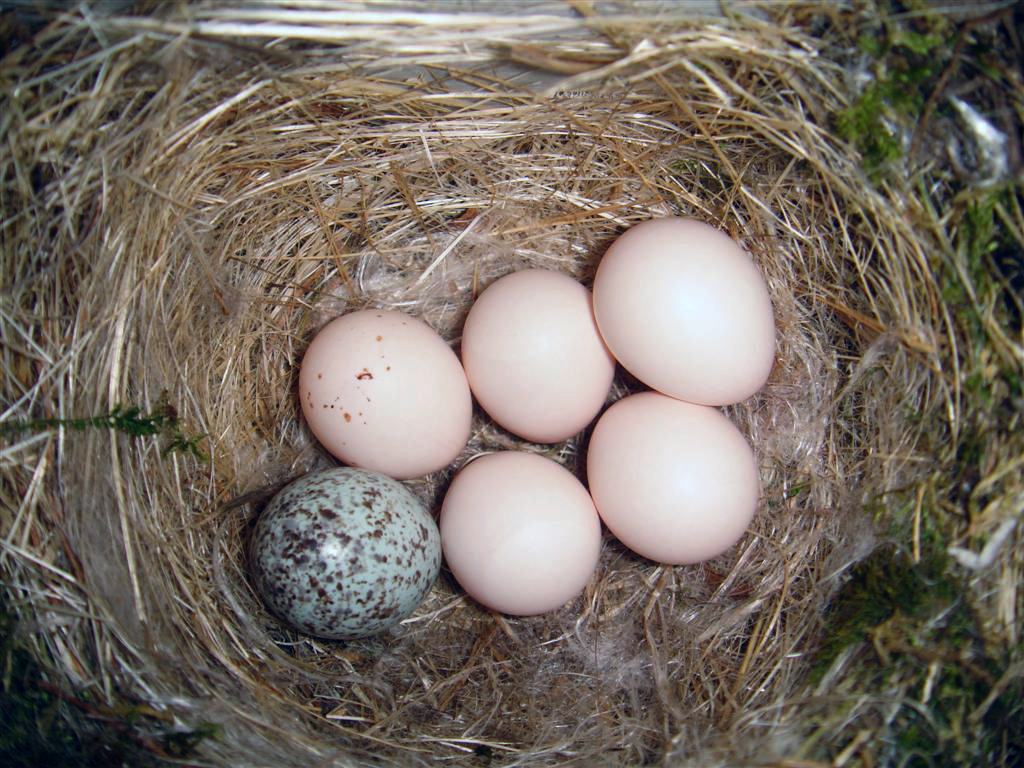
What is the first thing that comes to mind when we think of parasitism? Perhaps external parasites like fleas or ticks, or maybe an internal parasite like roundworms? It may come as a surprise that birds can be parasites too. Brown-headed cowbirds (Molothrus ater) and Common cuckoo birds (Cuculus canorus) are brood parasites.
A boord parasite is a bird that lays its eggs in the nests of other bird species. The other bird species, called a host, then raises these eggs and chicks. The brown-headed cowbirds and common cuckoos benefit from this relationship by saving time and energy that would normally be spent on child rearing. The host bird is negatively affected by having its time and energy spent raising another chick rather than being able to dedicate its full care to its own offspring.
Birds such as the Egyptian plover, antbirds, and brown-headed cowbirds show us that interspecies relationships can be beneficial or harmful and much more complicated than you might expect!
Source: Wikimedia commons, contributed by: Galawebdesign
Caption: Eastern phoebe (Sayornis phoebe) nest with a brown-headed (Molothrus ater) cowbird egg (bottom left).

