
By Richard Tew/Contributing Writer For The Post Newspaper
For roughly forty years, select Irish dance schools from around the state of Texas have had competitions to attend. For the first time, Irish dance competitions were opened up to all Irish dancers in the state last weekend in the city of Pflugerville, located just north of Austin.
Irish dancing had meager origins. It started at the small crossroads near the entrance of the small villages that dotted the Emerald Isle, Dancers from the local village would perform during social events. Local traveling dance masters would ply their trade in local communities, often trading classes to local students for a few meals and lodging in a host family’s barn.
These intenerate dance masters had territories which would at times would intersect with another dance master’s area. Sometimes a competition between these dance masters ensued, with the winner taking over additional territory. This would eventually give rise to the competitive nature of the folk-dance form.
Over time, as Irish dance developed, the traveling began to slow down as dance masters solidified their classes in local villages creating the students and teachers of the future.
Fast forward to the 20th century and a rebirth of all things Irish in Ireland. An organization was born in Ireland in 1931 called “An Coimisiún le Rincí Gaelacha.” In English, the Irish dancing commission. They were established by the “Gaelic League” to develop and format Irish dance giving it new legs. In time, books of official dances which had been taught and performed across Ireland for centuries was created to document traditional dances from a region. A system of teacher certifications would come nearly twenty years later though not widely adopted for another couple of decades.
Over time, as the organization began to formalize and grow around the world, it closed ranks, only allowing members who sat the organization’s teachers’ exam entry into its competitions. Teachers who at one time could enter these competitions known as “feises” (pronounced “fesh”), without official membership were faced with a choice: take the exam or risk not having a venue for their dancers to be evaluated in a competitive environment.
In 1969 a split would occur leading to the formation of a second organization known as “An Chomdhdhail” (pronounced “An Cogal” meaning the congress of Irish dance teachers). Like their forebears, they would also set up processes for teachers to sit exams, become members and participate in their respective feiseanna. A number of organizations would follow including the first organization to be completely open platform to all potential teachers and dancers called “Cumann Rince Nasiunta,” known as “CRN” in 1982. Some organizations allowed their members in one country to participate in open platform events while remaining closed in other countries.
While organizations have been the norm for nearly 100 years, independent teachers, like the original traveling dance masters, also formed their own schools. These teachers continued teaching on their own as teachers have done for hundreds of years, taking the training they received from their teachers and passing it to their students.
While in the early years of Irish dancing teachers and their students to enter any feis they wanted, in the last forty years, the options became only those permitted by a teacher’s organization. In North America, options for both open platform and independent teachers dwindled. While competitions remained, options for open platform dancers still paled in comparison to their closed platform counterparts.
Last December, after about a year of perfecting a motion to be presented to An Coimisiún’s rule makers, the organization decided to let local regional authorities, consisting of several states under its jurisdiction, decide on each feis’ petition for open status. A similar rule existing in the organization’s rules but was limited in application to remote areas of Europe, Asia and South America where schools are rare. The motion was in large part an attempt to curb dwindling numbers of participants in feises in certain regions in the U.S. It would allow schools, not members of the host organization, to enter feises they were not previously allowed to enter. The benefit to the feis was obvious: more dancers compete and more profit to earn from increased attendance. While the host event reaped benefits of attendance, the new participants finally able to gain equal footing amongst their fellow dancers and the experiential benefits competition can bring.
The new rule, still in its infancy, is showing promise with increased growth in dancer participation what is known as the Southern and Western Regions. Thanks to the new rule, dancers who have had few opportunities (if any) to compete now have increased the number of events they can attend, improving their abilities and standards along the way.
Texas’ first adopter of An Coimisiún’s new open platform event was the Inishfree School of Irish Dance, located in San Antonio, Austin and Dallas. Irish dance students from all organizations had the opportunity to enter the “Capital of Texas” and “Live Music Capital” feises last weekend. Dancers from Clear Lake-based Tew Academy of Irish Dance, the Clann Kelly School of Irish Dance in West University, the McTeggart Irish Dancers from The Woodlands and the Cass-Barrington Academy of Irish Dance from Magnolia participated. Dance students from all schools brought home awards for their top placements in each category.
Once there, dancers, young and old enter various dances like reels and jigs and perform in either soft shoe dances or in hard shoes: dance shoes with fiberglass toe pieces and extended heels to make clicking sounds while dancing. The energy is high, the form controlled, the movements lively while performed with precision. Dancers are graded by adjudicators who look for dancing elements like form, execution, timing, crossed legs, turned out feet and pointed toes. Awards are given for the first few placements; rankings for all who participate in teach category which is based on dance type, age and ability. The music, another tradition passed down for centuries, is live and normally consists of an accordion or keyboard player. Sometimes violinists are used but are not as frequent. Costuming can range from sedate to wild to the outsider. Wigs are commonplace but not exclusive; experience and lessons in confidence, discipline, cultural pride and community, priceless.
Next for these dancers will be taking these new experiences and working toward the next competition, refining their skills, learning more about their rich dance culture and sharing with all who watch it along the way.
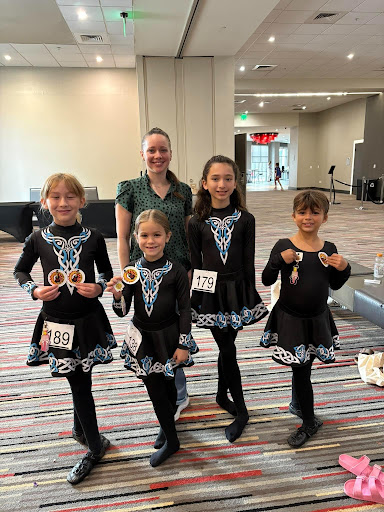
Photo cutline: Last weekend, Clear Lake-based Tew Academy of Irish Dance’s associate Teacher Becca Bryan (back row) traveled with four dancers to Pflugerville, TX for a first-of-its-kind Irish dance competition. Dancers brought back memories, experiences and several awards for their efforts. Note: All participating Irish dance schools in the Houston area were contacted and asked to submit a group photo for this story, no school replied to the request for pictures. Submitted photo for The Post Newspaper.

