
By Ruth Ann Ruiz
The Post Newspaper Features Editor
The United States hosted the G20 Energy Abundance Ministerial Meeting in Houston last week. U.S. Energy Secretary Chris Wright said the three-day meeting represented at least two-thirds of the world’s population.
Ministers and other diplomats from G20 nations in attendance included representatives from Canada, Germany, India, Indonesia, Italy, Japan, Russia and Saudi Arabia. Poland and Venezuela are not G20 members but attended as invited guests of the United States, this year’s G20 president.
On day one, EPA Administrator Lee Zeldin announced the repeal of 2024 greenhouse gas requirements for U.S. power plants put in place under the Biden administration. The repeal is part of President Trump’s plan to expand domestic energy production.
EPA Assistant Administrator for the Office of International and Tribal Affairs Usha-Maria Turner said in a written statement for The Post Newspaper, “EPA’s work at the G20 Energy Abundance Ministerial will foster global action to underpin water and energy security while protecting human health and the environment. Permitting reform is a key goal of this administration and we look forward to working with our international partners to create an environment conducive to developing abundant energy for Americans and citizens of other G20 nations.”
U.S. Secretary of the Interior Doug Burgum, who chairs the National Energy Dominance Council, on the second day of the meeting announced that that Hitachi Energy will invest $528 million to build a new transformer manufacturing facility in Mississippi. This investment combines with previous investments to bring their total to $1.5 billion across the U.S. for producing the needed components for electrical power plants.
“This is bigger than just one factory announcement,” Burgum said. “This is about America’s determination to build the infrastructure to win the intelligence race, to power the next generation of American manufacturing and to bring prosperity and affordability for American citizens for rapidly growing electricity production and to meet growing electricity demand.”
U.S. leaders appeared pleased with the announcement, and Japanese diplomats in attendance seemed to share in the enthusiasm.
Representatives from the attending nations met later in the day to discuss energy security and affordability, key components of the Trump administration’s energy plan. U.S. leaders repeated throughout the meeting that energy must be reliable, affordable and secure, and argued that depending on weather-driven sources or on regions controlled by terrorist groups undermines both goals.
A second day-two announcement involved expanding America’s production of liquefied natural gas (LNG). Houston-based Caturus LLC plans to add five production trains to its Commonwealth LNG facility in Cameron Parish, Louisiana, nearly doubling the facility’s planned output.
U.S. leaders said expanding LNG production will help make energy more secure and affordable for Americans and the world.
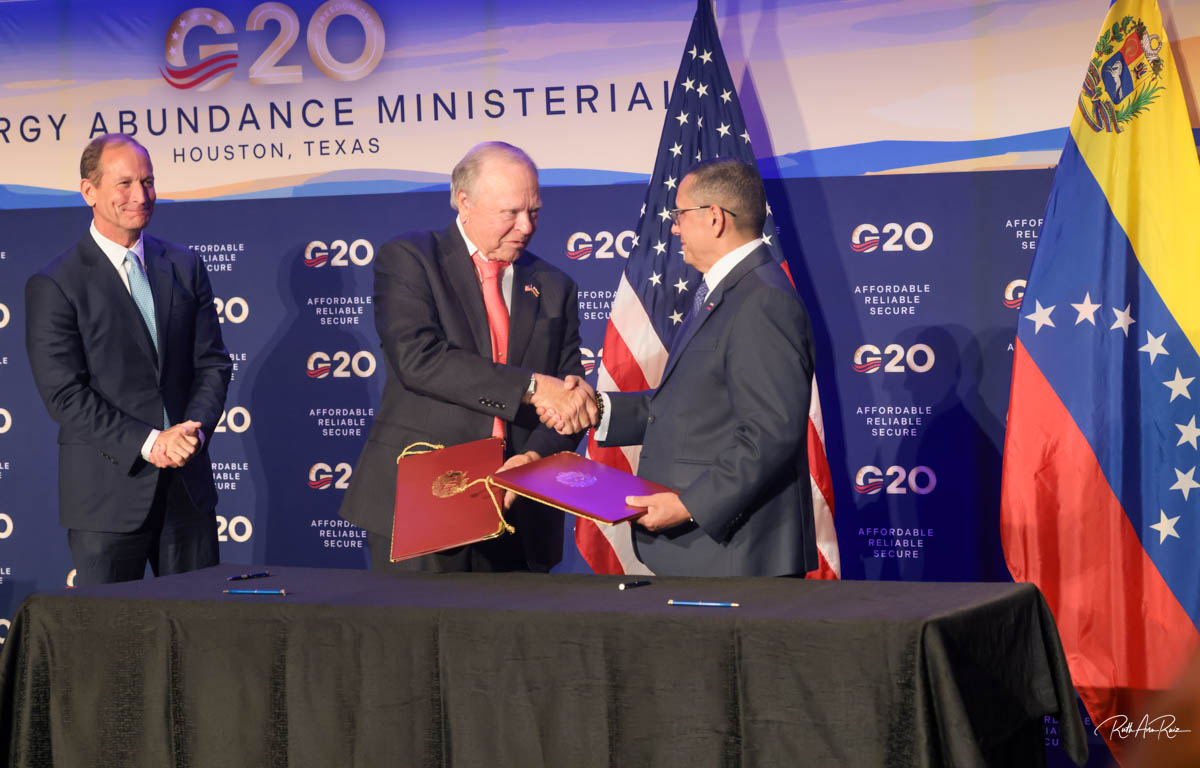
Day three of the meetings brought both the American and Venezuelan flags to the stage. Petróleos de Venezuela, S.A. signed a memorandum of understanding with Continental Resources Inc. to operate and develop the Ayacucho 2 Block in Venezuela’s Orinoco Oil Belt, one of the world’s most prolific oil-producing regions.
Continental Resources, headquartered in Oklahoma City, is the world’s largest privately held oil and natural gas producer. Located north of the Orinoco River in Venezuela’s Anzoátegui state, the Ayacucho 2 Block spans approximately 126,000 acres and holds an estimated 30 billion barrels of resources in place. Once the agreement is finalized, Continental will operate the block with 100% working interest.
“Continental was built to recognize great resource opportunities and have the conviction to pursue them,” said Harold Hamm, founder and chairman emeritus of Continental Resources.
When asked about his confidence in the agreement given the possibility of political change in Venezuela, Hamm said, “We are confident. This means a great deal to them. This is a new day, a new era.”
In closing the Houston meeting, Secretary Wright reminded attendees that President Trump favors commerce over conflict, and that the world benefits from more energy, not less.
U.S. Secretary of the Interior Doug Burgum reflected on the early days of the Alaska pipeline. “Americans built the Alaska pipeline in three years, and it’s now 50 years old,” Burgum said.
“Energy subtraction, in mode and policy, makes your country fragile and drives up gasoline prices,” Burgum said.
U.S. Leaders acknowledged that ongoing conflicts in the Middle East and the war between Ukraine and Russia have strained global energy prices, but expressed confidence that increased production would help stabilize markets.

