By Caleb Clarkson
One of the most satisfying things I’ve experienced during my few years in conservation is seeing a breeding season through from beginning to end. As the first Wilson’s Plovers and Least Terns arrive for the season, the opening pages of a six-month saga begin to unfold. Staking out territory, finding a mate, building a nest, laying eggs, and withstanding the outlandish whims of Texas weather on the Gulf Coast isn’t even the half of it. And sometimes, I immaturely think, “…and for what?”
Then the eggs hatch, and downy chicks scatter across the sunbaked sand. They stress out their parents, who do their best to protect them from the dangers that chicks haven’t the faintest clue about, until the adults are literally panting in the Texas heat. And sometimes, again, I pessimistically think, “what a hassle!”
Not all of the chicks survive, no matter how hard their parents try. But as the Texas heat slowly loosens its grip, the chicks that do survive can fly, find food on their own, and eventually migrate. And they do. Still immaturely, I wonder, “what comes next?!”
Then, when the breeding season comes again the following year, they return to do it all over again, sometimes alongside the chicks from the year before, now fully grown and taking on the role of parents themselves. That is how it has been for countless seasons in the past and, hopefully, how it will remain for countless seasons to come. As with so many things in the natural world, nothing is guaranteed.
And before I know it, I’ve seen the what for and why the hassle. I shouldn’t attribute the human ideal of a life purpose to creatures that are not human, but if we had to identify the closest thing to a “purpose,” it could be found in the theory of evolution. Evolution doesn’t reward happiness or fulfillment. What matters, biologically, is what manages to continue. Pacific salmon that die after completing their journey upstream and spawning might seem unfortunate to us, but from the perspective of natural selection, the important part is that enough offspring survive to carry the process forward. Suddenly, the immense effort required to deliver those eggs safely upstream, exhausting the parent to death in the process, pays off, because something comes after.
Humans sit in a unique position. We have altered ecosystems across the planet on a scale that few other species have. And no other species has developed the same ability to record what happened, pass that knowledge across generations, and build on it over time. Unlike evolution, most humans care about more than simply passing on their genetics. Much of conservation is the continuation of care put forth by the people who came before us, long before conservation even had a name. The earliest conservationists did not begin with nothing.
Understanding the full scope of biological systems takes years, decades, even centuries. Many conservationists begin projects they know will continue long after they are gone. A life’s work in conservation rarely solves every problem afflicting the thing it was devoted to protecting. But that work does not disappear when the person does. The knowledge and determination remain, making whoever picks up where they left off that much more likely to succeed.
The work of a conservationist very rarely belongs to them alone. Weathered and yellowed waterproof journals are left behind, along with Excel sheets that keep growing and growing. Hard-learned lessons from frequent failures are inherited and passed on with new experiences. There is no guarantee that conservationists will succeed, or that the things they fight for will survive. Conservation does not guarantee us a happy ending, and rarely does it ever finish a story. More often than not, conservation requires collaboration not just across regions and groups, but across time. Those in the present add their pages to an ongoing saga that began long before them and will, hopefully, continue long after.
Like the Wilson’s Plovers and Least Terns, perhaps the “what-fors?” and “hassles” of conservation are answered by one strangely comforting question: “What comes next?”
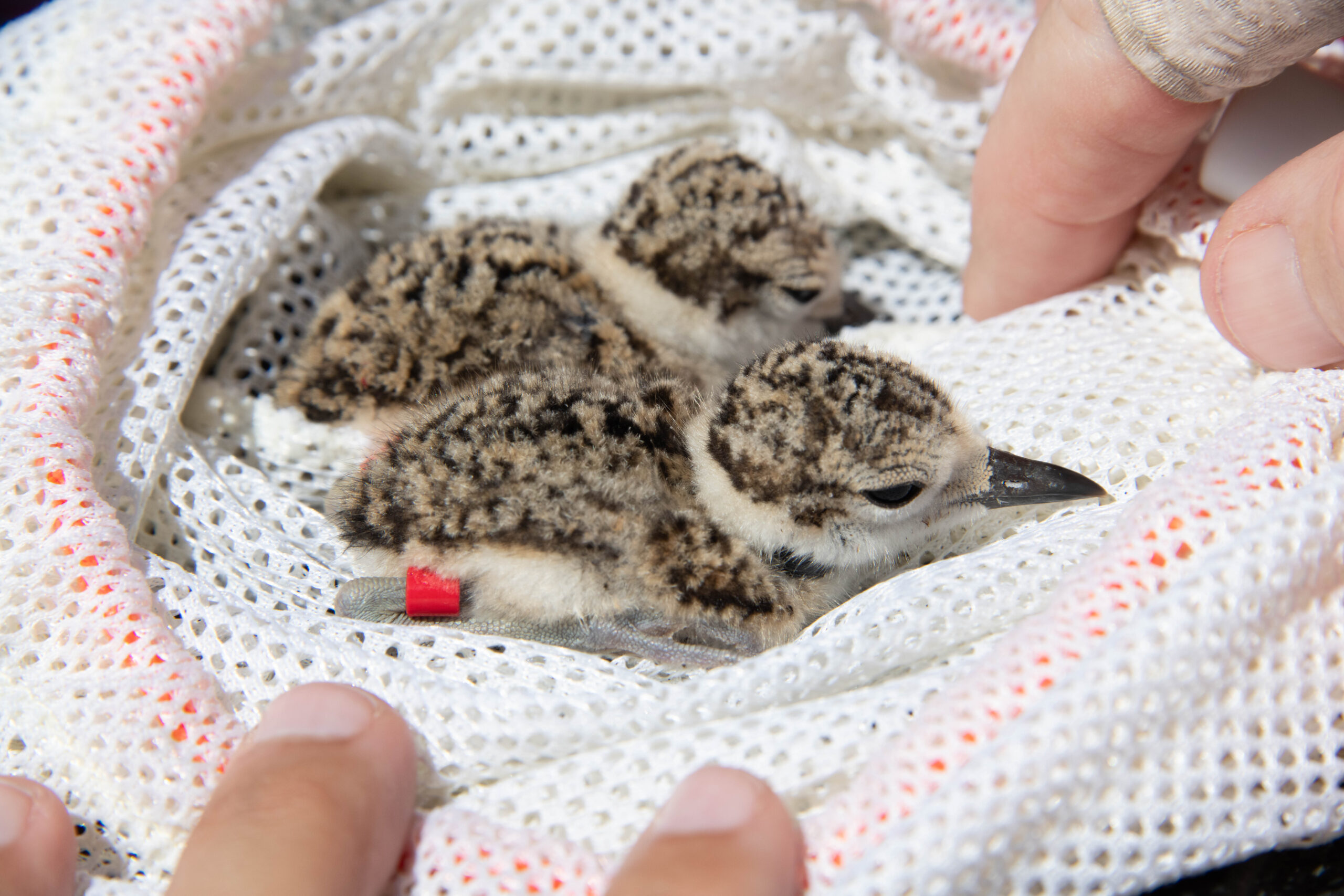
Photo: Two Wilson’s Plover chicks being banded by Gulf Coast Bird Observatory
Credit: Morgan Barnes

