
By Adam Trujillo
Go to any Texas beach and you’re bound to see three things: sand, water, and gulls. Unfortunately, gulls are some of the most difficult birds to identify, and are often overlooked for this reason! In fact, we at Gulf Coast Bird Observatory are hosting a whole class devoted to identifying gulls and terns on the Texas Coast. There’s more variety than you might think!
The first step in identifying gulls is acknowledging a hard fact: there’s no such thing as a seagull. At least not in avian literature. I know media has taught us that the birds at the beach are seagulls, but the proper term is just gulls. Now that that’s covered, we can learn about the gulls and family.
To start, the gulls and terns are in the family Laridae. In this family, we have the gulls, terns, skimmers, and kittiwakes. There are around 100 species that belong to the Laridae family, with around 28 of those species being here in North America. Some of the most common gull species you’ll find here on the Texas Gulf Coast are the Laughing Gull, Herring Gull, and Ring-billed Gull.
Gulls can be tricky to identify because it can take them around four years to grow into their adult plumage. In a breeding adult Laughing Gull, look for a black hood with white eye arcs, gray upper parts, and deep red bill and legs. You can also listen for their laughing type call. In a breeding adult Herring Gull, look for a large gull mixed amongst other gull species, with a yellow bill with a red dot on lower jaw, and dull pink legs. In a breeding Ring-billed Gull, look for a medium-sized gull with a ring around the yellow bill, yellow legs, and pale eye.
Terns are generally smaller and, in my opinion, cuter than the gulls are. The common species you will find here are the Least Tern, Caspian Tern, Forster’s Tern, and Royal Tern. A breeding-age Least Tern is small with gray upper parts, white underparts, black cap, and a yellow bill. In a breeding Caspian, look for a large tern with a distinctive thick, bright-red bill often with dark marks towards the tip, black cap, and black wing tips.
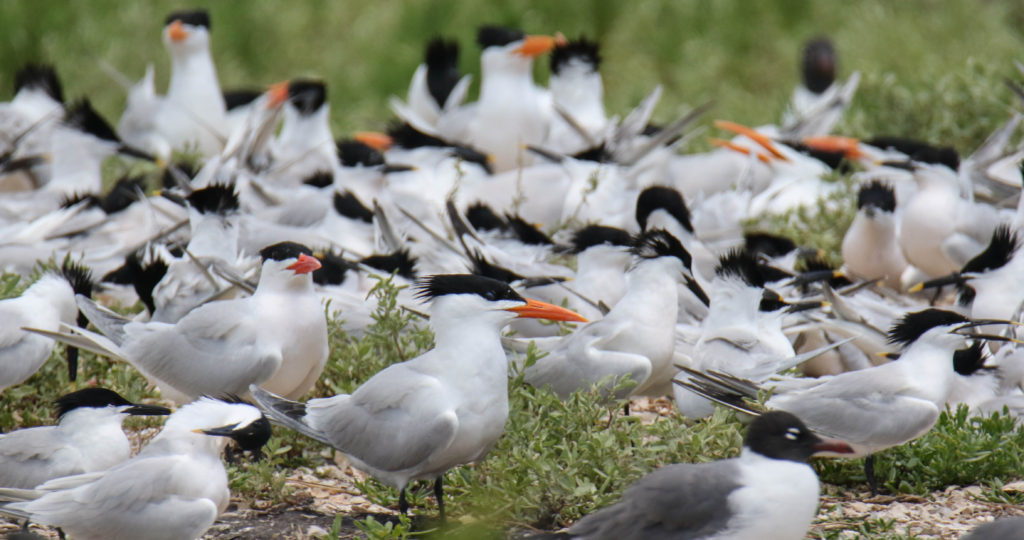
In a breeding Forster’s, look for a medium-sized tern with pale whitish wings, black-tipped orange bill, black cap, and a forked tail. And in a breeding Royal, look for a large tern, slightly smaller than the Caspian, with a solid orange bill and shaggier black crest.
Lastly, a special member of the Laridae here on the Gulf Coast is the Black Skimmer. Look for a bird with black upper part, unmistakable black and orange bill with longer lower mandible, and orange legs. Watch them use this lower mandible as they skim over the water searching for smaller fish.
All of the birds listed above are colony nesters, meaning you won’t find just one breeding pair, you’ll find many, maybe hundreds in a single area making their nests. They also like to travel in flocks, so you’ll see them roosting in large groups on the beach.
If gulls and terns peak your interest, join in on Gulf Coast Bird Observatory’s class: Gulls and Terns of the Upper Texas Coast! You can register online at www.GCBO.org, or take a look at our resource pages for help identifying different species!
Caption: Gull and Tern identification can be challenging. Can you pick out the Royal Terns, Sandwich Terns, and Laughing Gull in this photo?
Photo by Alan Wilde

