By Celeste Silling
As an aspiring naturalist, there aren’t many organisms that I dislike. Bats, rats, weeds, and spiders are all cool in my book, but there is one plant that this tree-hugger actively hates. Poison Ivy, for those of us who are reactive to it, is a perpetual menace on the Upper Texas Coast. But, as always, it is important to know thy ivy enemy, so let’s take a closer look at this infamous plant.
There are three species of Poison Ivy: Toxicodendron orientale, which is found in East Asia, Toxicodendron radicans, which grows throughout eastern Canada and the United States, Mexico and Central America, and Toxicodendron rydbergii, which is found throughout Canada and much of the United States. Sometimes these three are grouped together as subspecies of Toxicodendron radicans, which shows you how closely related they are.
Poison Ivy, despite its name, is not actually in the ivy family. Instead, it is in the Anacardiaceae family, with cashews, mangos and pistachios. Poison Ivy can grow in a variety of ways; it can be a climbing vine (hence the Ivy name), a small plant, or shrub. I have seen it growing in all three of these forms here, sometimes all in the same small area.
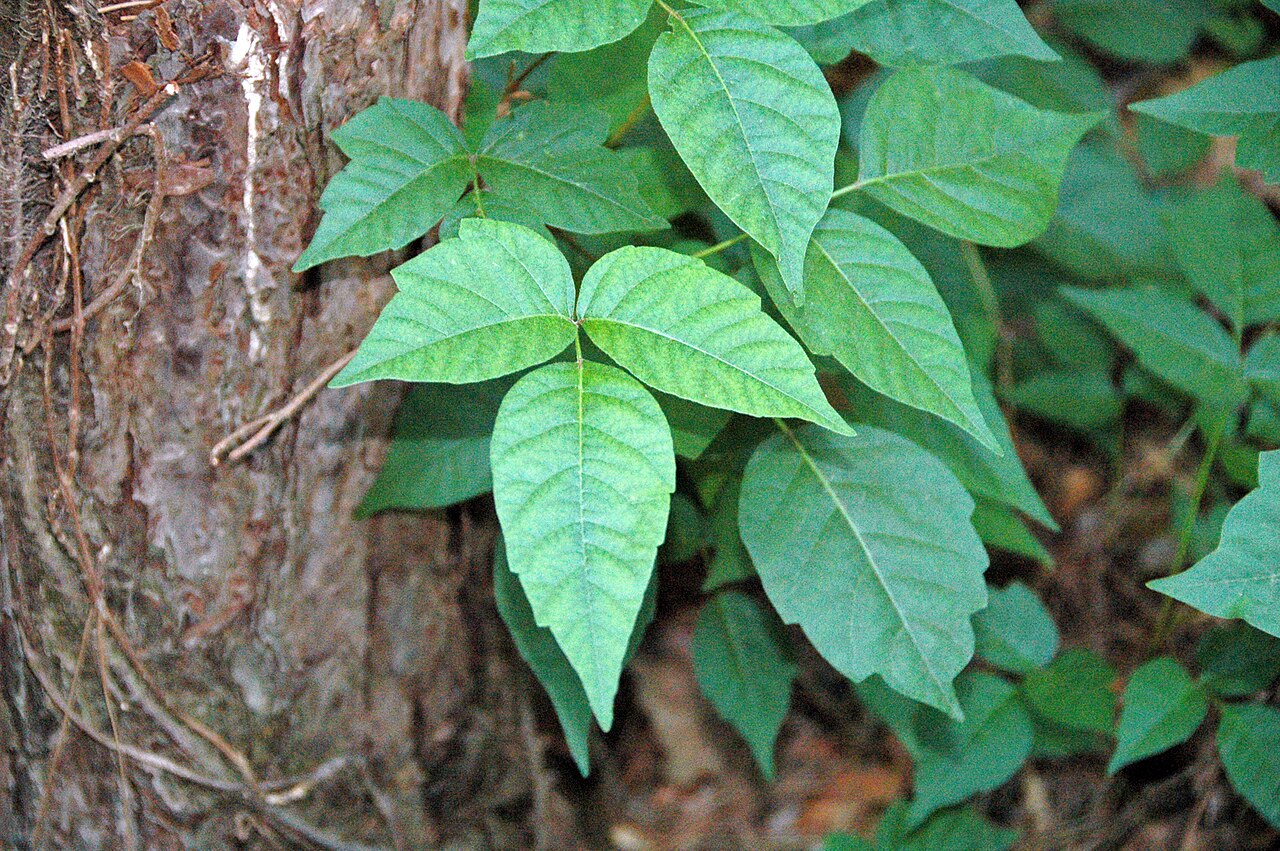
There is some variation in the appearance of Poison Ivy across its range, but a few things remain consistent. The most recognizable feature is the plant’s clusters of three leaves, arranged in a certain way. Usually, the left and right leaves resemble mittens, while the center leaf is relatively symmetrical. The margins vary, but are usually somewhat toothed.
Of course, what Poison Ivy is most famous for is not it’s appearance. It is best known for causing irritation and even serious rashes. Posion Ivy sap contains an oil called urushiol, which can be found on the leaves, vines, and other parts of the plant. Urushiol is not a poison, but it is an allergen, and most humans have at least a minimal reaction to it. The itchy, painful skin reaction caused by urushiol is called Urushiol-induced contact dermatitis.
Unfortunately, repeated exposure to urushiol can actually cause increased and worsened reactions. When I first moved here, for example, I barely reacted to Poison Ivy at all. Now, after years of walking the trails and brushing against the stuff, my skin reacts with horrible, painful rashes.
Urushiol can easily be transferred from the plant to your clothes, a pet’s fur, shoes, skin, and so on. The urushiol oil can also last for years, so even dead poison ivy plants aren’t safe to touch. Cutting or mowing the plants can also release the allergen into the air, so be very careful when tending your lawn.
But Poison Ivy isn’t all bad. Birds are able to eat its seeds, and other animals and insects can eat it’s leaves. Urushiol lacquer can also be made from the sap, which has been used in lacquerware in Asia for millennia. It’s nice to know that this delinquent plant is at least helpful in some ways.
Be careful out there this summer, and watch where you walk! We’ve got plenty of Poison Ivy lurking here on the Texas Coast.
Photo credit: James St. John, CC BY 2.0 <https://creativecommons.org/licenses/by/2.0>, via Wikimedia Commons
Photo caption: Poison Ivy

