by Taylor Bennett
Gulf Coast Bird Observatory’s avian research team is continuing to monitor for non-breeding shorebirds along the Upper Texas Coast till the end of March. Our main focus is those species that are classified as endangered, threatened, or of high concern due to habitat loss and climate change. There are six target species we monitor for Piping Plover, Red Knot, Snowy Plover, Wilson’s Plover, American Oystercatcher, and Black Skimmer. During monitoring, we tend to see other migrants along the beach. One such species we often see this time of year is the Northern Harrier.
Northern Harriers are medium-sized hawks that migrate here during the fall and tend to stay throughout the spring. They breed in the Northern United States and Canada. They prefer habitats with lots of open space such as prairies, marshes, wetlands, and even coastal dune habitats. We typically see them near wetlands and the dunes along all of our survey sites.
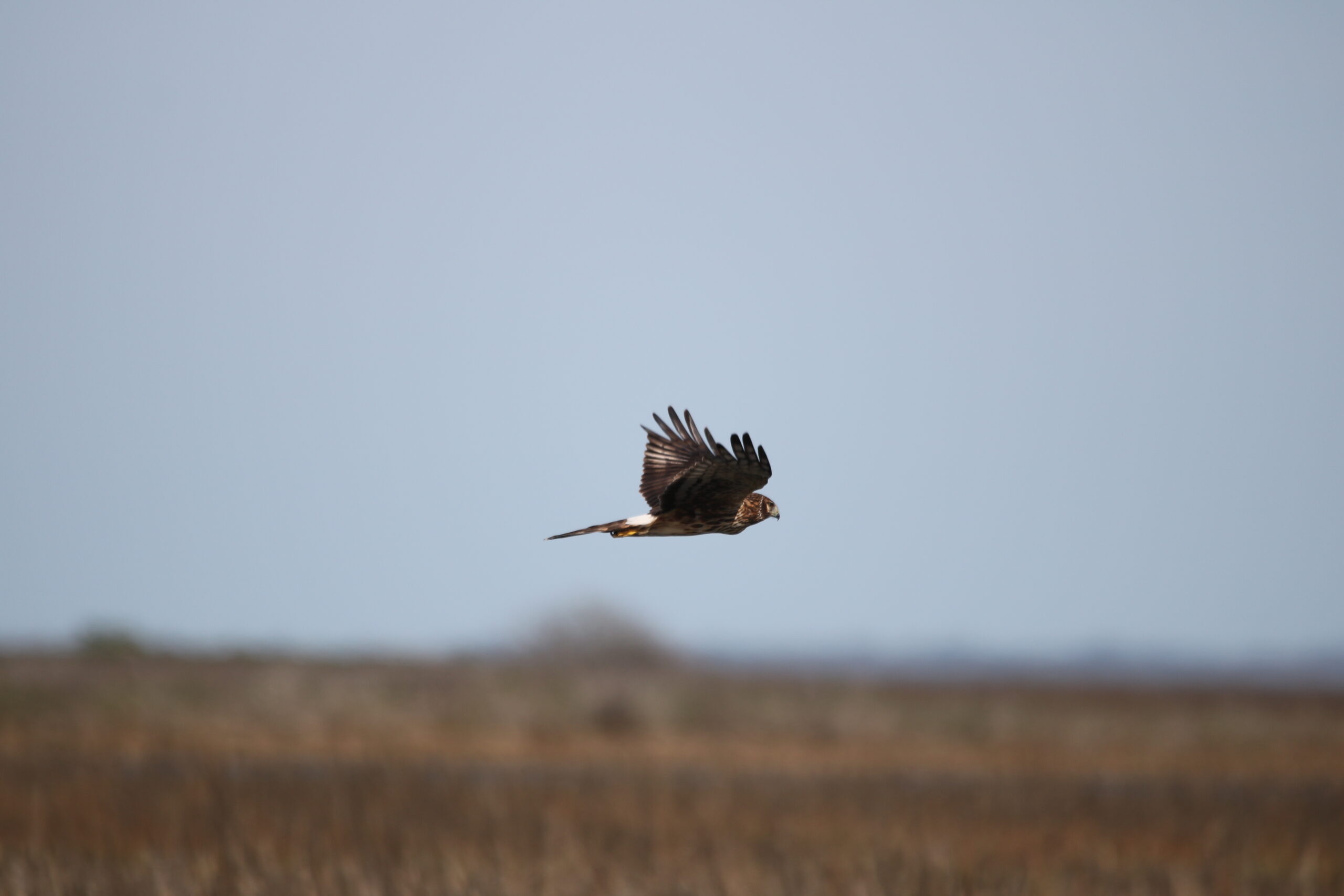
The Northern Harriers have certain features that make them stand out from other hawk species. One such feature is their owl-like head. Northern Harriers are the only hawk species that have modified feathers that form a facial ruff or disc like owls. Males, females, and juveniles all have this. Another feature that makes them stand out is a white patch located at the base of their long rectangular tails.
Northern Harriers are one of the few species that have strong differences in males, females, and juveniles. Females are typical larger and heavier than males. They are mostly brown with a buffy belly with heavy brown streaks. Males are mostly gray which is why they are often referred to as “gray ghosts” with white bellies that are slightly spotted. Juvenile males and females are darker brown and have more of a reddish belly with heavier streaks along their breasts and sides. The only difference between juvenile male and females are their eye color; male eyes are greenish-yellow, while females have chocolate brown eyes.
All Northern Harriers have slender yellow legs and both adult males and females have lemon-yellow eyes. Females and juveniles migrate earlier, and they dominate over the male population, which is why we tend to see more females and juveniles than males. Males prefer to hunt in open habitats while females prefer to hunt in tall and dense vegetation.
Northern Harriers are opportunistic feeders, and their selection of prey depends on the season, habitat, and how much prey there is. They typically feed on small mammals such as mice and shrews as well as passerine birds. When they are wintering in the North, their diet preference is voles.
Northern Harriers depend on their sense of hearing over their vision when hunting prey. Their facial discs aid them by directing sound to their ears much like an owl. Northern Harrier hunt on the wing and have the tendency to fly low to the ground keeping their wings in a “V” shape. They are also able to hover and make quick and sharp turns when hunting prey.
Their overall conservation status is of least concern; however, their population is declining. This can be largely attributed to habitat loss due to drained wetlands and agriculture practices as well as the reduction of their small mammal prey due to overgrazing and the use of pesticides. On behalf of Gulf Coast Bird Observatory, thanks for reading.
IMG_0935: Juvenile female Northern Harrier observed hunting near the dunes along Matagorda Beach, Matagorda, TX. Photo taken on December 19, 2023, by Taylor Bennett.

