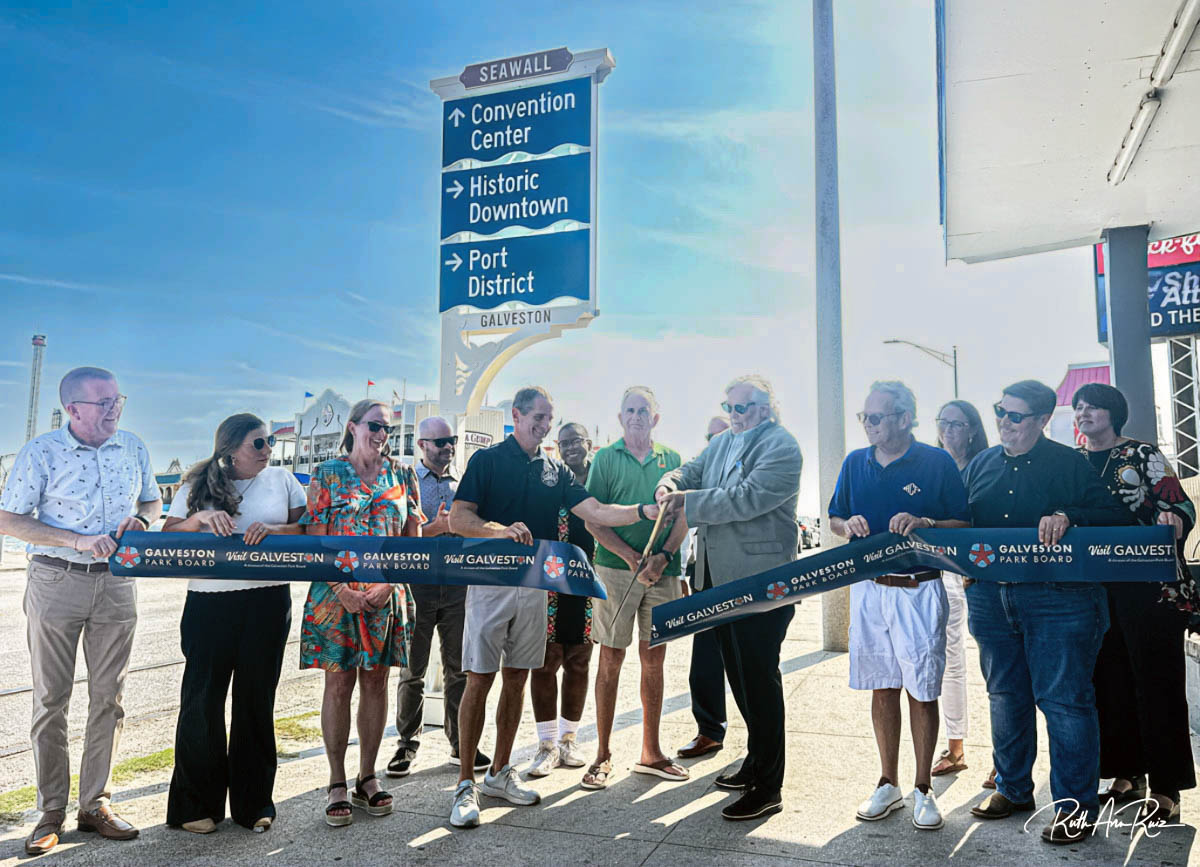

By Ruth Ann Ruiz
The Post Newspaper Features Editor
Tourist wayfinding signs are finally a reality and have been popping up across Galveston during the past week.
The signs might seem less necessary than they were when the project was first conceived, given advances in cellphone navigation technology, but they are eye-catching—and Galveston Mayor John Paul Listowski explained their importance.
“We are a first-class tourist destination. This is exactly what you would expect to find in a first-class tourist destination,” Listowski said.
The signs were designed to reflect the culture of the island. Galveston’s historic Victorian architecture was incorporated into the designs. Each sign is painted in subdued seaside colors, with representations of Gulf waves also incorporated into the design.
Dolphins are playfully displayed on one side of a sign on the Rosenberg median. while the names of places of interest, with arrows pointing visitors in the right direction, appear on the other side. Other areas feature signs with Galveston’s marine wildlife such as sea turtles and pelicans.
Throughout the city, from one end of the island to the other, signs and kiosks are in places to help visitors find their way while also informing them about the city’s history and places of interest.
City leaders, along with Galveston Park Board members and staff, came out in the searing Texas sun Thursday to celebrate the new signs with a ribbon cutting.
Getting to that ribbon cutting took more than two decades.
Plans for tourist wayfinding signs date as far back as 2003, according to Caitlin Carnes of Visit Galveston. The concept had been discussed for years but began to take more definite shape in 2021. In 2023, Corbin Design was hired, and its team began the process of developing Galveston’s new wayfinding system.
Now, approximately 400 signs are being installed across the island, with staff expecting the project to be completed by the end of September.
With that many signs to be placed, there are sure to be a few minor glitches along the way. Anything that needs attention, such as arrows misdirecting tourists, will be addressed after all the signs are in place.
Because the project went through years of discussions and different iterations, conflicting dollar amounts have been associated with it. Tony Lyle, executive director of the Galveston Park Board, cleared up the confusion.
“The cost was $1.5 million,” Lyle said.
According to a document from Visit Galveston, the money for the new signage comes from the Hotel Occupancy Tax paid by overnight guests, not from property taxes.
Where older signs duplicate the new ones, the older signs will be removed.
With Galveston’s glaring coastal sun, blowing sand, sea salt, road tar and other elements, the signs have an expected life span of about 10 years.
After more than two decades of discussions, designs and revisions, Galveston finally has its first-class wayfinding system—and residents and visitors will have plenty of time to put it to use.

