Rebecca Bracken
If you’re like me, you sometimes find yourself skimming through TV channels looking for something entertaining to watch. As I did so last week, I stumbled on the ABC show Dancing with the Stars. Now, this is not an endorsement or plug for that show, but watching the novices and professionals stumble into their partnerships and learn to dance together made me think about how animals often dance to impress as well. In fact, many animals dance to communicate or seduce a mate, often more gracefully or energetically than we do as humans. But which animals are the best two-steppers?
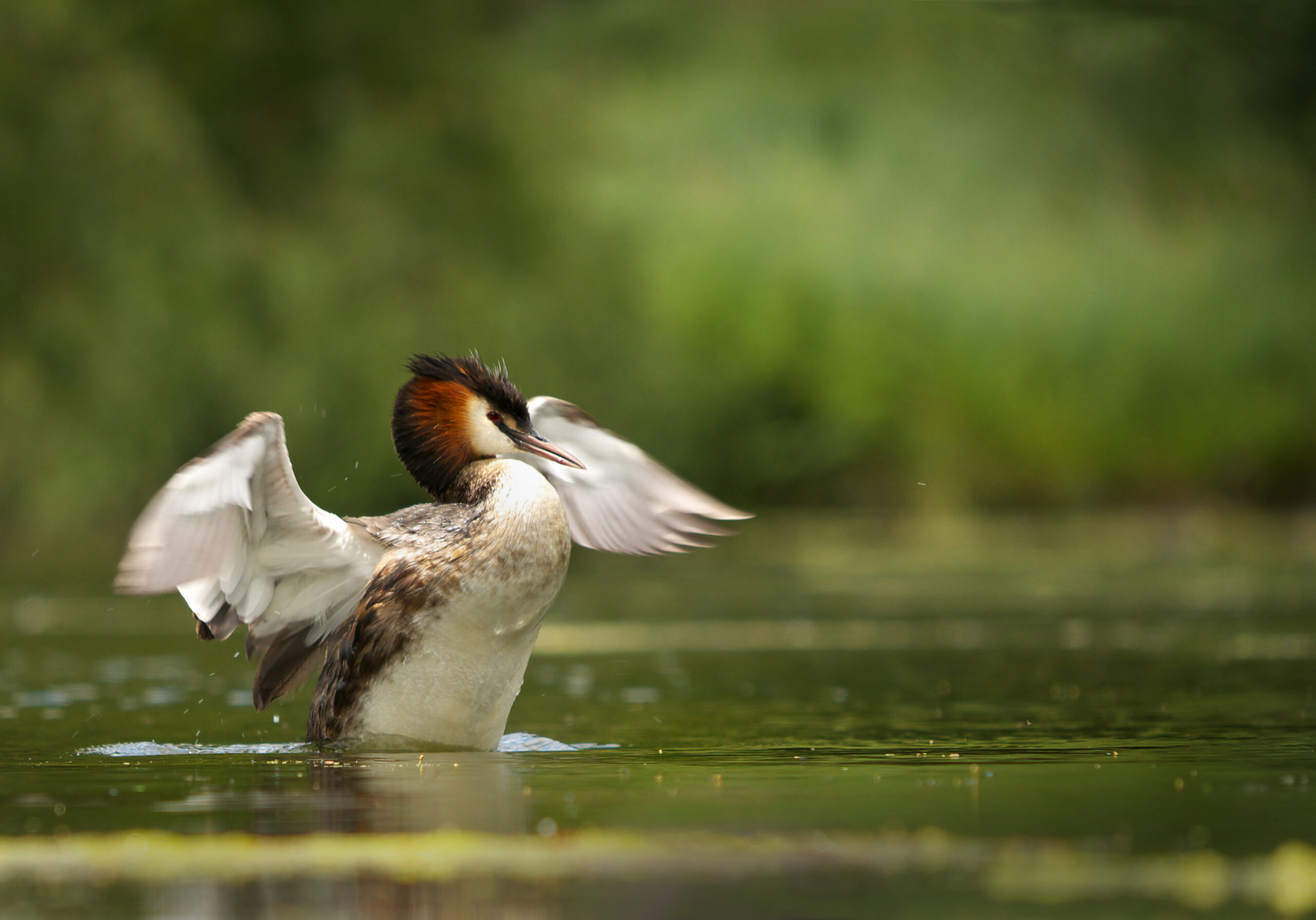
Let’s start with the dance of the Great Crested Grebe. Found across Europe and parts of Asia, Africa, and Oceania, the grebe is the largest of the Old World grebe species, featuring a prominent dark double crest and orange-chestnut neck ruff. While their colors are striking, it’s their courtship dance that really riles things up. During their dance, often described as a water ballet, the male and female begin by shaking their head and running their bill through the feathers on their back. Then, using weeds as props, they swim underwater, grab a beakful of weeds, swim towards each other, and rear up breast to breast. Can’t image what I’m describing? Here in North America, look for the Clark’s Grebe, whose courtship dance is similar, but saves one standout move for the finale. After the head shaking and preening, the male and female rush side by side across the water’s surface, holding themselves upright. Given their furious paddling, it appears that they are walking (or running) on water instead of swimming!
Another animal with some fancy footwork is the sifaka. Sifaka is actually a genus of arboreal lemurs found exclusively on Madagascar. But what makes this genus unique is their leaping abilities! Built for the trees, they have adapted to a strange way of locomotion on the ground. Instead of walking on all fours, or slowly on two feet, these lemurs move using a unique, sideways-hopping dance-like motion. During these comical sessions, the sifaka might actually look more like a triple jumper or conversely, a graceful prima ballerina, extending their arms for balance as they go. Some jumps are up to 30 feet!
Now, you may not think that snakes dance, but many actually do! However, their dance isn’t to impress a female, or as a form of locomotion. Instead, many snakes use fiery displays to compete with other males in a combat ritual. Male rattlesnakes are known are approach other males, squaring up their bodies, and weave and wiggle back and forth for more than an hour. Each male is attempting to force its opponent to the ground in order to win access to the females, with larger males normally winning. Amazingly, this dance is just for show; the fighters rarely are harmed, and venom is typically not discharged during the contest.
I left one of my favorite animal dances for last, because dinner is calling as I write this! If you want a dance with a real meaning, the honeybee dance is for you. When a honeybee returns to the hive, it shimmies in a repetitive pattern of straight lines, circles, and hip wiggling. All the movements together indicate the direction and distance of their next meal! And the more energetically and enthusiastically the returning bee dances, the better the food is. Even more amazingly, bees have likely been using some variation of this dance to communicate for millions of years. And we find the waltz to be an old dance.
Animals have the ability to communicate in many ways, some of which we are still working to understand. But it is well established that animals dance to communicate, no music needed. Maybe it’s one of the reasons we relate to many creatures, because we all can use a similar form of movement to communicate our wishes. Guess it’s time to brush up on my dancing skills!
Photo: Great Crested Grebe
Credit: Frank Vassen from Brussels, Belgium, CC BY 2.0 <https://creativecommons.org/licenses/by/2.0>, via Wikimedia Commons

