Abby Bressette
As someone pursuing a career in conservation research, I have spent many of my summers collecting data outdoors. Often, I step into the field with tunnel vision, focusing only on the tasks I need to complete. As a Research Intern at GCBO, some of these tasks include spotting adult Wilson’s plovers and their chicks, locating and monitoring nests, and counting least tern colonies. Some of my favorite memories of field work, however, were when I was pulled out of my data-trance by something that, while unrelated to my research, was unexpected and captivating.
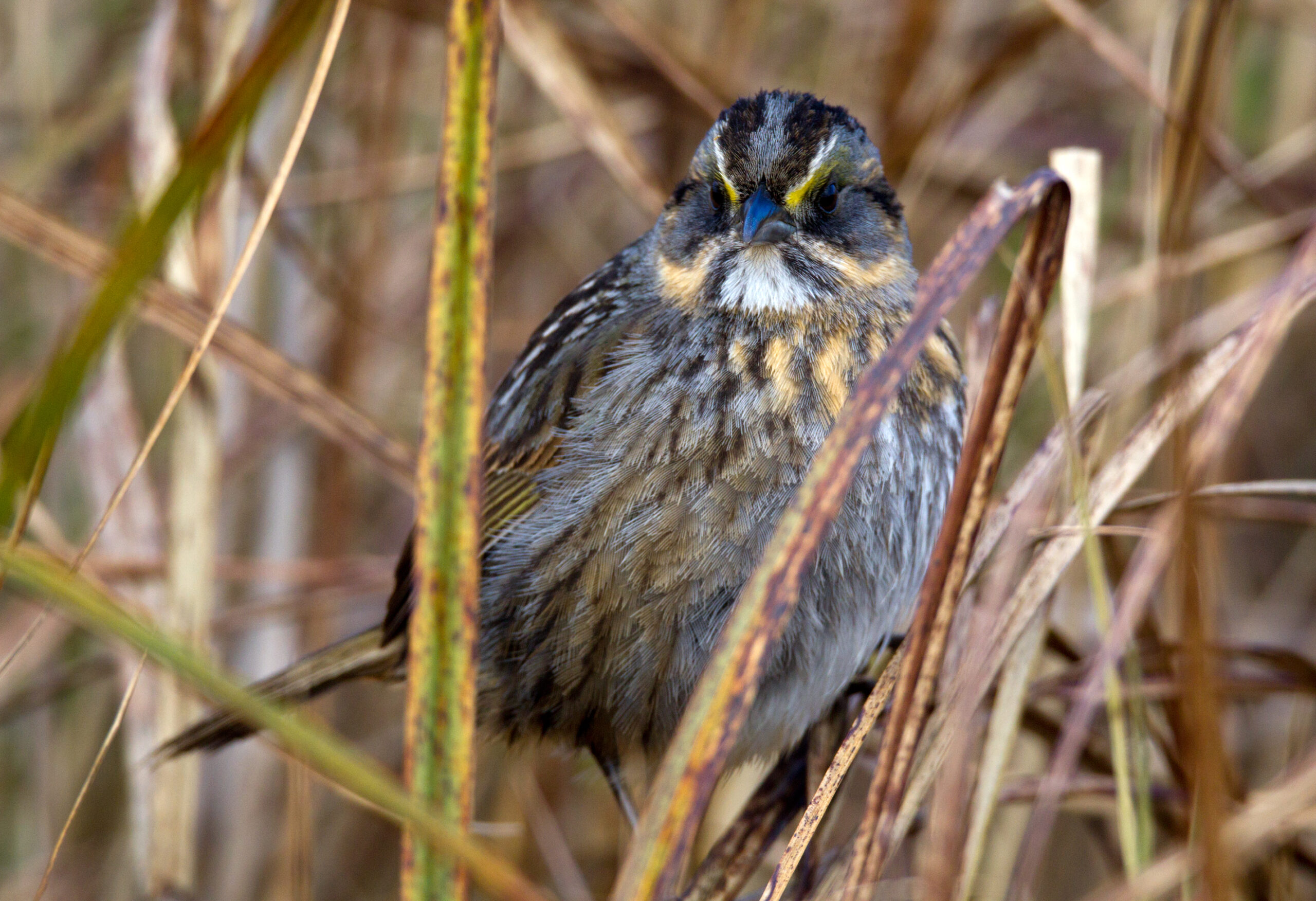
This summer, I was in the passenger seat of our work UTV alongside my fellow intern, Hailey, and our field technician, Kate at one of our field sites on the beach. We had driven past the dunes and into the salt marsh when we heard an unusual bird song. At first, we thought it was a red-winged blackbird, until I spotted a gray sparrow with a white throat, a streaked chest, and a splash of yellow next to its bill.
The seaside sparrow (Ammospiza maritima) is found almost exclusively in salt and brackish marshes along the Gulf and Atlantic coasts of the U.S. Plants found in the ideal habitat for a seaside sparrow include smooth cordgrass, salt grass, and rushes. While migratory in some parts of its range, the seaside sparrow is a year-round resident of the Texas Gulf coast. Patchiness in habitat has led to the formation of subspecies with distinct plumage and ranges, including several Gulf Coast subspecies. Seaside sparrows forage for seeds, insects, and other invertebrates on the ground and in vegetation.
During their breeding season in spring, males display to females by raising their wings and vocalizing. Both males and females use display as a way to defend their territory, raising their wings and spreading their tail feathers. Seaside sparrows are sometimes called the “goldilocks bird” due to their specific habitat needs. For nesting, seaside sparrows require habitat that stays dry both during high tide and flooding events. To further protect their eggs from inundation, they weave grass nest cups above the ground in tall vegetation.
Seaside sparrows are currently threatened by habitat loss as development expands along coastlines. Small, isolated subspecies are especially at risk of decline. In the late 1980s, the Dusky seaside sparrow, found in Florida, went extinct. The Cape Sable seaside sparrow, a subspecies endemic to the Florida Everglades, is currently endangered. Other threats to seaside sparrow populations include runoff of pesticides and other pollutants as well as rising sea levels. Conserving and restoring salt and brackish marsh habitats along coasts in the U.S. is crucial to protect seaside sparrows, as well as other native flora and fauna that depend on these unique habitats.
Photo: Seaside Sparrow
Credit: Mike Williams

