
By Ruth Ann Ruiz
The Post Newspaper Features Editor
She may have been birthed on the East Coast, but she’s every bit a Texan and as such, there is no way she is gonna sink. The USS Texas was decommissioned on April 30, 1948 and was the first U.S. battleship to become a permanent memorialized museum.
Taking her position as a museum in the Houston Ship Channel facing the San Jacinto Monument at San Jacinto State Park, the Battleship Texas hosted visitors who have admired her since her decommissioning.
Alas, her days facing the memorial are in the past, as she succeeded in an elegant exit.
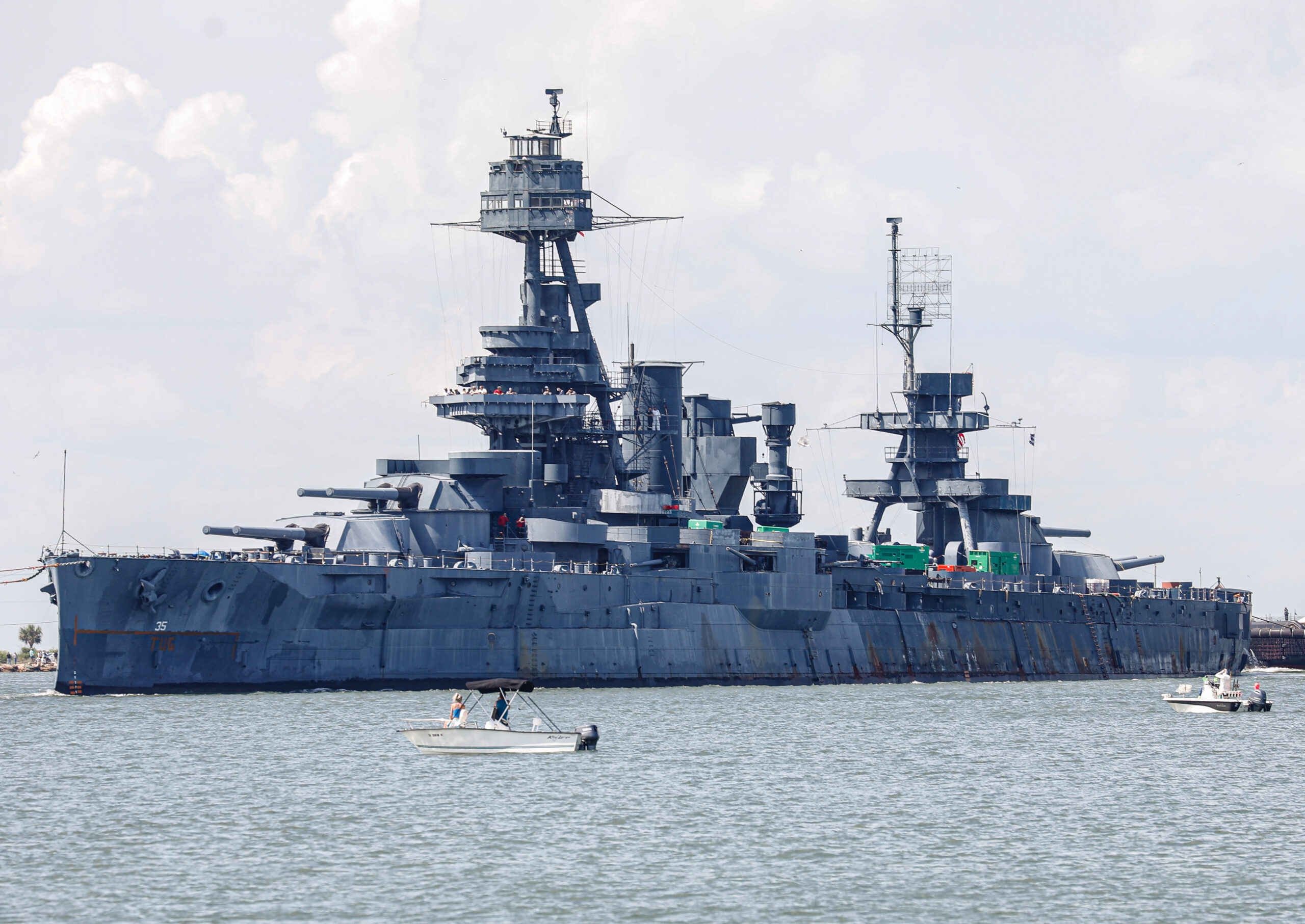
Her voyage from San Jacinto State Park to Galveston Bay on Wednesday drew thousands of viewers. Cars lined up in the early hours of the morning with cameras flashing as she made the cumbersome turn from her moored position to enter the Houston Ship Channel.
At every viewing point along the way, people came out to lay their eyes upon her. A tugboat was used to tow her. She was escorted by the Coast Guard and many other boats as she moved down the ship channel. She could be seen from great distances in all her battleship glory surrounded by her escorting flotilla.
As she moved into Galveston Bay, a fireboat announced her arrival, and cheers from the gathered crowd encouraged her passage. She arrived at her dry dock at Gulf Copper and Manufacturing’s shipyard, where she will have her hull restored.
Her life started in 1912 just before World War I. She was sent down to serve in the waters of Mexico. Back and forth she went from Mexico to the US; on one voyage she docked in Galveston.
She was a revolutionary ship for her time and was the first to mount anti-aircraft guns. She hosted what at the time was state-of-the-art directors and rangefinders for the gunfire. She was the last U.S. battleship to be built to burn coal and within a short time she was converted to use oil to power her engines.
During WWI she served her nation with movement of supplies and had been a training ship for those who fired the first American battleship shots of WWI.
It was upon her deck that a plane was first launched from a U.S. Battleship.
On March 10, 1919, a scouting airplane flew off the USS Texas. The plane was outfitted with pontoons so that it landed in the water and was hoisted back onto the ship with the ship’s crane. This exercise demonstrated the value of aircraft-borne gunfire spotters, and soon more battleships were deployed with scouting airplanes.
World War II saw her serving her country once again in conflict and she prevailed in assisting the nation. Gunnery officers directed sailors to load the weapons and she fired upon our enemies. She kept going, holding up her end of the bargain throughout the war. Wherever she was sent, she prevailed.
She went to the shores of Omaha Beach on D-Day along with tours in the Pacific and down in African waters. She saw it all, and she held strong, keeping her sailors safe from enemy fire.
After serving her nation from her infancy well into adulthood, The USS Texas earned her rightful place as a museum.
She shone brightly for decades and was admired by many. But then, as the numbers of guests who came dwindled down, she lost her alure.
Without admirers purchasing tickets, there just wasn’t enough funds to maintain an antique battleship in tip-top shape.
Her hull began to show signs of neglect, patched up repairs were the best her caregivers could give her. That wasn’t good enough. Her hull would need a complete repair done at a dry dock.
She was closed to visitors in 2019 as part of the plan to get her repaired.
The caretakers of her regal beauty were faced with a dilemma. “If we didn’t get her out of San Jacinto, I think she just might have ended up as scrap metal,” said Bruce Bramlett, Chief Financial Officer for the Battleship’s foundation.
A decision was made: she would be moved for repairs, and she would need never return to San Jacinto State Park. But she wasn’t ready for a sea voyage.
Work had to be done: 780,000 gallons of foam was pumped into her hull to keep water from seeping in. Forty pumps were installed on the ship to dump away water that managed to get through the foam. Marine professionals worked for one and half years to prepare her for her voyage to Galveston Bay. Their work proved to be of the highest level in her successful voyage.
Where will be her final home? “She’s going to stay in the upper Texas Coast,” said Tony Gregory, the CEO of the ship’s foundation. “We are negotiating with the cities of Baytown, Beaumont and Galveston,” he added.
Repairs to the hull are guaranteed, yet she needs so much more to become a place where thousands of visitors can once again enter her and feel the power of her years of service to her nation.
Though the funds to make her beautiful aren’t yet acquired, there is no doubt she will become a vision of strength and maritime beauty. She has many admirers who have fallen in love with her.
Barmlett is one individual who has grown very attached to her and reminds us of just how easy it is to fall in love with the Texas Battleship. “Eleven years ago, I was hired as CFO and it was just a job but somewhere along the way she and I fell in love,” Baramlett shared.
It takes visitors to fund the ship and the ship is going to need to be where she can attract the most visitors. This was shared by both Gregory and Bramlett. Stay tuned to the waves of air and sea as we all anticipate learning of her final home.