By Celeste Silling
One of Texas’s most interesting birds is the Attwater’s Prairie Chicken, a type of grouse. These birds are very local, as they are found only in two Texas counties: Colorado County and Goliad County. They only live in the gulf coast prairies, a habitat that is now hard to find.
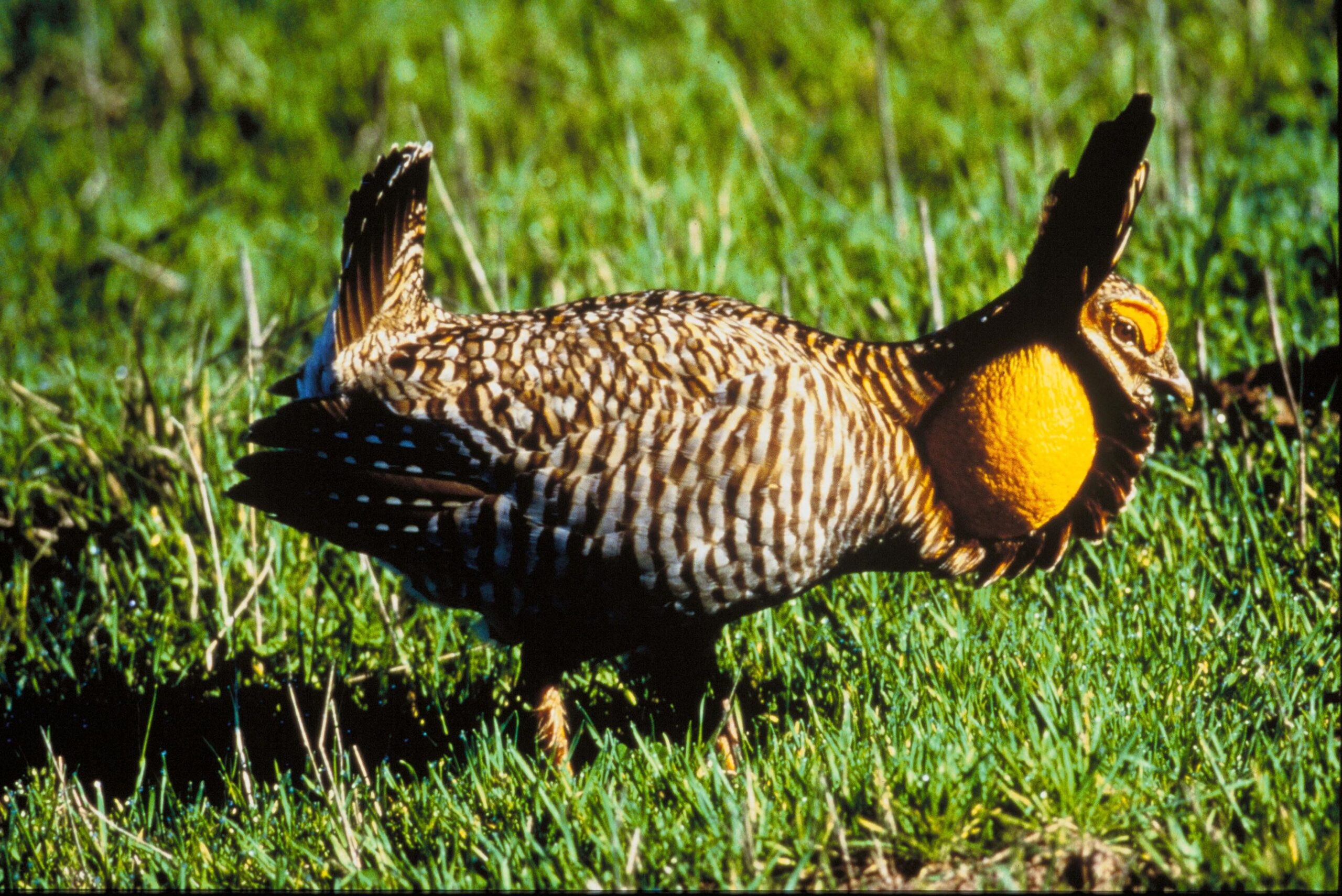
For those who have never seen a male Attwater’s Prairie Chicken before, let me attempt to describe it. The bulk of the bird’s body looks like a striped chicken, with brown and white bars going horizontally down its body. On its face are neon orange eyebrows that make it look (in my opinion) a little bit perturbed.
But the feature that really stands out are the air sacs on the sides of the neck. When the male grouse is relaxed, its neck looks relatively normal. But when it’s trying to attract a mate, the feathers on the sides of its neck raise up to look like cat ears, and the bare orange skin underneath inflates. It looks like someone superglued two orange balloons to their neck. The female, on the other hand, lacks the orange eyebrows and air sacs.
The male Attwater’s Prairie Chicken uses these strange fashion accessories when he is trying to impress a female. During the mating display, the male will raise feathers on the side of his neck, inflate air sacs, lift his tail up, and make a booming sound, and stomp around like the attractive bird he is. This display, which is often done by multiple grouse at a time, is called a lek. I highly recommend looking up videos of Prairie Chicken leks, as it really is an interesting display.
This bird was once relatively common in Texas and Louisiana. But unfortunately, its population deeply declined after it was heavily hunted in the 19th and early 20th centuries. The numbers continued to plunge as the grouse’s habitat was converted into cropland and rangeland. Less than 1% of the gulf coastal prairie habitat still exists today, making it one of the most endangered ecosystems in North America. This so reduced the bird’s numbers that they were declared endangered in 1967.
Fortunately, there is still hope for this species. Several organizations are successfully raising Attwater’s prairie-chickens for release into the wild. About 300 of these birds are released every year at the Attwater Prairie Chicken National Wildlife Refuge and private property, where the U.S. Fish and Wildlife Service and The Nature Conservancy implement management practices.
Interestingly, the Houston Zoo’s Attwater’s Prairie Chicken breeding facility is housed at the NASA Johnson Space Center. The space center provides the perfect place to rear the birds, as it is quiet and safe enough for this endangered species. While the NASA rearing site is not usually open for visitors, Gulf Coast Bird Observatory is offering a once-in-a-lifetime tour of the facility in our online Experiences Auction at www.gcbo.org. And if you want to learn more about the rearing program, you can read about it at www.houstonzoo.org.
It truly takes a village (and apparently a space center) to rehabilitate an animal population that has dropped this low. So, let’s care for the habitat and animals that surround us here in Texas, and keep their populations viable. The Prairie Chickens will thank you!
Photo: A male Attwater’s Prairie Chicken displaying.
Photo by George Lavendowski, USFWS

