
By Richard Tew, NASA/JSC correspondent The Post Newspaper
Last Monday, in NASA’s hangar located at Ellington Field, four astronauts were announced for the upcoming Artemis II mission.
The auspicious event saw NASA administrators, politicians, dozens of astronauts and fans of the space program. NASA Administrator Bill Nelson, along with JSC Director Vanessa E. Wyche spoke of the significance of the occasion as it herald’s NASA’s mission to return humans back to the Moon. It’s been fifty years since this feat was accomplished.
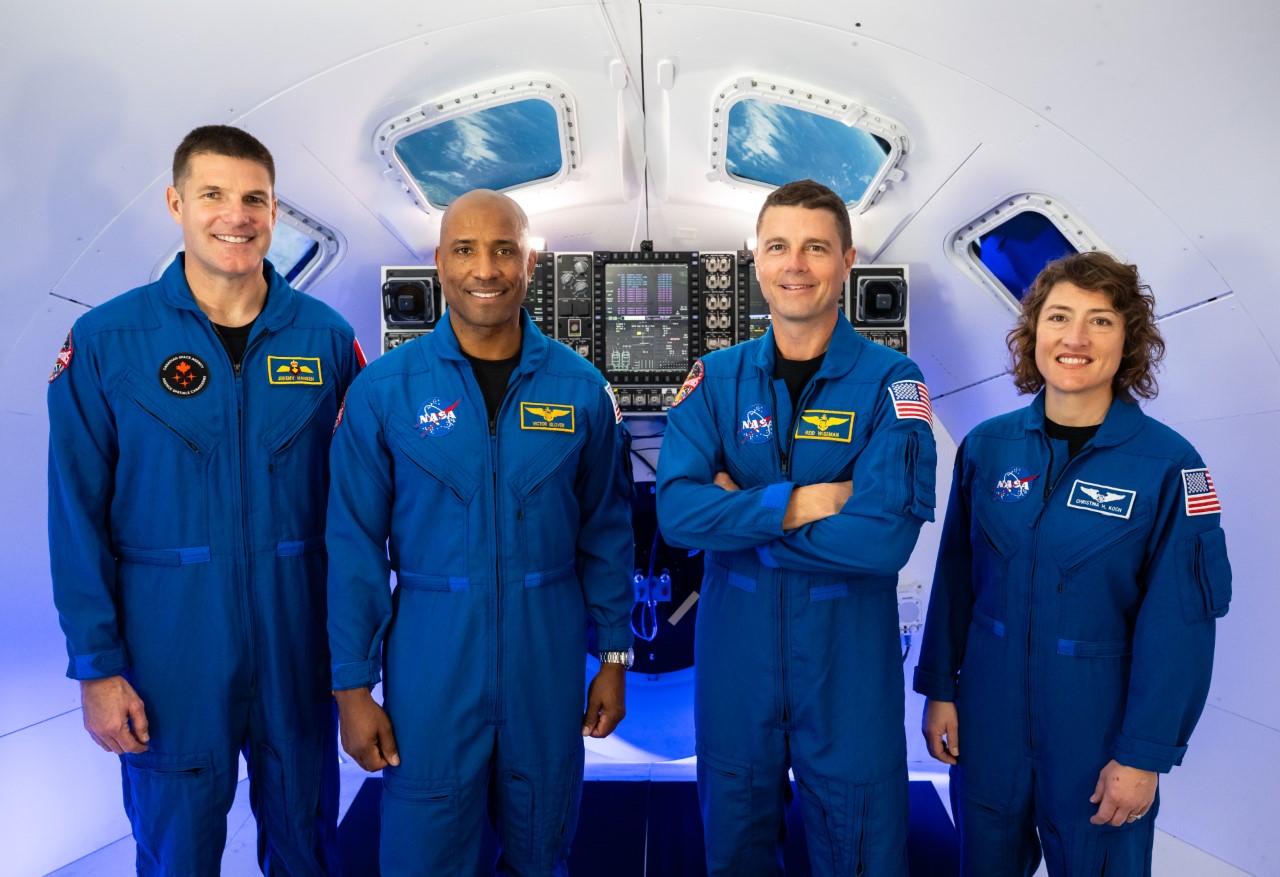
Selected from NASA’s astronaut program is commander Reid Wiseman, pilot Victor Glover and mission specialist Christina Hammock Koch. Rounding out the crew of four, is mission specialist Jeremy Hansen from the Canadian Space Agency (CSA).
Wiseman, a Baltimore, MD native, is a decorated aviator serving as a Captain in the U.S. Navy. He has spent time in space as a part of Expedition 41 (2014) aboard the ISS for 165 days. He was originally selected for NASA’s astronaut program as part of the 2oth class in 2009.
Hailing from Pomona, CA, Glover, the first black astronaut to travel to the Moon, joins the Artemis II flight crew with extensive aircraft experience. While in the Navy, he logged 3,000 flight hours in more than 40 different aircraft, has 400 carrier-assisted landings and has 24 combat missions under his belt. Glover has previous space flight experience serving as the pilot for SpaceX’s Crew-1 flight and as a member of Expedition 64 on the ISS.
Born in Grand Rapids, MI, Koch, the first female astronaut to travel to the Moon, has notched three missions to the ISS as a flight engineer: Expedition 59, 60 and 61. She has set the record for the longest duration space flight for a woman (328 days). An electrical engineer, Koch has helped with many experiments on the ISS and logged a combined six spacewalks, totaling some 42 hours.
Canadian Astronaut Hansen served as a colonel in the Royal Canadian Air Force, has spent years training as a pilot, taking his first steps in the field of aviation at age 12.
All four astronauts bring with them a diverse set of experiences they will need for the ten day mission projected to start around November of 2024.
JSC Director Vanessa E. Wyche expressed enthusiasm about the promise of the space program’s future missions, something on clear display at the launch event.
“This is an amazing time to be a part of our human spaceflight endeavors,” said Wyche. “We have our community behind us.”
Wyche said it’s the collective effort of the near 11,000 workers (contractors and civil servants) that make each mission possible.
“This is an all hands on deck moment. Everybody is very excited to be here everyday to do their part to make this happen,” said Wyche. “It is all of us right here on Earth that make it happen for them (astronauts).”
Sitting at the tip of the SLS rocket is the Orion Spacecraft. Orion is the “home” for the astronaut crew. Howard Hu is the program manager for the Orion Program.
Hu says the spacecraft has to have things like life support systems: food, a toilet and other life-sustaining features to make the approximately 240,000 mile trip to the moon. During the mission, Orion and its crew will traverse millions of miles as the spacecraft travels around the Moon to conduct more research for the Artemis III mission. That mission will see astronauts on the surface of the moon. So how much human effort is involved with navigating the spacecraft? Thanks to modern technology, Hu says many of the functions are automated.
“It’s a fully-automated system but there are manual overrides,” said Hu. “But if the crew does need to get engaged, or if a system went down, there are critical, manual capabilities they can utilize.”
Back on Earth, in JSC’s mission control building, teams of dedicated flight controllers and directors spend their shifts planning each mission, building on each previous experience in space.
Artemis II Lead Flight Director Jeff Radigan will be leading a team of mission experts heavily invested in both a safe and productive crewed mission back to the Moon.
In a recent story, Artemis I Lead Flight Director Rick LaBrode said after each mission, experiences are shared with the next lead flight director and related mission team members. Radigan says these discussions have helped him prep for the 2024 launch of Artemis II.
“I’ll tell you, in ‘those lessons learned’ meetings, I did a lot of talking because I know because all of the things coming out of his mission are now my challenges,” said Radigan. “We absolutely have to learn from one mission to the next. We call this the Artemis campaign and Artemis II is just one step in that campaign.”
Radigan says a lot of information was gathered about the Orion propulsion system and about the trajectory of the SLS rocket.
“Preparation is how we are successful,” said Radigan.
Having their first astronaut to go to the Moon is something the Canadian Space Agency views with great pride. The CSA has long contributed both astronauts, specialists and technology to the various NASA projects beginning back during the 1980’s and the early days of the space shuttle missions.
“We are extremely excited to see this continued collaboration,” said Mathieu Caron, Director of Astronauts, Life Sciences, and Space Medicine for the CSA. “To me, today (Monday) marked a very special day. This return to the Moon is particularly exciting for us. It’s making Canada the second country to send an astronaut beyond Earth’s orbit to the Moon.”
Caron says he noticed an excitement at the crew announcement event he hasn’t seen in a while. He likens the interest in the new Artemis missions to the previous interest in the Apollo missions of the 60’s and 70’s.
Wiseman says when the SLS rocket propels the crew on a quick 9-minute ride to outer space, he will be taking the trip with “Three of the coolest people I have ever met in my entire life.”
Noting a few technological challenges yet to work through before the mission, optimism is high. Wiseman says starting June he and his fellow astronauts will be “hitting the books” to familiarize themselves with the Orion Spacecrafts and its various systems. Next will be extensive simulator training to learn how to best work as a group aboard Orion.
“I want to stress, we need to get out of Houston. We need to go see the men and women who are building this vehicle, we need to thank the American public and the Canadians, and the whole international team as we set our sights on a really global effort here,” said Wiseman.
Photo cutline:
The Artemis II crew, From left to right: Mission Specialist Jeremy Hansen (CSA), Pilot Victor Glover, Commander Reid Wiseman and Mission Specialist Christina Hammock Koch pose inside an Orion simulator at NASA’s Johnson Space Center in Houston.
NASA/James Blair
When he is not writing on NASA/JSC, Richard Tew teaches Irish dance to all ages in Clear Lake. Learn more at www.tewirishdance.wordpress.com.

