By Celeste Silling
It’s finally fall, which means that billions of birds and other animals will be migrating through Texas! Most migratory birds migrate at night. They use the stars, rising sun, and other clues to navigate their route South, usually stopping to rest somewhere safe during the day. There are many dangers along their route including nighttime light pollution, which can confuse them, interrupt their navigation, and draw them into populated areas full of buildings to collide with. But worry not! Light pollution is perhaps one of the most manageable forms of pollution, and you can easily help birds by avoiding it.
Light pollution is defined as the inappropriate or excessive use of artificial light. This might not sound very dangerous, but it can be very harmful on a large scale. Large scale light pollution can result in Skyglow, which is the glow of the sky above brightly lit inhabited areas. You can see this if you’re ever driving at night between towns and see a general glow coming off of a city, town, or settlement. It’s almost as if the air above the area is giving off a glow of its own! This blocks the stars and can give the false impression of an approaching sunrise.
Nighttime lighting isn’t inherently a bad thing. It makes it easier for us to drive and walk at night, and makes us feel safer when we’re out. The issue comes when the lighting is excessive or ineffectual. Many lights, including street lights, yard lights, and the lights of stores and gas stations, are poorly designed in this sense.
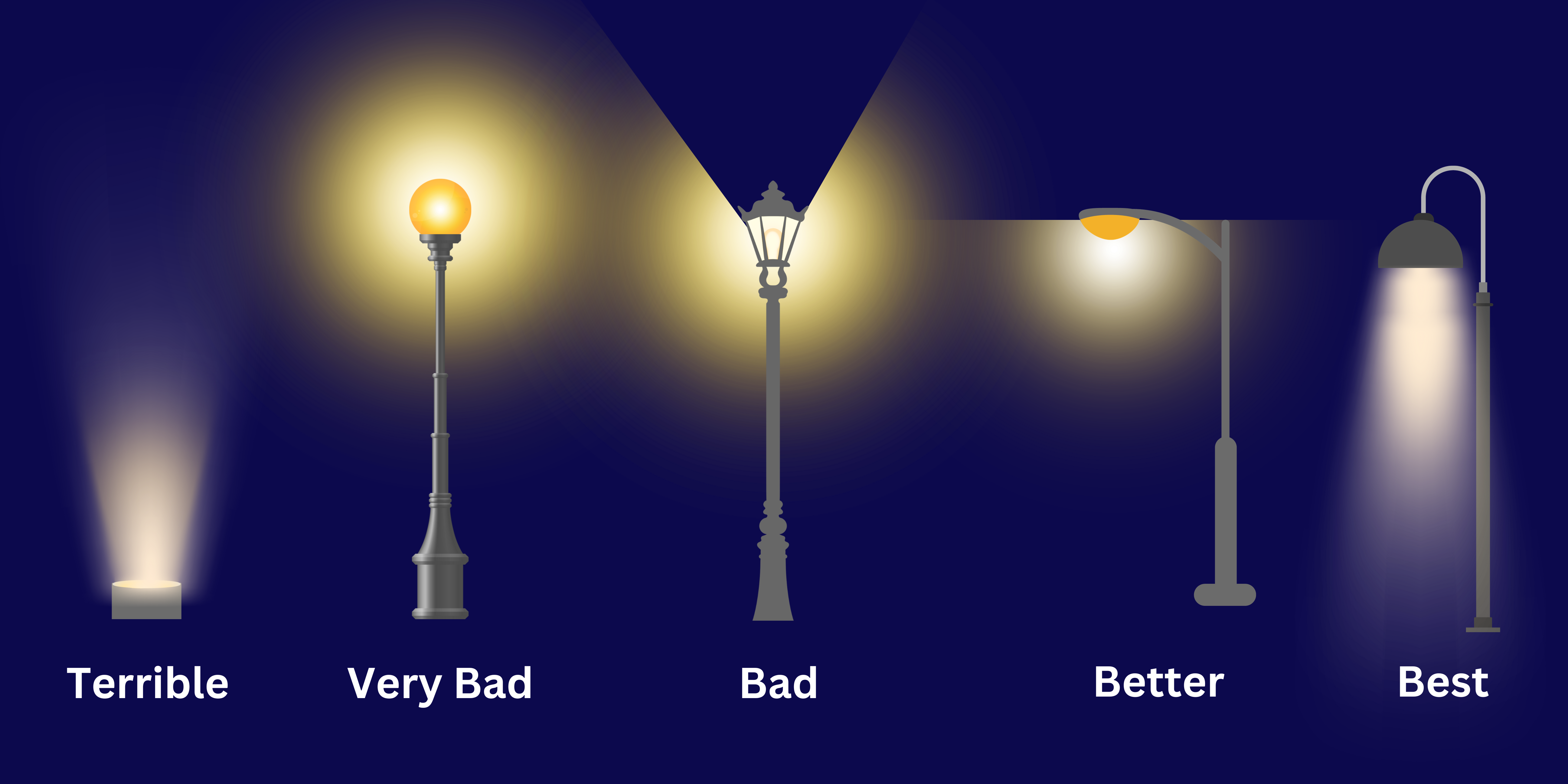
The first question one must ask when considering a nighttime light is: what is it meant to be illuminating? If it’s a street light, it’s meant to illuminate the street and sidewalk underneath it. If it is not illuminating this, it’s not doing a very good job! Unfortunately, many street lights and other lights are designed in a way that shine light upwards or to the sides, away from where it’s supposed to be. You can use shielding (picture a lamp shade) to funnel the light down where it needs to be. This increases the visibility on the illuminated area, and decreases light pollution.
If you’re looking to see this firsthand, try this experiment. In a darkened room, place a book next to a flash light (or a phone with the “flashlight” on) on a table. Turn the flashlight on and put it on the table facing upwards. Then try to read the writing in the book. Believe it or not, this is how many outdoor lights are designed, facing upwards. Not only do they pollute the night sky and blind the people walking by, but they fail to light the sidewalk (or book) beneath them.
Now place your hand flat about an inch or so above the light. Is the book easier to read? Perhaps a little, as there is less glare and more of the light is bouncing downward. Finally, hold a bowl around the light, hovering a few inches or above it. Now look at the book. It should be well lit, as all of the light is angling downwards and not above or to the sides. This is the most effective outdoor lighting, as it goes where it’s supposed to, doesn’t pollute, and doesn’t blind the user. If only all outdoor lights were designed in this way!
There are plenty of ways to decrease your light pollution, including turning off unnecessary lights, angling lights downwards, dimming the lights that you do use, and educating others. However you do it, the birds will thank you!
Photo caption: Some outdoor lighting fixtures are more effective than others
Photo Credit: Celeste Silling

