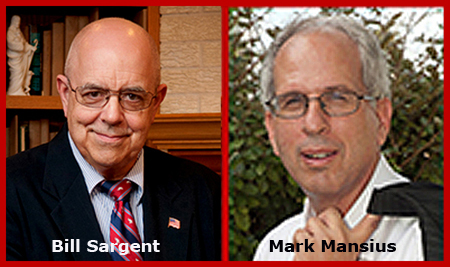
Last week the Galveston County Daily News published one of our guest columns, this one on the Supreme Court’s ruling on Birthright Citizenship. We received a question back from a reader in Pennsylvania and in an effort to keep a dialogue going we are including here the question and our response to it. We encourage questions and feedback that is respectful and on topic.
“I noticed Bill Sargent’s and Mark Mansius’s July 9th guest commentary said the Supreme Court’s decision on the Birthright Citizenship case was 5-4 but I am seeing it was decided 6-3. I’m confused. Did they get it wrong?”
Here is our response: Thanks for your comment and for holding our feet to the fire. We needed to be more precise. Yes, both the 5-4 and 6-3 are correct.
Only five Justices found that Donald Trump’s Birthright Citizenship Executive Order “violated the Constitution,” specifically the language of Section I of the 14th Amendment which reads: “All persons born or naturalized in the United States, and subject to the jurisdiction thereof, are citizens of the United States and of the State wherein they reside.” Those Justices were Chief Justice John Roberts and justices Sonia Sotomayor, Elena Kagan, Ketanji Brown Jackson and Amy Coney Barrett.
Justice Brett Kavanaugh – the sixth vote to overturn the President’s Executive Order – did so saying the order violated current law, not the Constitution. So, while the vote to strike the President’s executive order was 6-3, only five said the order was “unconstitutional.”
If Justice Kavanaugh’s point is correct (and we believe it is), the Congress can “fix” the problem by the passage of legislation. The Justice laid out the way the mess left by the Court’s decision can be fixed and to make it clear that just being born in the USA doesn’t make a person a U.S. citizen. It will require Congress to clarify the meaning of who is “subject to the jurisdiction” of the U.S.
Lawyer and constitutional law expert Alan Dershowitz said the same thing on July 4th — that Congress has the authority to define who is “subject to the jurisdiction” of the United States. Dershowitz said he believes congressional action will stand a stronger chance of surviving judicial review than Donald Trump’s executive action.
There is precedence for doing this. When the 14th Amendment was ratified in 1868 it excluded American Indians from receiving citizenship. The reasoning was they owed their allegiance to their tribe and not to the United States. In 1924 the Congress passed the Indian Citizenship Act which granted citizenship to American Indians born within the territorial limits of the United States and allowed them to have U.S. citizenship.
Congress could pass legislation saying that
Only children born to U.S. citizens or born to non-citizens who have been legally in the United States or its territories for a minimum of eight contiguous years, who have allegiance to the United States and who haven’t committed a felony are eligible for U.S. citizenship.
This would make it clear, and reflect the original intent of the drafters of the 14th Amendment. It would pass judicial pass scrutiny – originating in Congress and being signed by the President.
The question is whether our politically-charged Congress is capable of considering and enacting such a measure. If they’re unable to pass the SAVE Act which is supported by more than 70% of Americans, it’s highly unlikely they could do what is required to fix the mess the Supreme Court decision has left us with.
We hope this adequately addresses your question and appreciate your willingness to continue the dialogue on this important topic.

