

By Ruth Ann Ruiz
The Post Newspaper Features Editor
Some people have a way about them that leaves you believing you can accomplish anything without them ever saying a word of encouragement. Dale Carter is one of those people. He certainly affected me this way.
Our interview lasted just over five hours. After our lengthy chat both in his parlor and on the veranda of his home a few blocks from the Gulf in Galveston, I had to pry myself away.
Through years of studying and memorizing classic English and his Northern Texas manner of speaking, Carter has developed a voice that he uses to calm the souls of grieving loved ones and, in my case, fed me with inspiration.
As he spoke to me about his life, he said in a matter-of-fact tone, “I was a sickly child.”
Then he went on to list the various ailments he faced when he was young.
“I almost died of tuberculosis,” Carter said.
He was also thinner and shorter than his peers.
Physical illness and physical traits were not all that made young Carter different from his peers. At one point in his school years, Carter was classified as a special education student and was removed from mainstream classrooms. He then spent two years in special education classrooms.
Today, he understands that he has dyslexia and has been able to take his career and his life places beyond what anyone thought possible when he was a sickly child who didn’t fit in with the “normal” students.
He enjoys his life, though no one would say he lives his life in a normal manner — not Dale Carter. He lives his life in the way he has carved out for himself, a way that brings him joy and brings comfort to individuals during their most difficult moments in life.
Carter describes his work as being in the souvenir business. He surrounds himself with historic works of art, busts of famous individuals, and other curiosities from the past.
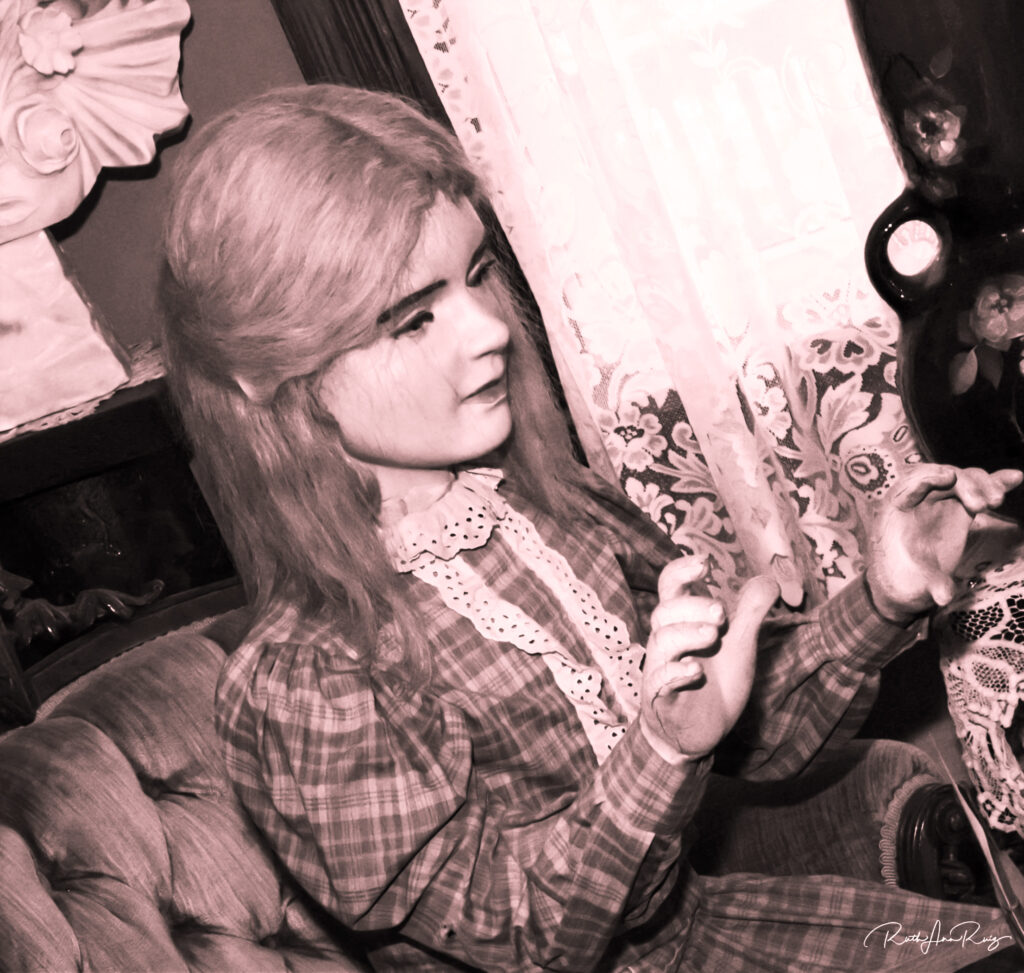
Antique chandeliers worth thousands of dollars provide overhead lighting in his historic Victorian home. Pricilla, a 100-plus-year-old mannequin from Chicago, sits in his parlor. Her hair is made from that of a horse, and her face is made of papier-mâché
The art and other pieces of history around him are not his life’s work. Rather, they are his passion. Since he was a young man, he has worked at jobs with the goal of collecting as many pieces of historic art as he could possibly manage.
“My first job as a sack boy at a grocery store was during Thanksgiving week. After that week you can work just about any place,” he said “I wasn’t going to quit working because I wanted to buy some antique furniture.”
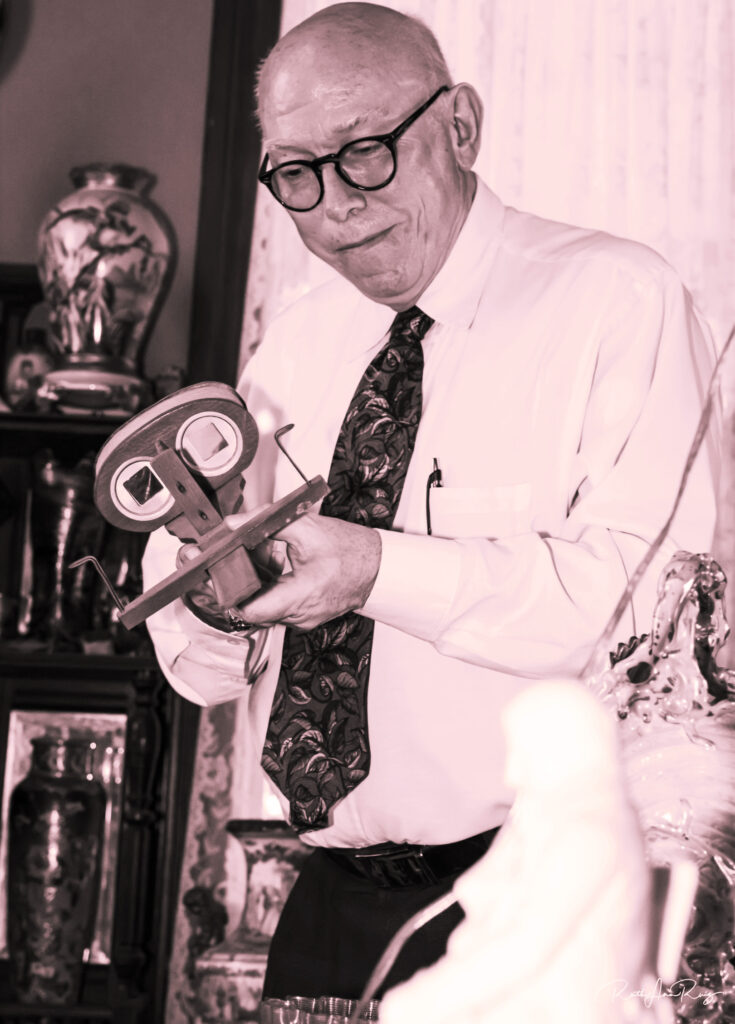
The very first antique item that young Carter acquired was a stereoscope, which he brought out to show to me.
“I could see history through this,” Carter explained as he loaded images into the stereoscope.
Dale Carter, who loves history, quotes numerous historic leaders and can recites classic literature without stopping to catch a breath, is a mortician. His life’s work has been embalming the dead.
He explained the souvenirs he provides are preparing faces and bodies for loved ones to appreciate as they say their last goodbye to someone whose life has been snatched away by death.
Describing how he manages his career, he said that with each moment he is living, he is focused only on that moment, that situation. The result of this mindset is that with each body he is charged with embalming and preparing for a funeral, his only concern is for that one body.
Prior to preparing the deceased for viewing, he prepares himself mentally.
“You won’t see it, as it happens in my mind. I’ve done this thousands of times,” Carter said. “I listen to classical music as I work on a body. It sets my mind in a good place and makes me feel good, as though I can achieve anything. And I keep my mind in a happy place by cultivating happy thoughts.”
As he shared these aspects of his work with me, he pondered out loud.
“I would like to see the brain waves of me as I prepare to work on a body,” Carter mused.
After 41 years as a mortician, he described his mental preparation as effortless.
While working on a body, if he knows the person’s favorite music, he will play it. If he does not know the person’s story, well, in his words, “They will be forced to listen to opera.”
As a professional, Carter is not allowed to share the names of those whom he has worked on, but there is one exception. Early in his career, he was given a body that he described as having no eyeballs.
“I called the medical examiner, who, back in those days, I could easily speak with myself, and he told me that this was a serial murder case, and I was sworn to secrecy about the missing eyeballs,” Carter said.
Decades later, he reported, he embalmed the body of Charles Albright, a man who had been convicted of murdering a woman whose eyeballs had been missing. Albright was found guilty of only one woman’s death, though he is suspected of killing several others in the Dallas area.
Without mentioning names or details, he did speak of difficult cases involving faces that had been marred. With each case, he uses his gift of love for those he does not know and his skills with cosmetics to restore faces so that mourners can experience as beautiful a souvenir of that person as possible.
It was as a child that Carter became fascinated with the beauty of someone whose face had been carefully tended to by a mortician. At his grandmother’s funeral, he was awestruck by how beautiful she looked in her coffin.
When he questioned adults as to how his grandmother looked so beautiful in her casket, they were not able to provide him with an answer. Without a good answer, young Carter tucked the experience away in his mind while he explored life and grew up to hold various jobs.
The job he held before making his way to working with the deceased, he described as being a “bomb maker” in a factory. This work, he said, he detested.
One day, a mature coworker demanded he go work at what he wanted to do. It was then that he knew he had to pursue the answer to the question he’d had at his grandmother’s funeral.
Thus, by attending Dallas Funeral Institute, he began his quest to help the deceased look their best. There he learned the scientific knowledge that is required to become a licensed embalmer along with other skills and aspects of working in the funeral industry.
Carter’s life work and the way he lives drew the attention of filmmakers, who spent 10 years documenting Dale Carter. The documentary, “Song of the Cicada,” in which Carter plays himself, is a work of art, just as Carter’s life appears to be a work of art.
The film has won numerous awards and played at film festivals from Dallas to Los Angeles and at international festivals. Unfortunately, it is not on any of the public streaming platforms.
Perhaps the owners of the film will find a streaming platform so that a larger audience can become familiar with Dale Carter and the “Song of the Cicada.”
Carter and his collection of antiques and art have outgrown his Galveston house. His eyes are now fixed on a Victorian house in Alexandria, Louisiana. Once he sells his current home, he will move all his belongings across the Texas-Louisiana border and continue working as a mortician and pursuing his passion for collecting.

