
By Alex Coenen
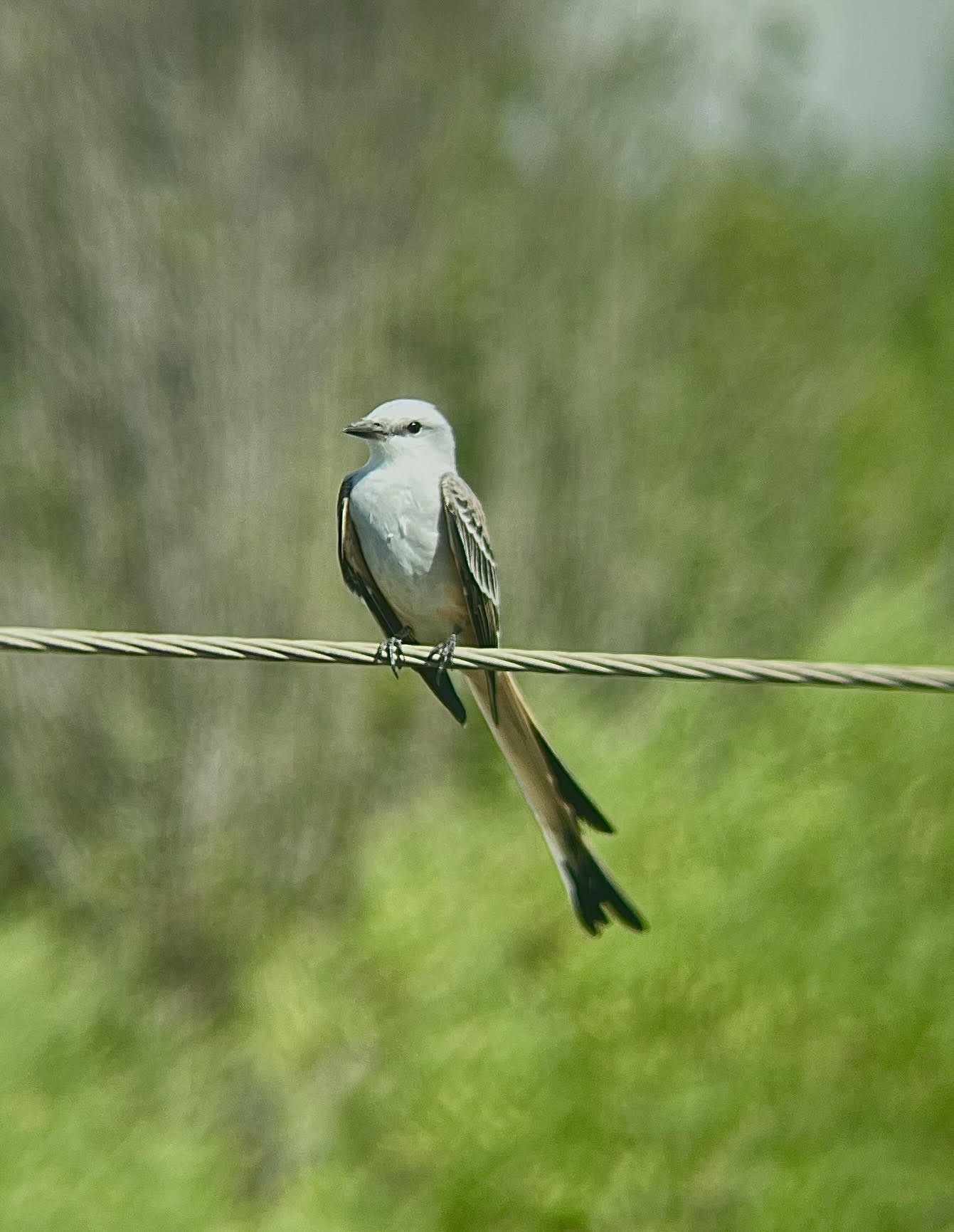
As you go down a desolate country road during early dawn, you might see quite a few birds sitting on the telephone lines. There are many species that do this, but one is more conspicuous than the others with large, protruding tail feathers trailing behind the rest of its notably kingbird-sized and shaped body. If its tail feathers, which seem to have a mind of their own as they flutter in the wind, are notably longer than the bird’s body, chances are you are looking at a wonderful Scissor-tailed flycatcher (Tyrannus forficatus).
The tail feathers of these birds are forked, meaning the longest feathers are located at the outer edge and gradually get smaller in size as they reach the center of the tail. One might say their tail feathers resemble that of an open pair of scissors! Adult male Scissor-tailed Flycatchers typically have longer tail feathers than adult females. But the females still have much longer tail feathers than any other kingbird, making them easily identifiable.
The remarkable tail feathers aren’t the only thing unique about these birds. While the sides of their body are a soft salmon-pink color, their axillary feathers (feathers that are located right below the wing) are a bright scarlet which flashes as they glide from their perch to catch insects. When they fly, they create an unmistakable X shape with their wings widespread and their tail feathers sprawled out.
You’ve likely seen these birds in the spring and summer in Texas, where they eat mainly grasshoppers and beetles and can be found in open grasslands, shrubland, and coastal prairie. They migrate a short distance from their wintering grounds in Mexico and the western coast of Central America to Texas and surrounding states. They have a long breeding season from the months of April to August, then migrate back to their wintering grounds sometime in early August to early November.
Scissor-tailed flycatchers have experienced some range expansions to the Mississippi River, Louisiana, Arkansas, and Kansas. This is likely due to the clearing of woods for agricultural development, creating vast prairie regions.
While these birds are a common sight along our roadways here, studies have shown that Scissor-tailed Flycatcher numbers have declined by about 31% between 1966 and 2014. To help conserve these birds, researchers advise protecting their nesting and perching sites. They suggest leaving strips or patches of brush intact when clearing brush or applying herbicides. This is beneficial for other native species as well, who might be running low on available habitat.
Fortunately for us, the Scissortails seem to be doing quite well in Texas, especially along the coast out of the cities. So, the next time you’re driving down a country road or the Bluewater Highway, keep an eye out for birds on the phone lines. If one of them has a long tail and a small pale body, you might be looking at a Scissor-tailed Flycatcher!
Photo: Alex Coenen
Caption: Scissor-tailed flycatcher perched on a wire near Quintana Beach.
Alex Coenen is interning at Gulf Coast Bird Observatory this winter and spring. GCBO is a non-profit organization dedicated to saving the birds and their habitats along the entire Gulf Coast, and beyond into their Central and South America wintering grounds.

