
By Rebecca Bracken
Here at Gulf Coast Bird Observatory, one of our main focuses is the conservation of shorebirds and their nesting habitat. Some of the most pressing threats to these birds are caused by humans, and so part of our job is educating the public on how they can help. Here’s a great chance for you to actively help birds, just by staying off some islands!
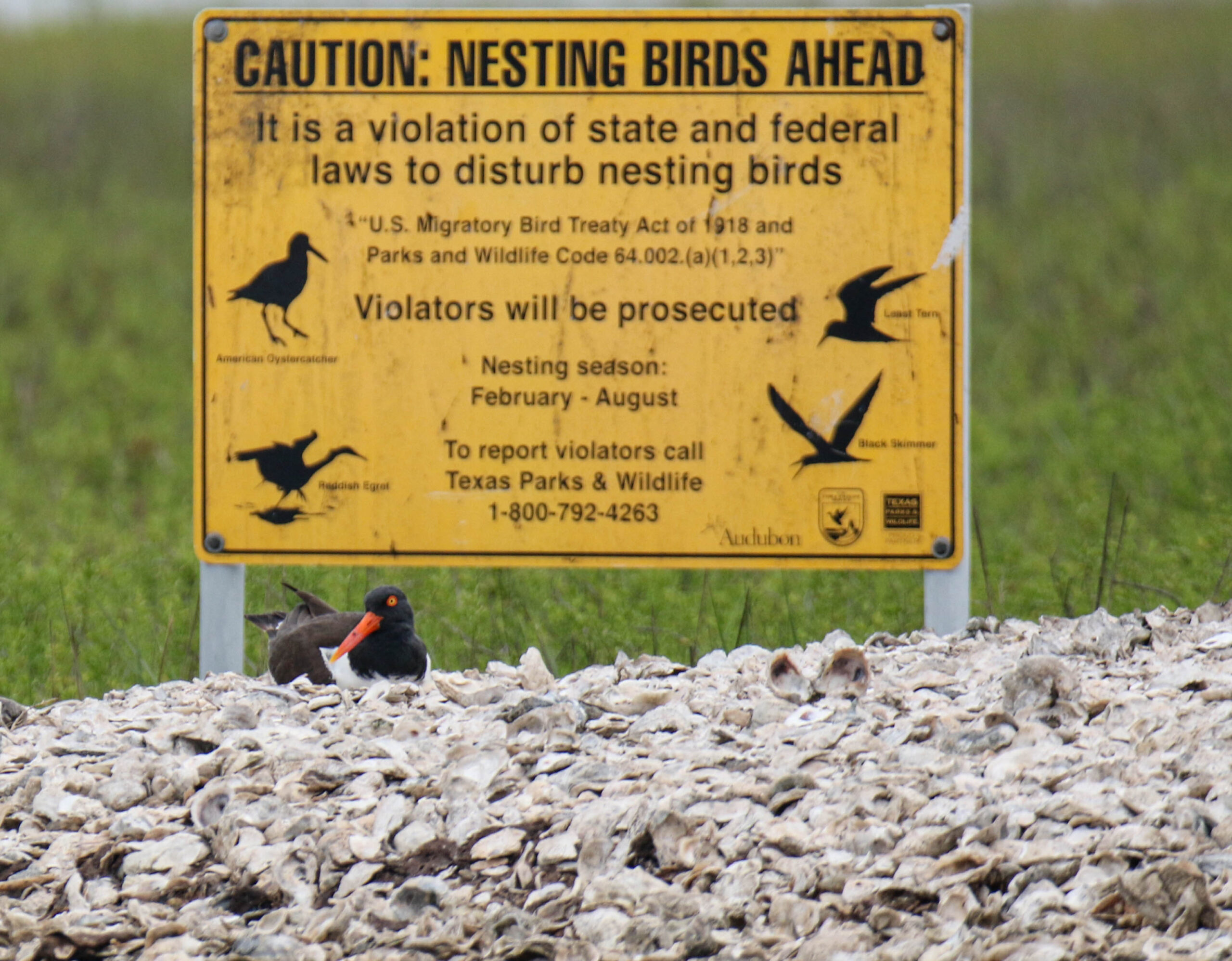
If you’re ever out in Galveston Bay, or in many other bay systems along the coast, you’ve probably seen the “nesting bird island” signs. Many are quite large and are bright yellow. Some are smaller and less obvious, but are scattered around the many islands in the bays where birds nest each year. The information on these signs is incredibly important; you should take a look at one, from a distance, next time you’re out.
These signs state that the marked island is a nesting bird island. They ask that you keep off the island at certain times of the year, and sometimes even say “no trespassing.” What these signs indicate is that hundreds, if not thousands, of birds choose to nest on the island each year. We monitor American Oystercatchers and Black Skimmers on many of these islands, but birds such as Brown Pelicans, Roseate Spoonbills, Caspian and Royal Terns, and even Reddish Egrets also nest among the vegetation. These islands are important colonies for these species, and the presence of even one person can be detrimental.
So how do you know if you’re too close to an island? First, if it’s a “no trespassing” island, keep off! It is illegal to disturb a nesting colony, especially if there is a no trespassing sign posted. Even if you don’t see a sign, if there are birds, please stay off the island and stay a distance away to prevent changes in the birds’ behavior.
If you do approach an island, and you see birds running or flying off the ground, you are too close! If a bird flies off its nest because you got too close, there’s a chance that its eggs could be damaged or eaten or the eggs could overheat. Some birds are more susceptible to disturbance than others. Terns, for example, nest in large colonies, and all it takes is one person walking through the colony for all the birds to abandon their nests. Many of the species that nest here are of conservation concern, meaning their populations are declining in size, and the loss of even one colony in one year can have catastrophic effects.
We’ve had reports recently of someone crisscrossing one of the islands in West Galveston Bay where American Oystercatchers, Black Skimmers, Forster’s Tern, and Gull-billed Terns nest each year. Last year, something similar happened, and most of the Black Skimmer colony, which generally consists of several hundred birds, abandoned the nesting site. The continued presence of someone fishing and walking around on this island, which has numerous signs indicating that it’s a nesting island, has already had an effect on the nesting oystercatchers.
As we continue through the breeding season, we ask you to educate your friends and family on the importance of these nesting bird islands. We hope you enjoy the summer months and have great success in your days fishing, but please do so responsibly and respect the wildlife! Follow all signage, keep your distance, and enjoy the water. Thanks for your help in protecting these awesome birds!
Photo: An American Oystercatcher nesting on a Texas island.
Photo by Alan Wilde

