
By Richard Tew/Space and Technology Editor for The Post Newspaper
On Wednesday, NASA’s Artemis II launch wasn’t foiled by April Fools shanigans. Instead, the “most powerful rocket ever launched by NASA” hurtled towards the heavens marking the first time humans have traveled to the Moon since Apollo 17 in 1972.
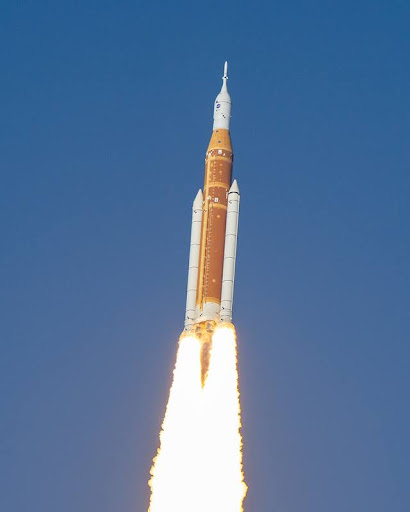
Despite several scrubbed lauches over the last three years-the last just a few weeks ago-Artemis II’s Space Launch System (SLS) the heaved the nearly 6 million pound, 322 ft rocket, topped with the Orion Spacecraft and four crew into orbit around the Earth Wednesday afternoon at 5:35 p.m CST for a ten-day mission.
The crew, which consists of NASA astronauts: Reid Wiseman (commander), Victor Glover (pilot), Christian Koch (mission specialist) and Canadian Space Agency astronaut Jeremy Hansen, went through hours of preflight checks and even a quick game of cards, a long held tradition before lauches. The crew plays until the commander (Wiseman) looses a hand. According to NASA, the tradition is played to ward off any back luck.
According to NASA’s blog: before launch, there were a couple anomolies which were later rectified. The Flight Termination System is a safety system which allows enginners on the ground to send a signal to destruct the rocket if it were to veer off course during ascent. Another issue which was addressed involved a sensor on the Launch Abort System’s attitude control motor controller battery which NASA says showed a higher temperature than they would have expected. “It is believed to be an instrumentation issue and will not affect today’s launch,” according to NASA reports.
The T-10 count down hold was extended to allow engineers time to work through final liftoff preparations. The new lift-off time was continued mere minutes after followed by unanimous “go’s” across the board at Kennedy Space Center.
Once launched, the SLS carried its crew to space before jettioning it’s two booster rockets after just two minutes of flight. At 5:43 (CST), the main engine core stage completed and separated from the “interim Cryogenic Propulsion Stage and the Orion space craft. Six minutes alter, Orion’s solar panels deployed.
Over night into Thursday, the crew peformed several key test stages of the mission in order to try out systems and prep Orion for a trip around the Moon, which could come as early at April 6. The trip will also see the deployment of four “CubeSats” as part of a secondary payload. If it is successful, Artemis II will take humans past the Moon and to its “dark side,” something no human has ever seen. The distance will be just over 252,000 miles.
Also during the press conference, Acting Associate Administrator, Exploration Systems Development Mission Directorate Lori Glaze was asked what she felt about the Artemis II launch.
“I think it went extremly well,” said Glaze.
Artemis II is the second of several “Armtemis” missions NASA has planned, with future missions aiming to establish a base near the south pole of the Moon to serve as a spring board for a future mission to Mars.
NASA Administrator Jared Iasscman stressed the imporance of the mission during a post-launch press conference.
“This is part of a much bigger program. This is America and our partners’ return to the Moon, and we are trying to do it this time to stay, said Isaacman.
Photo cutline: Wednesday at 5:35 pm (CST) NASA’s SLS rocket topped with the Orion spacecraft launced four crew towards the Moon for a ten-day round trip mission. Photo by NASA.

