Kayla Pringle
Spin, Swim, Survive: The Story of Wilson’s Phalarope
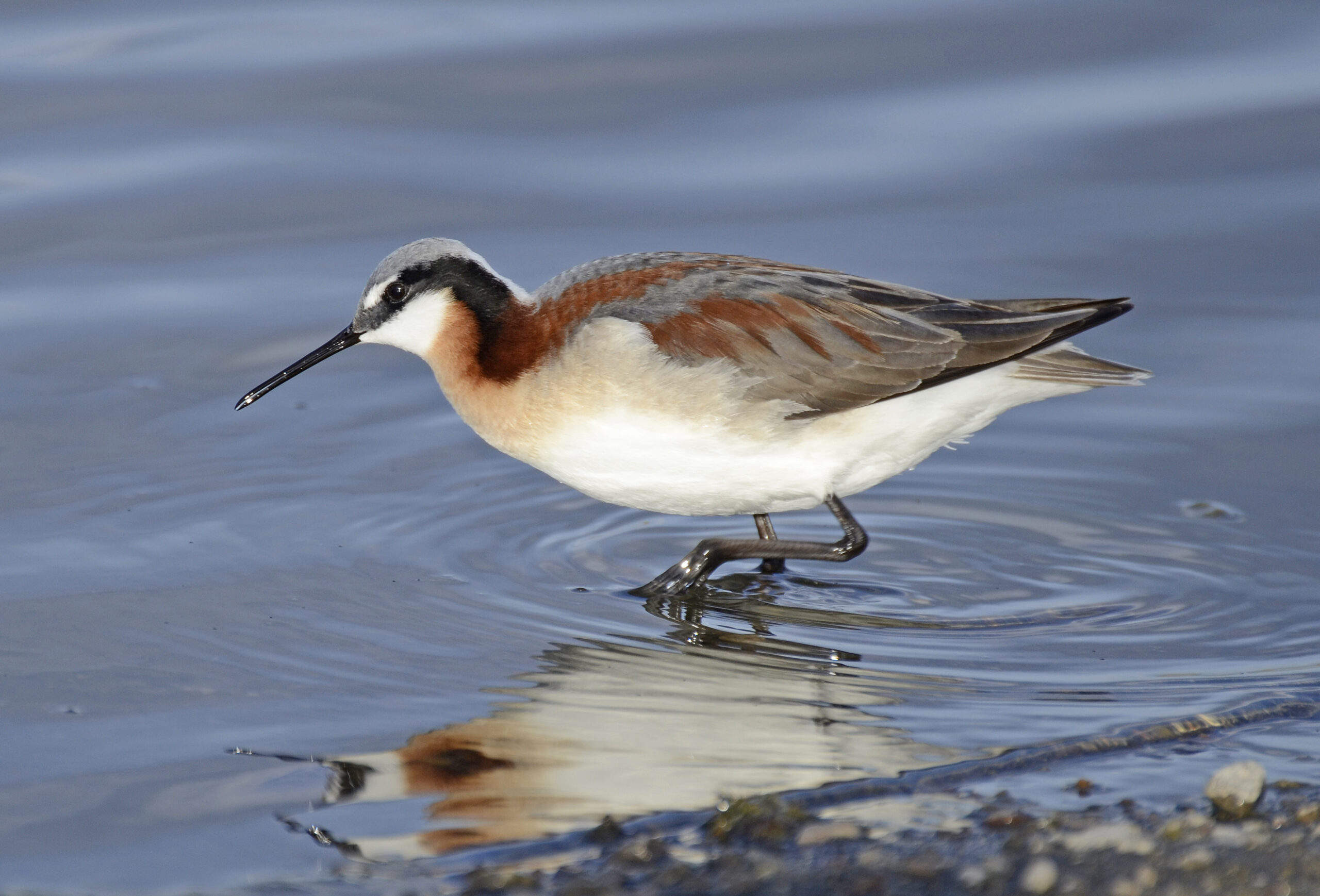
A small, greyish shorebird spins in tight circles on the water. It’s not confused — it’s stirring up its own mini whirlpool to bring food to the surface. I personally call this phenomenon ‘invertebrate soup.’ It’s peak fall migration right now, and Wilson’s Phalaropes do this wherever they stop to feed. Their invertebrate soup typically consists of midges, shrimp, and other aquatic invertebrates. It’s one of the strangest and most unique feeding behaviors in the bird world.
Wilson’s Phalaropes do not breed in Texas, but they do migrate through Texas during fall and spring migration. While they are migrating, their preferred habitats to stop at include coastal wetlands, marshes, and sewage ponds. Wintering grounds include high Andean salt lakes and coastal wetlands in southern South America.
Breeding season for Wilson’s Phalarope takes place in the interior of the western US and western Canada. All phalaropes have a polyandrous mating system. This means that females will mate with multiple males. Female phalaropes prefer aggressive males — ones that jut their heads back and forth in a posturing display, sometimes breaking into fights with other males. Once the female has chosen a mate, she will then lay her eggs in a simple scrape in the ground (usually 4 eggs per clutch). Once she lays her eggs, the female will abandon the nest and go mate with another male.
During breeding season, phalarope females will have more colorful plumage than the males. This is also atypical — usually the males are the ones with the brighter plumage, since they’re the ones competing for a mate’s attention. But from what we know about their polyandrous mating system, this makes complete sense. Females are the ones competing for males, so they’re the ones who evolved to stand out.
Male phalaropes will tend to the scrape and bring in vegetation to help the nest blend in to its surroundings. The males will incubate the eggs for 18-27 days. Chicks will pop out of the egg with feathers, eyes open, and the ability to feed themselves. In the bird world, we would refer to their chicks as precocial, meaning they are able to take care of themselves from the beginning of their life with relatively little help from the parents. For example, baby songbirds are altricial, since they hatch with no feathers and eyes closed. Songbird parents have to spend most of their energy taking care of their babies until they fledge, and sometimes afterwards too.
While Wilson’s Phalarope are of low conservation concern, they are still declining overall, like many other bird species. They had a sharp population decline in the early 1900s, but conserving and protecting wetland areas helped them rebound and stabilize. Wetlands, water quality, and the availability of surface water are crucial to the survival of Wilson’s Phalarope. Continued habitat protection, particularly around the shallow saline lakes and wetlands they rely on during migration, will be essential to keeping their numbers stable in the years ahead. With ongoing conservation efforts, this unique little shorebird can remain a familiar sight across its breeding and wintering grounds for generations to come.
Photo: Wilson’s Phalarope
Credit: VJAnderson, CC BY-SA 4.0 <https://creativecommons.org/licenses/by-sa/4.0>, via Wikimedia Commons

