Caleb Clarkson
On the rural county roads of coastal Texas, the carcasses of animals that met the ultimate wrong-place-at-the-wrong-time fate occasionally pepper the ditches and culverts along the unshouldered, two-lane roads. As I drive past roadkill, I try to save myself the grisly details by keeping my eyes on the road. Often, I fail. When I cross paths with roadkill, I can’t help but try to identify the creature and figure out how everything went wrong. Maybe someone ought to. It feels right to acknowledge the unintended costs of convenience and feel for the critters who may never know what a road is until they’ve crossed their first, only, and last.
But I’m not the only witness. In the trees, a committee of vultures gathers, waiting to start the wake. To humans, roadkill and dead animals often evoke disgust and the deep-seated urge to turn around and look away. We’re wired that way! An early human stumbling upon a waterhole surrounded by dead animals would probably be wise to avoid drinking the water. Disgust is an evolutionary tool that pushes us away from danger. But for vultures, like the Turkey Vultures found here in Texas, death is an opportunity.
When an animal dies, the systems that maintain life cease to function. When the cogs stop turning, they don’t just cease to exist. It takes a long process to return what once was into what it always was: a collection of molecules. In the grand scheme of things, most of the matter that makes up life on Earth simply changes form. Dinosaurs, giant bugs, mammoths, and dodo birds come and go, but the things that make them don’t. They just change shape. Vultures are some of the first to start that process.
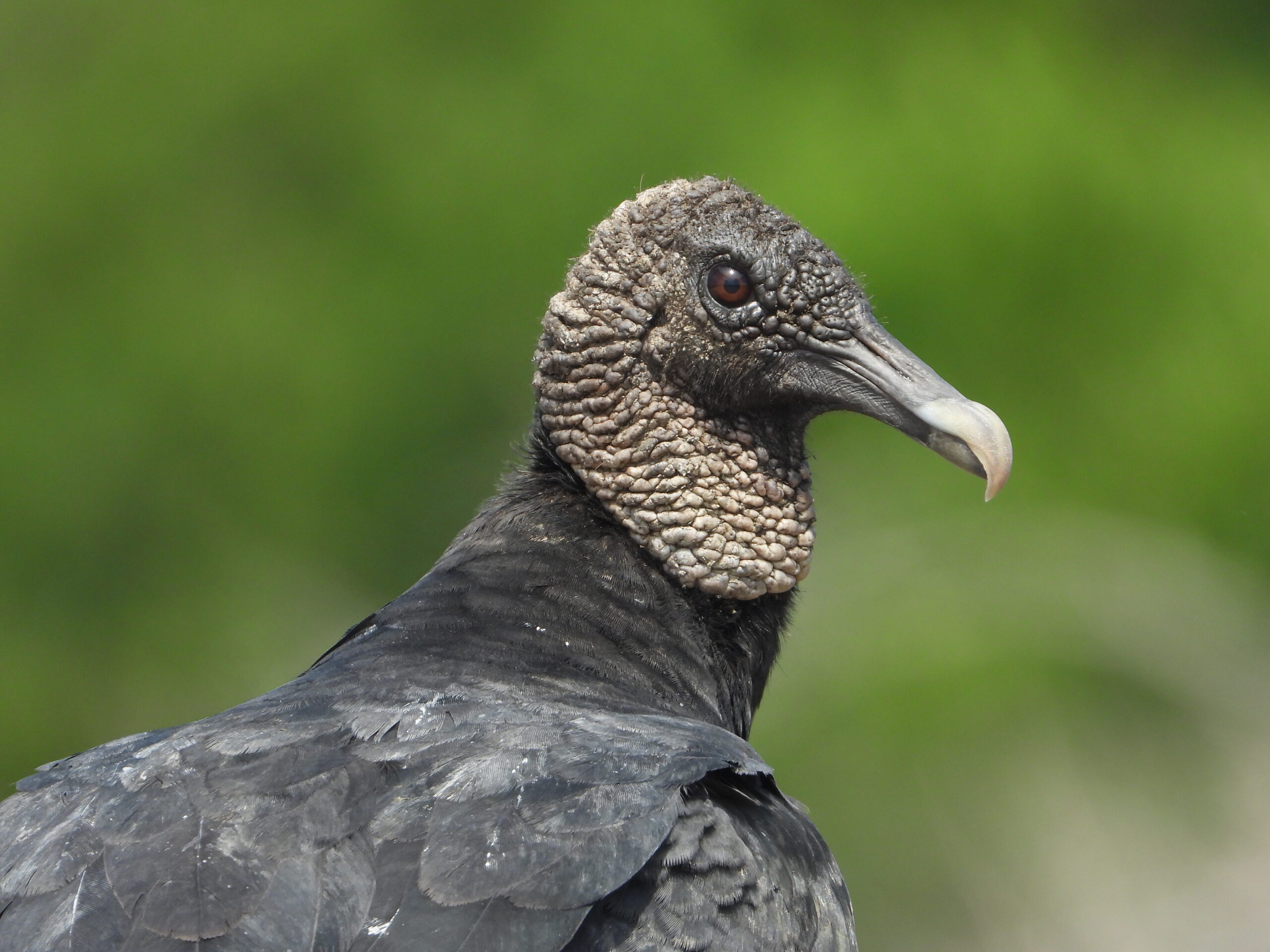
The same odors of death that make us retch, Turkey Vultures can detect at remarkably low concentrations. Using the natural rising air thermals of the landscape, they cover vast distances, gliding and expending very little energy as they search for their next meal. Vultures are not necessarily the most charismatic creatures, with their bald heads and raspy calls, and many people view them with a sense of disgust. However, their unique appearance actually makes them quite efficient scavengers. Their bald heads help keep feathers from becoming dirty as they feed while also reducing places where harmful bacteria can linger. Their stomach acid is extraordinarily strong as well, helping them break down bacteria and other potentially harmful substances that could make other animals sick.
It’s only natural to equate the dirty business of carcass disposal with the ugly-duckling image of the vulture, but vultures have not always been seen that way. In ancient Egypt, the goddess Nekhbet appears as a vulture or as a woman with the head of a vulture. Vultures were associated with motherhood and protection, far from the grim associations we often give them today. Other cultures throughout history have also found meaning in the vulture’s relationship with death, sometimes viewing them not as bad omens, but as part of the process of change and renewal.
So maybe next time, when I’m driving down the road, still trying to look away and still failing, I won’t just see death. I’ll see a procession of vultures, and instead of a bad omen, it will be a sigh of relief. The thing that once was is returning to the ecosystem, taking new shape and beginning again.
Photo: Black Vulture
Photo Credit: Celeste Silling

