by Taylor Bennett
During the winter, Gulf Coast Bird Observatory is surveying for non-breeding shorebirds along the Upper Texas Coast. We monitor Matagorda Beach, Bryan Beach, Quintana Beach, Surfside Beach, and Follet’s Island until the end of March. Our target species are Piping Plover, Snowy Plover, Red Knot, Black Skimmer, and American Oystercatcher. Along with these species, another wintering species we come across is the Yellow-rumped Warbler.
Yellow-rumped Warblers are small songbirds that are only here during the winter months. There are two subspecies, the “Audubon’s” and the “Myrtle”. We typically see the “Myrtle” species here in Texas. It is considered to be the most common wintering warbler in North America. It can be found in the Southern United States to as far South as Mexico and the Caribbean.
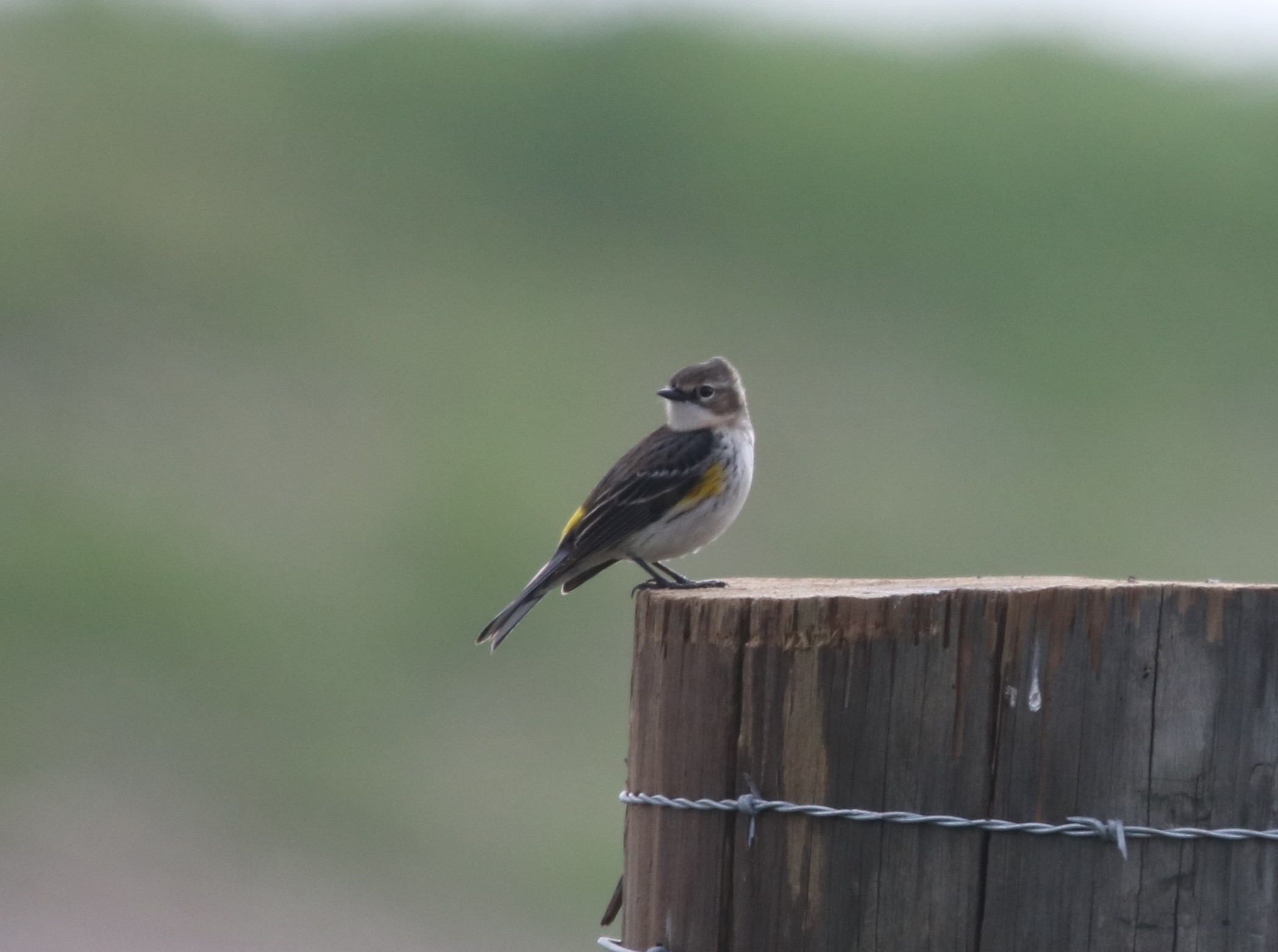
Like many birds, its plumage changes with season. We see them mainly in their wintering plumage when their bodies are brownish gray above with white wing bars and white below including the throat. They have white bellies with gray streaks and yellow patches on both sides. Their head is gray with a faint white eye stripe or eyebrow and a white eye ring. They also have small pointed black beaks and short black legs. Their most distinguished feature is of course the bright yellow patch on their rump. This is why people often refer to them as “butter butts.” Both the “Audubon’s” and “Myrtle” species have the distinct yellow rump patch.
During the winter they migrate and feed in large flocks. They can be found in a variety of habitats such as agriculture fields, residential areas, marshes, shrubs, forests, and even beaches. We have observed them here at GCBO headquarters at our feeders, while surveying for Loggerhead Shrikes in grassy and shrubby habitat, and even in the salt cedar patches along Matagorda Beach. They are everywhere no matter where you go this time of year.
One reason they are found in so many places is their versatile diet, which consists of insects, seeds, and even berries during the winter. They will eat insects like caterpillars, larvae, beetles, ants, grasshoppers, locusts, flies, and spiders and they like to eat seeds such as sunflower, goldenrod, and beach grass. They have been observed eating other random things like frozen apples, maple sap, raisins, suet, and peanut butter. What makes them unique from other warbler species is their ability to eat berries off of bayberry, wax myrtle, and poison oak.
They are the only warbler species that can digest wax from bayberry and wax myrtle berries that would be toxic to other birds thanks to their unique digestive system. Because of this ability, they are able to winter farther North than other warbler species. This is also why they are called Myrtle Warblers because they are particularly fond of wax myrtle berries.
Unlike our target species, Yellow-rumped Warbler are classified as low concern in terms of conservation status. However, they do migrate during the night and are prone to building strikes, so please remember to turn off your non-essential lights from 11pm-6am from August to November and March-May. On behalf of the Gulf Coast Bird Observatory, thanks for reading.
IMG_Yellow-rumped Warbler: Yellow-rumped Warbler observed posing on fence post in Brazoria, TX on February 8, 2023. Photo by Taylor Bennett.

