By Taylor Bennett
Beach nesting bird season officially began last month, and the Gulf Coast Bird Observatory research crew has been diligently monitoring the upper Texas Coast for our target species, Wilson’s Plover, and Least Tern. The Wilson’s Plover is a shorebird that prefers to nest in the soft sand along the dunes, mudflats, and shelly areas with vegetation. During the breeding season, they split into pairs and create their own territories. The Least Tern is a water bird that prefers to nest in large groups mainly in flat, open shelly areas. Both of these species are federally protected by the Migratory Bird Act and are considered species of high concern due to habitat loss and disturbance.
For each species, we monitor for pairs, nests, and chicks. To help keep track of pairs and their chicks, we band both the adults when they’re on the nest and the chicks when they hatch. This year, we have expanded our crew with three more people and also added Brazoria County beaches to our monitoring sites. However, due to lack of productivity, we had to drop the new sites. We continue to monitor Matagorda County beaches including Matagorda Beach and Sargent Beach.
At Matagorda Beach, we monitor half of Matagorda Peninsula and three other areas: Colorado River Mouth Flats (CRMF), Three-mile Cut, and Dunes Drive. So far, we have located four Wilson’s Plover nests and four chicks. One nest was along Matagorda Peninsula, two nests were within Three-Mile Cut, and one nest was at CRMF. Sargent Beach is divided into two sections, Sargent East, and Sargent West.
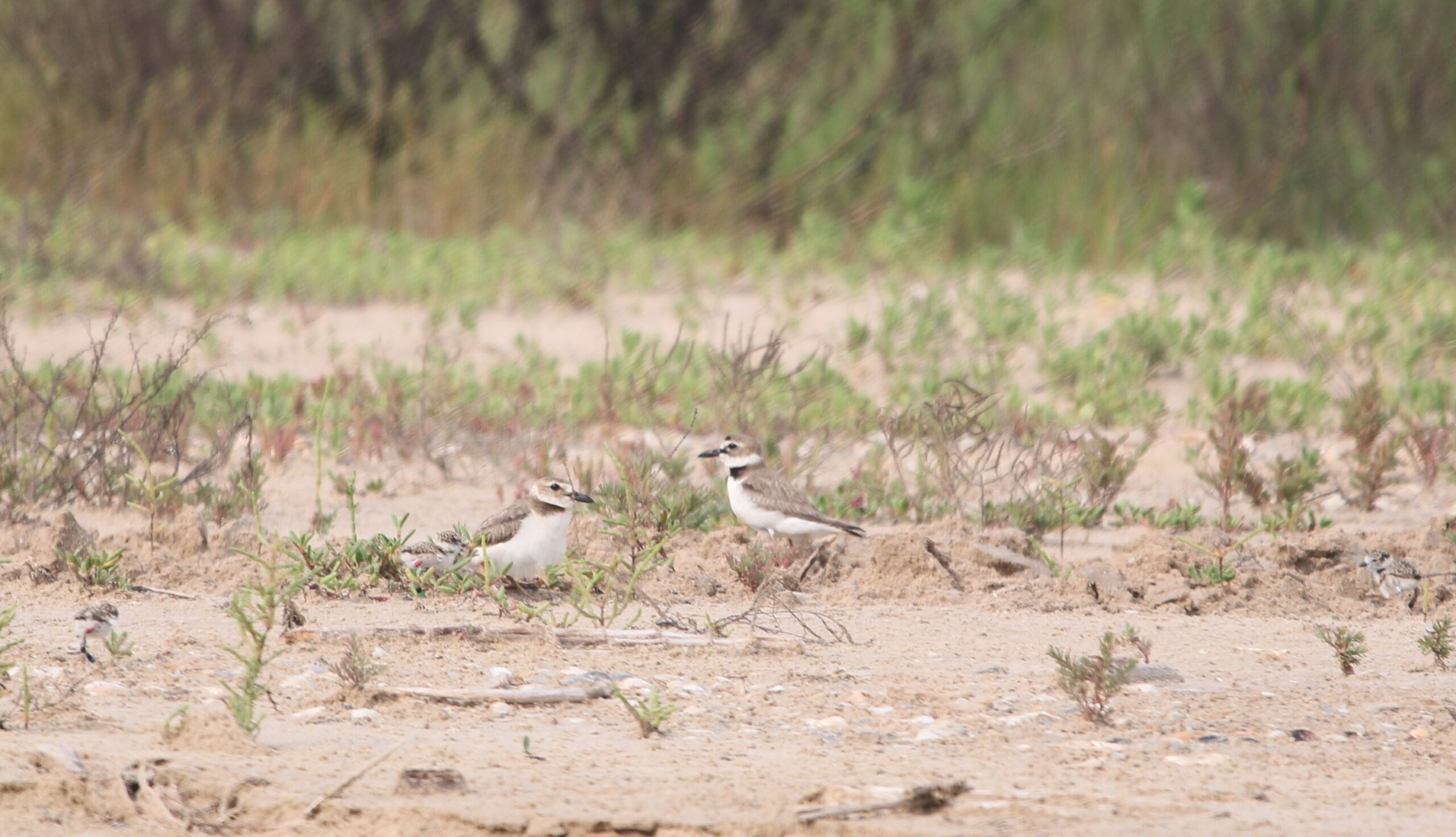
Our first Matagorda Peninsula nest was found April 30th. It belongs to a banded pair: male “YC” and female “VP”. Their nest successfully hatched with two chicks, and we were able to capture and band them on May 21. Three more nests will hatch next month. We also located and banded one chick belonging to banded female “T5” and her unbanded mate. Along with the chicks, we successfully banded one adult female “M3”.
At Sargent East, we have located eleven Wilson’s Plover nests and two broods with chicks. All but two nests failed due to weather, predation, and human disturbance. Fortunately, we were able to successfully band four chicks and two female adults “L3” and “N3”.
At Sargent West, we located nine nests and eleven chicks. We were able to successfully band female “K3” and she, along with her mate, hatched three chicks which we banded as well. We successfully banded four additional chicks as well.
We have located four Least Tern colonies on the Matagorda Peninsula. One at CRMF, two along Matagorda Peninsula, and one at Dunes Dr. The one at CRMF has already failed due to weather. The other three are still going strong and we are now waiting for chicks to hatch.
At Sargent East, we have located two Least Tern colonies. One already failed due to weather and we are awaiting chicks for the other. At Sargent West, we’ve located two more Least Tern colonies, and both are awaiting chicks.
April through July is the most vulnerable time for Wilson’s Plovers, Least Terns, and other nesting birds. Please remember to fish, swim, and play 50 yards away from nesting birds and chicks. Drive slowly, avoid the dunes and back beach areas where plovers and terns tend to nest, and keep dogs on a leash at all times.
On behalf of Gulf Coast Bird Observatory, thanks for reading.
Family photo of Wilson’s Plover parents and their brood of three banded chicks. Photo by Taylor Bennett in Sargent Beach May 13, 2024.

