By Caleb Clarkson
The morning sun finally clears the dunes of Matagorda Peninsula, casting long shadows across the windswept sand. As humans yawn, stretch, and amble off to work, the day has already started for a hard-working Wilson’s Plover.
She is known simply known as “C5”, after the code etched onto a band placed on her leg by researchers. She scours the sandflats, the wrack, and the dunes, watching and listening for any invertebrates who might be available for breakfast, until she spots one of her favorites, a plump fiddler crab. In an upright posture, she tiptoes merrily down the beach towards the crab, feigning complete indifference towards the asymmetrical crustacean. That is, until she’s within striking distance. In a burst of speed, the crab is caught and held firmly between the halves of her thick beak, an adaptation perfectly suited for cracking the hard shells of the crustaceans that make up much of her diet.
After the excitement, she pauses to meticulously preen, cleaning and carefully arranging her feathers before making her way back home. Home for C5 is not marked with a mailbox or address, and it doesn’t have set borders or fences like the homes that we have. Instead, her “home” flexes and shifts with the seasons and tides, its boundaries expanding and contracting with the availability of food, space, and shelter.
While her home might look different than ours, the experiences of C5 and humans alike overlap greatly when it comes to pesky neighbors. Recently, a new pair of Wilson’s Plovers had moved in, and they were already getting dangerously close to stealing C5’s favorite crabbing spot. For now, however, the coast is clear, and she reunites with her mate in the shady vegetation of her cozy dune.
While she was away, her mate had been hard at work excavating sediment and forming scrapes. A multitude of divots pepper their territory, each one a potential spot for her to lay her eggs. To some, the scrapes may look identical, but to C5, the differences are obvious. In a posture akin to pride, her mate leads her past the scrapes he’s labored to make. One by one, C5 passes them up. Perhaps not enough sand, or too wet. Maybe it’s too windy, or this time, there’s way too much sand! Whatever it is, they’re just not “right”.
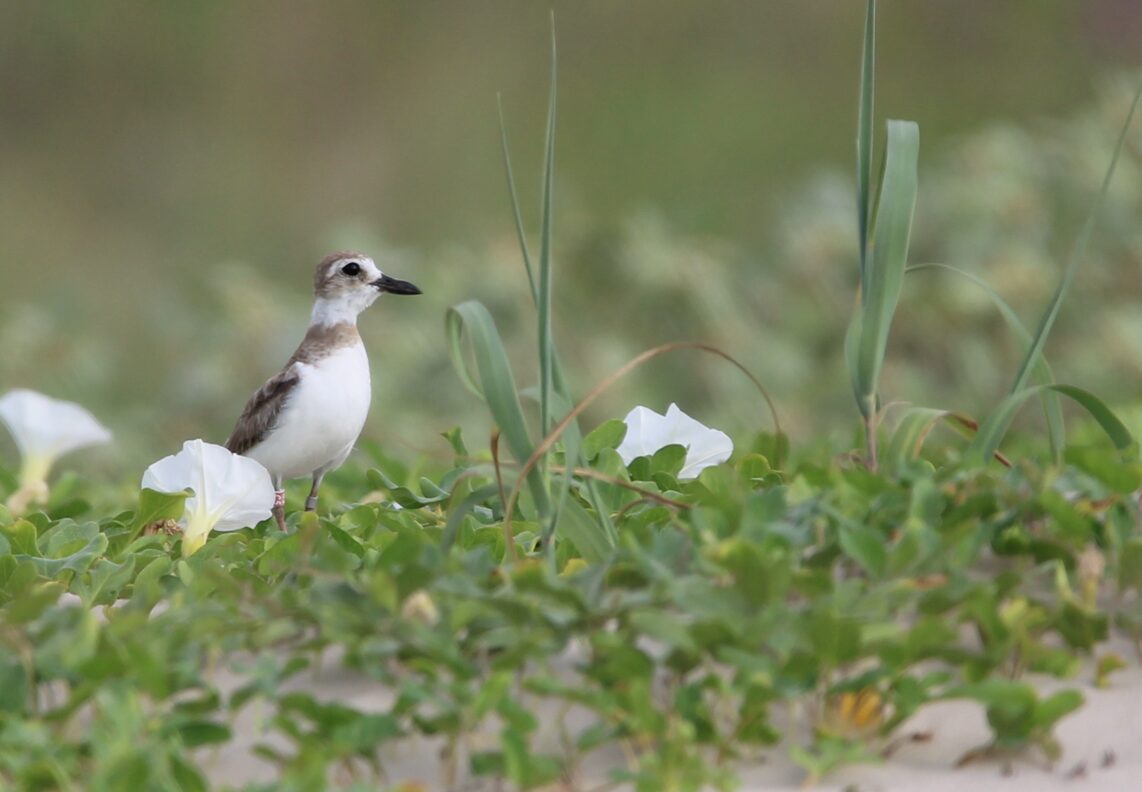
Finally, she finds the one. A scrape that’s not too shallow or too deep, tucked away in the mingling tendrils of beach morning-glory. There, hidden under the flowering vines, the sun doesn’t shine so hot, the wind doesn’t blow so hard, and the prying eyes of potential predators seldom give a second glance. Slowly, she lowers herself onto the manicured bed of crushed seashells, shifting and settling until it feels just right. Soon enough, there will be eggs.
But first, of course, they chase off their pesky new neighbors. C5 and her mate spring into action, parading around the invaders, barraging them with aggressive peeps and pips. Before migrating to Texas, the pairs might have been acquaintances on their wintering grounds, foraging and moving together. However, this is the summer breeding season, and an encroachment on C5’s favorite crabbing spot is more than just the threat of sharing. Resources are finite, and C5 and her mate are going to need all the resources they can get if they want to successfully raise their eggs and subsequent chicks to fledge.
C5 and her mate defend their territory as if their lives depended on it, because, well, they do! The invaders, wisely, fly off over the dunes; what good is a crabbing spot when being pestered and pecked at by the militant landlords? They’ll find a peaceful spot to eat and nest, too, as long as it’s far, far away from C5’s cozy little dune.
Photo credit: Caleb Clarkson
Photo Caption: C5, a Wilson’s Plover, surveys her territory

