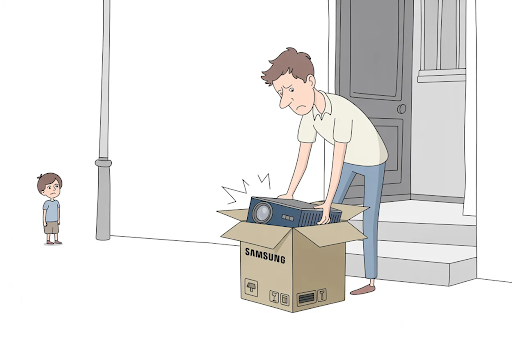
Illustration by Dustin Elliott
William Hunt’s Samsung projector breaks while still under warranty, but the company tells him it can’t find the parts to fix it. Instead of a refund or a replacement, the manufacturer simply mails the broken device back to him and marks the file “completed.” Can a consumer advocate break through this wall of silence?
Q: Last year, I bought a Samsung Freestyle 2nd Gen projector from Amazon for $365. It came with a warranty valid for a year. When the unit stopped working eight months later, I opened a service ticket and sent it to an authorized repair center in New Jersey.
Samsung confirmed receipt and even emailed me to say it would cover all labor and parts as a “one-time accommodation.”
Then the situation turned bizarre. The repair facility notified me that the unit was indeed defective but could not be repaired because the necessary parts were unavailable. Rather than offering a replacement or a refund, Samsung closed my ticket.
I’ve spent the last two months in a customer service black hole. I called and chatted with support more than four times, and every single time they promised a supervisor would call me back within two days. Those calls never came. I emailed “Extra Care” contacts and got no response. I even submitted a complaint through the CEO portal and emailed executives directly.
Then I sent a formal demand letter citing the Magnuson-Moss Warranty Act. The next day, I received two automated emails from Samsung stating the “service of your unit was completed” and that they were shipping my projector back to me unrepaired.
It feels like they are just waiting for my warranty to expire so they can walk away from a defective product. I just want a working projector or my money back. Can you help me? — William Hunt, Tulsa, Okla.
A: Samsung should have replaced your projector or issued a full refund the moment it determined the device was unrepairable. Under the Magnuson-Moss Warranty Act, a manufacturer can’t simply shrug its shoulders because it ran out of spare parts. It’s legally obligated to make the consumer whole.
You did almost everything right here. After a few initial calls, you started a paper trail, which is essential to a successful case. You even escalated the matter to the executive level, which is exactly what I recommend when the front-line support agents start reading from a script. I list the contact information for Samsung on my consumer advocacy site, Elliott.org.
The only thing you might have done differently was to stop the phone calls sooner. As you discovered, “we’ll call you back in 48 hours” is often corporate-speak for “please go away.” When a company fails to follow through on a promise once, move everything to email so you have a record of the inaction.
I’ve dealt with similar “parts unavailable” excuses before. In a previous case involving a Samsung washing machine, the company eventually agreed to a buyback after a similar standoff.
I contacted Samsung on your behalf. A spokesperson for the company told me they were “looking into this ASAP.” Shortly after that, the company reached out to you and expedited a full refund for your projector. “We will carefully review this matter in an effort to constantly improve the customer experience,” a spokeswoman added.
I’m glad we could pull you out of the black hole. Enjoy the next movie night—hopefully with a brand that remembers to stock its repair parts.
Christopher Elliott is the founder of Elliott Advocacy (https://elliottadvocacy.org), a nonprofit organization that helps consumers solve their problems. Email him at chris@elliott.org or get help by contacting him at https://elliottadvocacy.org/help/
© 2026 Christopher Elliott.

