Article by: Taylor Snyder
While you might not know them by name, you’ve undoubtedly seen the stocky white birds that follow cattle and tractors around as they move through fields. Scientifically speaking, these are Cattle Egrets (Bubulcus ibis) but, depending on where you live or even who pointed them out to you for the first time, you might call them something else. Personally, I grew up calling these birds Charley Birds. And while I can’t exactly tell you why, I can tell you that these birds go by a lot of different names.
Regardless of what you call them, these birds are incredibly adaptable. They’ve been documented following pretty much anything—tractors, cows, camels, hippopotamuses, and even fire—that will help them and their pals on their quest for food.
Originally from Africa, these resourceful birds made their way to South America in the late 1870s and wound up in North America by the 1940s. While their range expansion has been primarily of their own doing, the spread of modern agriculture—particularly mechanical farm equipment and large-scale ranching—has definitely been a helpful factor. This is largely due to the fact that Cattle Egrets are kind of lazy.
While these egrets are perfectly capable of foraging for food on their own, they much prefer the easy pickings stirred up by farm equipment or large animals. Sometimes you’ll even find them perched on the backs of cattle, waiting for parasites like ticks to make themselves an easy meal. Funnily enough, Cattle Egrets even rely on other species of herons to establish heronries—essentially just a word for a group of breeding herons—rather than take the initiative to do it themselves.
If you’re interested in spotting a Cattle Egret, you shouldn’t have to look far. These birds are gregarious—which essentially means that they like to hang out with each other—and can be found in agricultural fields and wetlands. A good rule of thumb is: if you spot cattle, Cattle Egrets might not be too far behind.
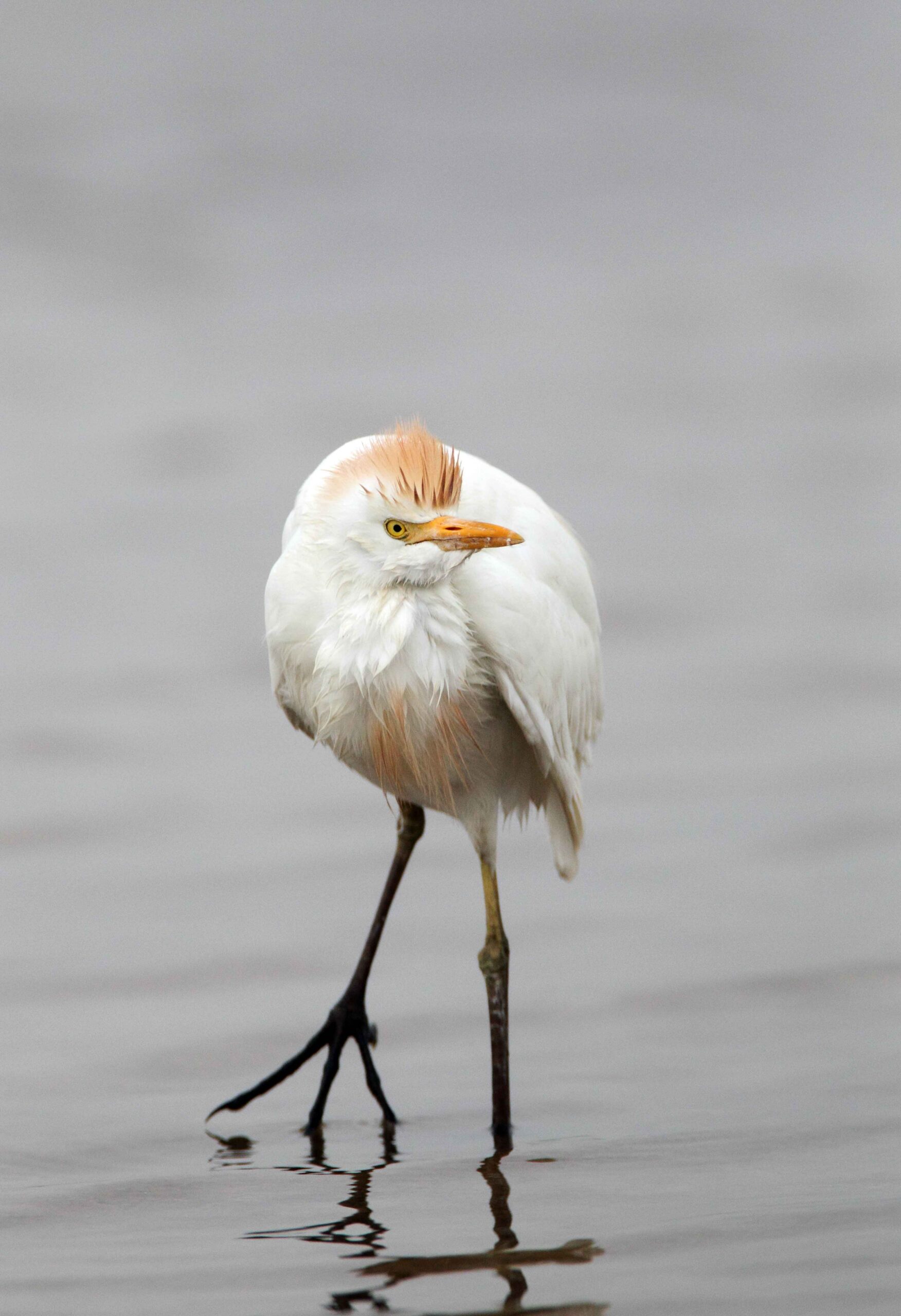
Since some Cattle Egrets spend both their breeding and nonbreeding season in Texas, you’ll probably get the opportunity to see them in both versions of their plumage. During their non-breeding season, they are all white with a yellow bill and black legs. But during their breeding season, Cattle Egrets swap their all-white appearance for white with a few buff dashes on their head, chest, and back. Additionally, their legs and bill are both yellow—sometimes their bills can even transition from purple near the eyes to yellow at the tip, it is quite the sight to see! Be sure not to mistake them for Great Egrets which are taller and more slender, or White Ibis which have a characteristic long, curved pink bill.
Photo: by Mike Williams

