by Taylor Bennett
We at Gulf Coast Bird Observatory continue to monitor for nesting Wilson’s Plovers and Least Terns on Matagorda Beach and Sargent Beach. The avian research team has been hard at work monitoring multiple Wilson’s Plover and Least Tern chicks at both sites.
Both of these species are protected by the Migratory Bird Act and are considered species of high concern due to habitat loss and disturbance, so please be cautious when visiting the beach and make sure to give them plenty of space. They are prone to human as well as natural disturbance such as weather and predators. One particular predator is the Laughing Gull.
The Laughing Gull is a medium-sized gull that can be observed year-round along the Upper Texas Coast. We mainly observe them feeding along the beach and nesting on the oyster reef islands in the bays. Like Least Terns, they are colonial ground nesters, meaning that they nest on the ground in large groups. They prefer to nest on remote islands and beaches along the bays that are high enough to avoid tidal flooding and remote enough from mammalian predators and bigger birds such as Herring Gull.
Unlike Wilson’s Plover and Least Tern, Laughing Gulls do not form scrapes, but instead form nests using dead vegetation. They can lay up to four eggs and when the chicks hatch, they are speckled with black and white downy feathers and are able to move around several hours after hatching. They are able to fly after 25 days.
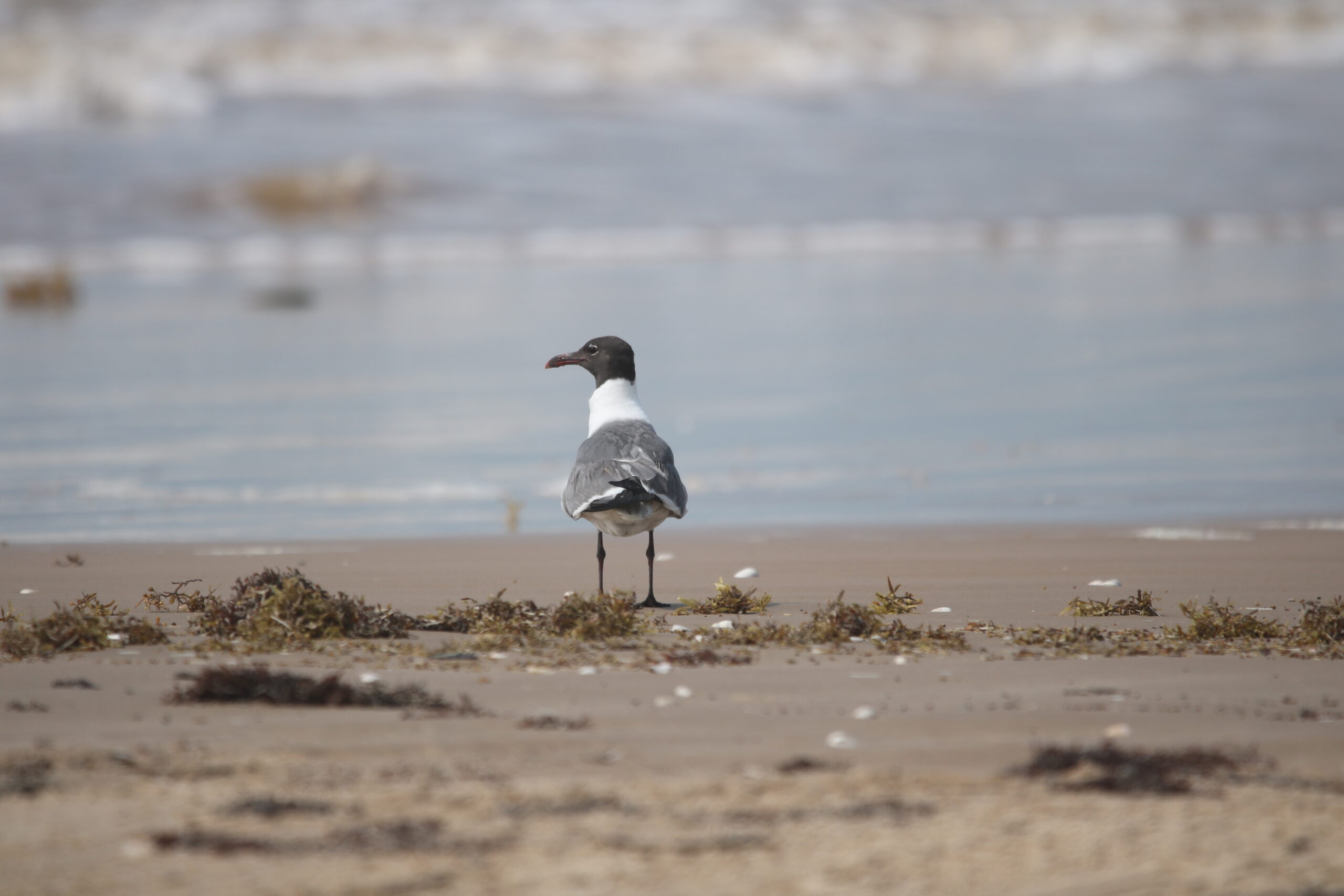
During this time of year, Laughing Gulls can be seen sporting their breeding plumage. Their head is black, with white eye crescents and a small red ring around their eye. Their bodies are dark gray with black wing tips and a white tail and belly. Their bills are bright red, and their legs are reddish black. During the non-breeding season, their heads turn white and blackish spots form around the eyes and neck and their legs and bill turn black. They are aptly named for the call they make which is similar to a human laugh.
Laughing Gull are very opportunistic feeders and have a very broad diet consisting of earthworms, flying insects, beetles, ants, snails, crabs, crab eggs and larvae, fish, squid, and berries. We often observe people feeding them fries, bread, fish guts, etc. This has made them prone to harassing and begging people for food as well as eating garbage. They will form large groups on the beach, around fishing boats, and fishing docks.
We highly discourage people from feeding them not only because they can be aggressive, but because they are also known to predate on shorebird and water bird eggs and chicks especially Least Tern and Wilson’s Plover. So, if you are visiting the beach this holiday weekend, please do not feed the gulls.
Like other beach nesting birds, Laughing Gulls are prone to human disturbance such as people, vehicles, dogs, trash, and debris. They are also prone to natural disturbance such as weather and predators. While there are plenty of Laughing Gulls to go around, this species is still protected by the Migratory Bird Treaty Act.
On behalf of Gulf Coast Bird Observatory, we wish you a happy and safe 4th of July. Please remember to drive slowly, give birds space, keep dogs on a leash, don’t feed the gulls, and please no trash and fireworks on the beach.
Photo Caption: Laughing Gull observed feeding along Sargent Beach. Photo by Taylor Bennett

