
By Rebecca Bracken
Who is that calling in the night? Nope, it’s not an owl! Our minds immediately jump to owls when we hear a bird calling out after dark, but they aren’t the only birds that are out at night. Nightjars (appropriately named) are a group of birds found around the world that are active at night, or in many cases, at dawn and dusk. Colloquially called goatsuckers, they neither suck the milk from goats nor drink any kind of milk. In fact, they are sometimes called bug eaters, which better describes their diet of insects.
Nightjars are found in almost every corner of the world, except for a few islands and Antarctica. They can be found in a variety of habitats, but most commonly in areas with some plants but also some open patches. They nest on the ground, laying their camouflaged eggs in a small depression. When not roosting on tree branches or incubating eggs, they are often seen sitting on open roads or swooping through the air catching insects.
Here in Texas, we have seven different nightjar species. Common Pauraque and Lesser Nighthawk are typically found in the southern portions of the state, while the Common Poorwill is found in the western half. Eastern Whip-poor-will are frequent coastal visitors during migration, while the Mexican Whip-poor-will is most commonly found in the Big Bend region. The Chuck-will’s-widow can be found throughout the piney woods of East Texas and into central Texas. But our most common nightjar by far is the Common Nighthawk.
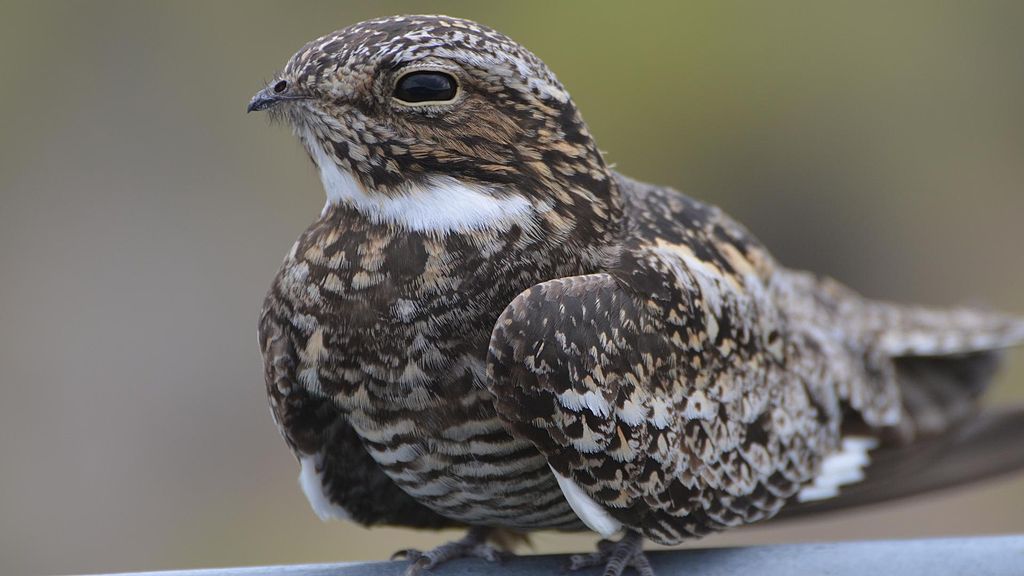
Common Nighthawks can be found in almost every place you can think of in our area. They nest in coastal dunes, beaches, logged forests, burned forests, forest clearings, prairies, sagebrush, grasslands, rock outcrops, and even on flat gravel rooftops in cities and towns. Nighthawks, like many of the nightjars, are crepuscular, active at dawn and dusk. They are known for their looping, almost bat-like flights alternating between continuous flapping and occasional glides. They eat flying insects almost exclusively.
Males court females by flying high in the sky and then swooping down low in a dive, creating a booming noise as air moves quickly over their wings. After landing in front of a female, a male will spread and wag its tail, display its white through patch, and croak at the female. Females are thought to choose the nest site, which are generally out in the open but sometimes near logs, boulders, or shrubs. Each female normally lays 2 eggs, which are white or gray with gray, brown, and black spots. Once eggs are laid, only the female will incubate them, but the male does come back to draw intruders away from the nest and to help feed the young. When chicks hatch after 16-20 days of incubating, they are covered with gray and cream-colored down feathers and are active almost immediately.
Common Nighthawks have experienced a suspected cumulative decline of about 48% since 1966 and are a bird of conservation concern in the US. One reason for this decline is the decrease in flying insects due to increased use of pesticides. We may hate mosquitos but many birds love, and rely, on them! Nighthawks are often hit by cars since they are known to look for food in roadways or lighted parking lots. So, if you’re out and about at dawn or dusk, keep your eyes peeled for a fast-moving bird swooping low or sitting in the road. If you’re careful, you might get to see a show by one of the coolest birds around!
Photo: Common Nighthawk
Photo by Andy Reago & Chrissy McClarren

