
By Kayla Pringle
If there’s one thing you should know about me, it’s that I love natural history. I worked in a natural history museum for over a year, and my favorite subject to discuss was our archaic whales. If you didn’t know, whales once walked on land before moving into the water and becoming fully aquatic, as we know them today. Whales are part of the cetacean group, which includes whales, dolphins, and porpoises.
Before we dive further, it’s helpful to go back to an event from about 380 million years ago (MYA). This was during the Devonian period when life was still entirely underwater. At this time, lobe-finned fish were known for wading along shallow shorelines, and they had unusually fleshy fins. These fins were so fleshy that, over time, they evolved into limbs.
These fish are considered the “first ancestors” of all land-living vertebrates, including humans. Believe it or not, this also includes dolphins, whales, and other cetaceans. This is because their ancestors started out on land before adapting features suited for aquatic life.
Archaeoceti refers to an extinct group of ancient whales that lived approximately 56 to 34 MYA. They are the earliest known whales and represent a transitional stage between land-dwelling mammals and fully aquatic whales. Archaeoceti had a mix of terrestrial and aquatic traits, including limbs adapted for walking and swimming, as well as specialized teeth. This group showcases the evolutionary shift from land-based life to fully aquatic existence in whales.
One of the most famous ancient whales is Maiacetus, which means “mother whale.” Maiacetus had four limbs, ears, a long snout, webbed feet, a tail (although it hadn’t yet evolved into the modern whale fluke), and lived around 47.5 MYA.
This whale was named Maiacetus when scientists discovered that the specimen was actually two whales: a mother and her fetus. Interestingly, the fetus was positioned head-first, which is typical for mammals giving birth on land, but the opposite of modern whales, which are born fluke-first. This finding led scientists to believe that Maiacetus was semi-aquatic or amphibious, likely giving birth on land and sharing many characteristics with land-dwelling and semi-aquatic animals.
Another fascinating ancient whale is Dorudon, which existed around 37 MYA and is considered by many scientists to be an ancestor of today’s whales. Dorudon was fully aquatic, with fins similar to modern whales and a tail fluke.
What I find most intriguing about Dorudon is its tiny, vestigial hind legs. These legs weren’t attached to the spinal column, meaning they served no function and were purely vestigial. Today, modern whales still have a pelvis, which is shrinking over time, further evidence of their land-dwelling past.
I hope you enjoyed this brief overview of a few ancient whales! I love whale evolutionary history because it’s a fantastic way to understand how evolution works and how we are all connected, even to lobe-finned fish from hundreds of millions of years ago!
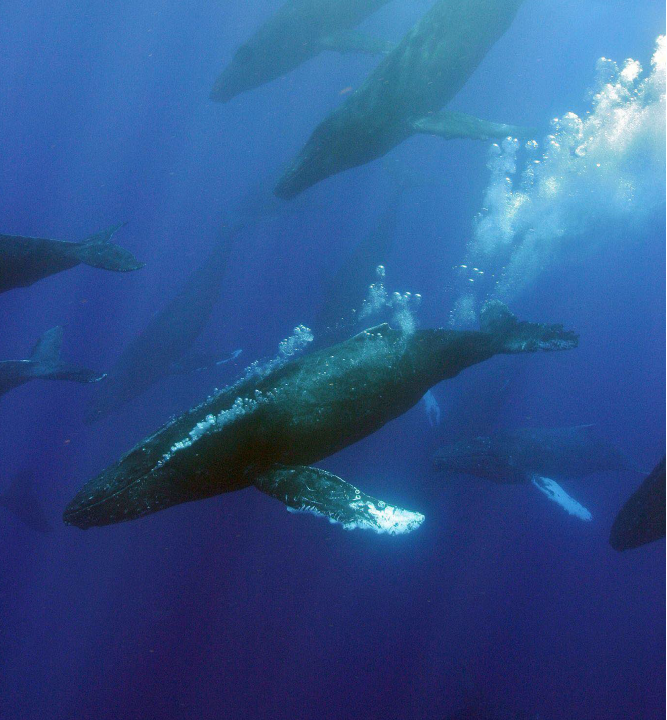
Photo: Humpback whales in the Hawaiian Islands Humpback Whale National Marine Sanctuary
Credit: Ed Lyman/National Oceanic and Atmospheric Administration, Public domain, via Wikimedia Commons

