By Rebecca Bracken
As the song goes, somewhere over the rainbow…bluebirds fly. Well, bluebirds don’t really fly over the rainbow, but there are birds that are rainbow colored. There are also rainbow-colored trees, and many animals that appear to be many colors. So, what is a rainbow, and why are so many things in nature so brightly colored?
A rainbow is actually light that is reflected through the inside of a water droplet. When light enters the droplet, it slows down and bends as it moves from the air to the denser water. The light is then separated into different components, called wavelengths, and when these wavelengths exit, we see a rainbow. Interestingly, how visible a rainbow is depends on the viewer’s position. Because it is an optical phenomenon, only occurring when conditions are just right, a rainbow is only visible from a certain direction.
But there are many rainbows in nature that are more permanent. For example, the rainbow eucalyptus, which naturally occurs in the Philippines, Indonesia, and Papua New Guinea. This amazing tree is a true natural wonder, with vibrant green, blue, red, and orange hues underneath orange-tinted bark. Color aside, the rainbow eucalyptus offers habitat and nourishment for a wide variety of species, from microorganisms feeding on its leaves to birds that nest in its branches. Its roots are so vast that they help stabilize the surrounding soil, which prevents erosion and maintains watershed health. The leaves are traditionally used to treat wounds, and are steeped in teas to treat asthma and coughs. Because of its striking appearance, you can know find the rainbow eucalyptus in botanical gardens around the world.
One of my favorite Australian birds is truly a rainbow in feather form. The Gouldian Finch, found in northern Australia, are unmistakable because of their vibrant colors. Even though the finch is small in size, somehow hues of bright blue, green, yellow, and purple are squeezed onto its body. While Australia is known for its colorful birds, the Gouldian Finch is really one of the most striking. The finch was listed as endangered, with fewer than 2,500 individuals remaining in the wild. The finch depends on grasses and seeds, which are commonly found in open grassy plains with scattered Eucalyptus trees. It is also a popular pet bird because of its beautiful colors.
There are also many small organisms that manage to exhibit bright colors, including the wattle-cup caterpillar, peacock mantis shrimp, and the peacock spider. The peacock spider is actually a genus of nearly 100 individual species of jumping spiders, predominantly found in Australia. While the name peacock implies many colors are present, it actually gets its name from something else. Peacock spiders are named for the intricate, yet colorful, mating dance and display that the males undertake when looking for a mate. The abdomen of the male spider is covered in light-reflecting, iridescent scales or protrusions in red, orange, white, cream, and blue. The abdomen itself has lateral flaps that can unfold similar to the tail of a peacock.
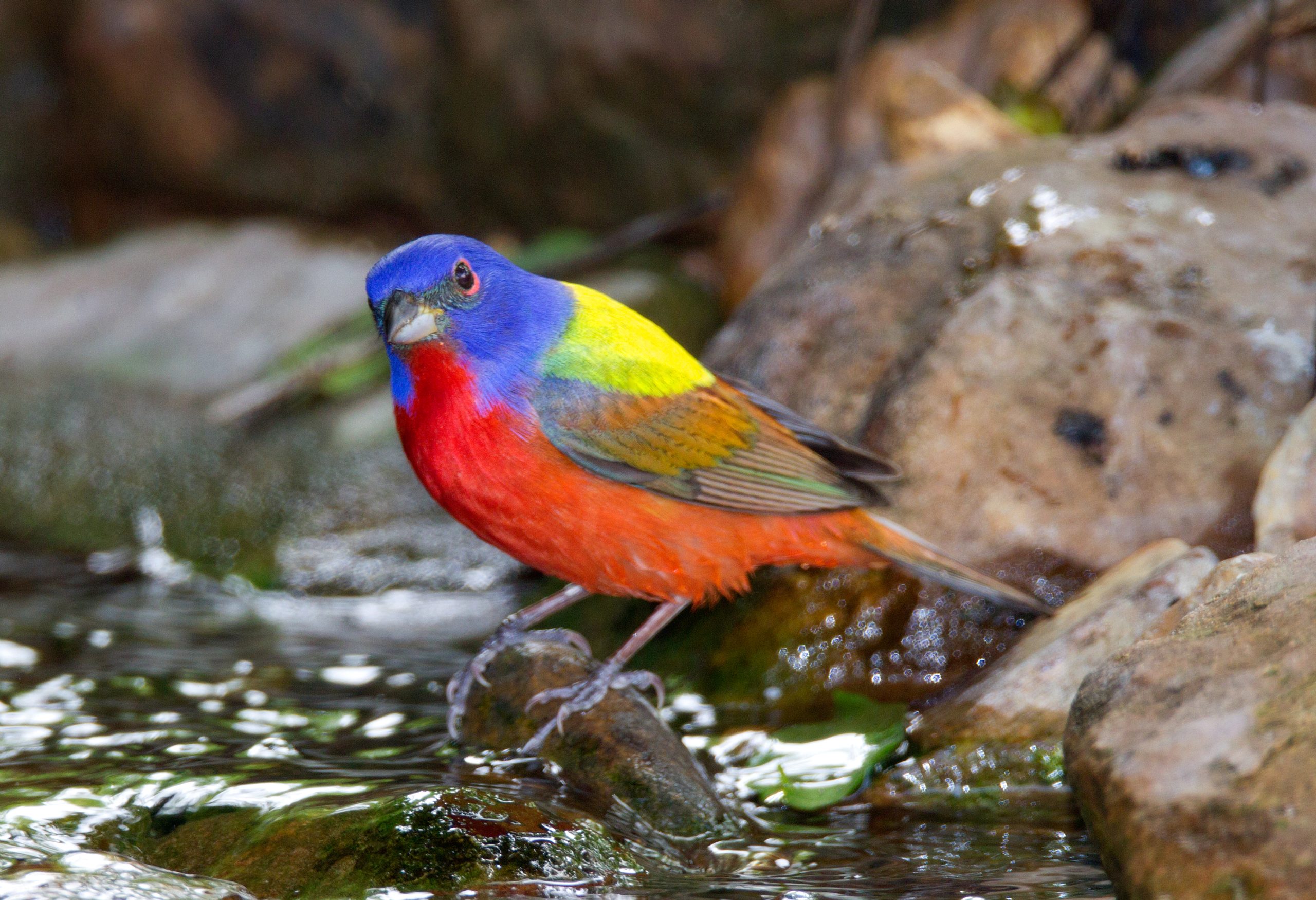
There are many other examples of dazzling colors in nature, including the Painted Bunting, a bird that is commonly found in Texas. The male bunting, like the Gouldian Finch, has a variety of colors, including a mostly blue head. Blue is considered the rarest color in nature because we only perceive objects to be blue due to the way light reflects off the structure, compared to other colors like green and yellow which can come from pigments. On your next nature walk, be sure to look at the world around you, and see what colors you can find!
Photo: Painted Bunting
Credit: Mike Williams

