By Kate Underwood
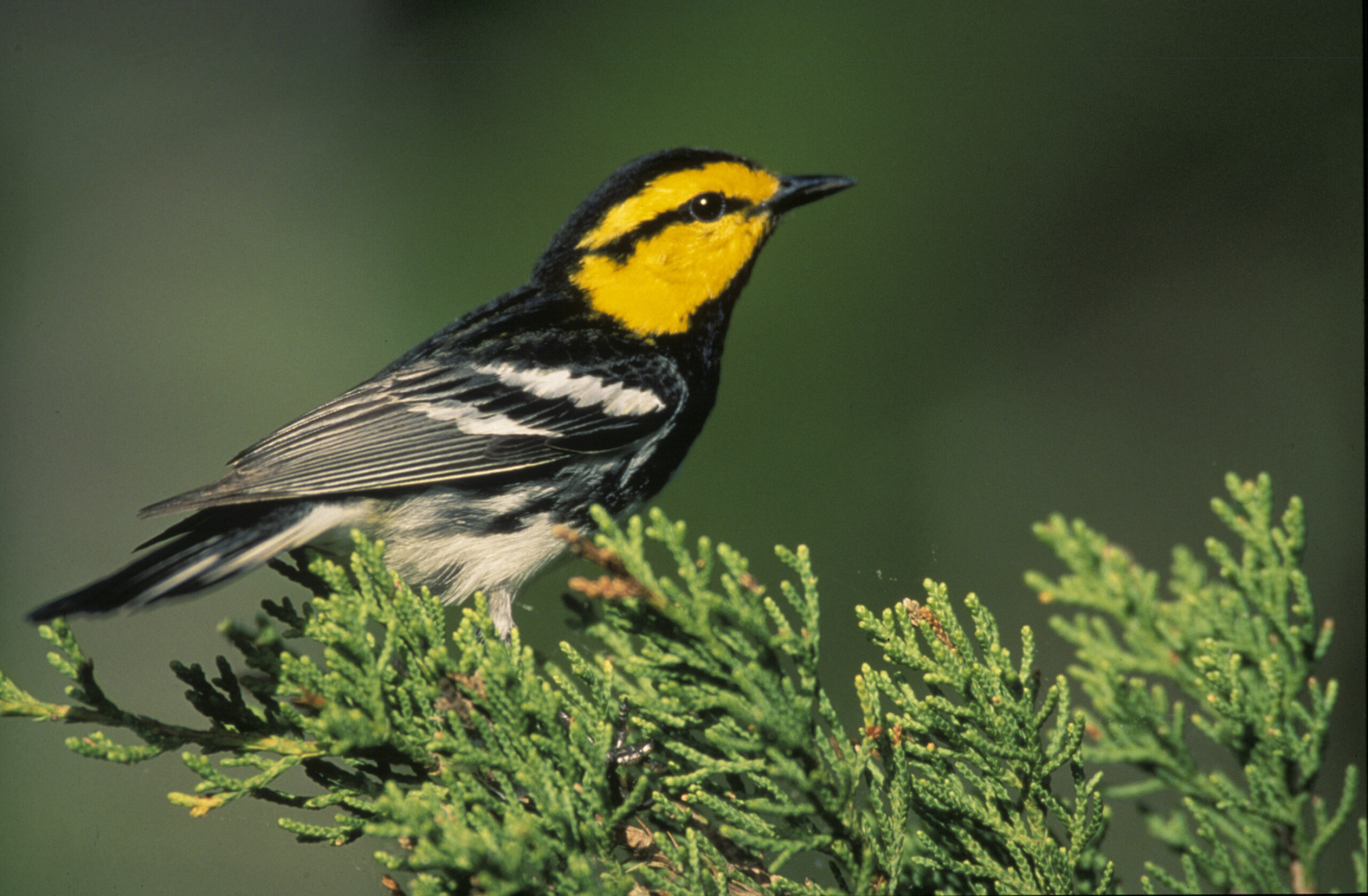
If you’ve lived in Texas for any amount of time, you’re sure to be familiar with some of the state’s iconic symbols. The bluebonnet, longhorns, and cowboy boots are synonymous with Texas, but have you thought about iconic Texas birds? Roadrunners, mockingbirds, and grackles come to mind, but there is one bird that is a Texas exclusive. The Golden-cheeked Warbler (Setophaga chrysoparia) breeds only in central Texas, meaning each and every one is a born and raised Texan! It doesn’t get more iconic than that.
From March to June, Golden-cheeked Warblers are what is known as a habitat specialist. They can be found in oak-juniper woodlands of central Texas, and are especially fond of the steep hillsides and canyons in the hill country. The males are boldly patterned with black and white, and have striking golden cheeks. The females are a bit more muted, but still have a distinct yellow face with a black and white body. They require large stands of mature ashe juniper trees (Juniperus ashei), also known as mountain cedar, in order to survive. This is because the bark of 50+ year old ashe juniper trees is a crucial component of nest-building for Golden-cheeked Warblers.
Males arrive on the breeding grounds in the early weeks of March to begin seeking out and defending a breeding territory. They will loudly sing a buzzy “la cucaraacha!” in order to fend off other males and attract females. The females will arrive a week or two after the males, select a mate, and begin preparing to lay eggs. She will gather spider webs, moss, grass, animal fur, and ashe juniper bark to make a cup nest high up in the branches of juniper or oak tree. The female will incubate the nest for 12 days, only leaving to eat. The male will continue to defend their territory, and sometimes bring food to the female. Once the eggs hatch, both parents will feed the young, and continue to do so for several days after they leave the nest and are learning to fly and catch their own food.
After the breeding season, the warblers will begin their long journey back to their wintering grounds in the mountainous pine-oak forests of southern Central America. Some will take the land route down, and some will fly straight over the Gulf!
Because of the Golden-cheeked Warbler’s restricted breeding range and specific habitat requirements, it is threatened with habitat loss and has been classified as endangered species since 1990. Historical logging, the creation of lakes that flooded critical habitat, and the rapid human population growth in central Texas have put a lot of pressure on golden-cheeked warblers and other wildlife. Despite these challenges, there are lots of people working hard to conserve them. Protected areas like Balcones Canyonlands National Wildlife Refuge, Government Canyon State Natural Area, and the Barton Creek Greenbelt in Austin are aiding in the continued survival of Golden-cheeked Warblers in the Texas.
If you’re interested in helping conserve this iconic Texas species, the best things you can do are turn off your lights at night during spring and fall migrations, leave no trace when you are enjoying the outdoors, be quiet and respectful of the birds’ space when you are watching them, and support organizations contributing to the recovery of Golden-cheeked Warblers.
Katherine Underwood, Avian Technician
Gulf Coast Bird Observatory
299 Hwy 332 West
Lake Jackson, TX 77566
Katherine Underwood is the Avian Technician at Gulf Coast Bird Observatory this year. GCBO is a non-profit organization dedicated to saving the birds and their habitats along the entire Gulf Coast, and beyond into their Central and South America wintering grounds.
Photo Source: Wikimedia Commons/ Steve Maslowski USFWS
Caption: Golden-cheeked Warbler

